
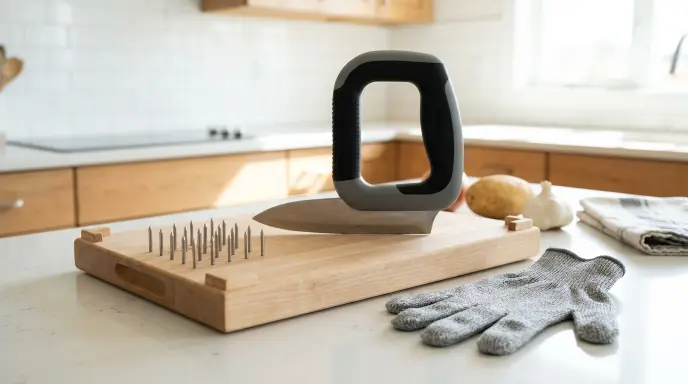
Pain-Free Chopping: The Best Adaptive Knives and Non-Slip Cutting Boards for Weak Hands (2026 Safety Guide)
Affiliate Disclosure: As an Amazon Associate, we earn from qualifying purchases at no extra cost to you. Prices and availability change, so always check the current listing.
Medical Disclaimer: This guide is for general information only. For personalized mobility advice, consult an occupational therapist (OT) or your healthcare provider.
1. Introduction: The Real Risk of Food Prep with Weak Hands
Most people assume the knife is the primary hazard when cooking with arthritis or weak hands. It is not. Preparing food with reduced hand strength presents a dual challenge:
- Holding and driving the knife: Standard pinch grips place extreme mechanical stress directly onto inflamed finger and thumb joints.
- Stabilizing the food and the cutting surface: A rolling potato, a skidding plastic cutting board, or an unsteady guide hand triggers just as many emergency cuts as a slipping blade.
Fixing only the knife leaves half the danger unchecked. A truly safe kitchen setup controls the blade, the ingredient, and the preparation surface simultaneously.
Quick Answer: The Safest Food Prep Setup
The most effective, slip-resistant food preparation system for weak, painful, or arthritic hands combines a vertical T-handle rocker knife (which uses arm and shoulder downforce instead of a finger pinch grip), a heavy-duty suction-mounted spiked cutting board to lock ingredients without guide-hand pinching, and Level 5 cut-resistant safety gloves for backup protection against blade slips.
Jump to a Section
Quick Comparison Matrix | Top Adaptive Knives | Non-Slip Cutting Boards | Essential Safety Accessories | Ergonomic Buying Guide | Step-by-Step Cutting Strategy | Related Guides | Frequently Asked Questions
2. Quick Buyer’s Comparison Matrix
| Product | Category | Ideal Condition | Key Safety Feature | Amazon Link |
| T-Handle Rocker Knife** (One-Handed Adaptive Ulu Knife) | Knife | Severe arthritis, stroke recovery, weak grip | Directs palm & shoulder downforce; zero pinch grip | Check Latest Price on Amazon |
| L-Shaped Vertical Grip Knife (ROCOCO Effort-Saving Chef Knife) | Knife | Wrist pain, carpal tunnel, rheumatoid arthritis | Upright vertical handle maintains a neutral 90° wrist angle | Check Latest Price on Amazon |
| Contoured Large-Grip Santoku(OXO Good Grips 5″ with Sheath) | Knife | Mild tremors, early-stage arthritis | Cushioned non-slip rubber grip + locking safety sheath | Check Latest Price on Amazon |
| Swedish-Style Spiked Cutting Board (Etac Prep System) | Cutting Board | Hemiparesis, severe arthritis, one-handed prep | Removable stainless steel spikes, adjustable clamping vise, 4 rubber suction feet | Check Latest Price on Amazon |
| Non-Slip Gripper Cutting Board (OXO Good Grips Utility Board) | Board | Hand tremors, smooth flat counters | Industrial suction cups prevent counter slippage | Check Latest Price on Amazon |
| Food-Grade Level 5 Cut-Resistant Gloves (NoCry Premium Food Safe Gloves) | Safety Accessory | Hand tremors, unsteady non-dominant guiding hand, low finger sensation | High-density EN388 Level 5 weave stops sharp blade nicks instantly; form-fitting lightweight stretch | Check Latest Price on Amazon |
| Stainless Steel Slicing Shield (HELIX 2-Pack Finger Guard) | Safety Accessory | Severely reduced finger grip, claw-grip difficulty, tremor-prone food holding | Curved 304 stainless steel barrier deflects knife blades directly; open adjustable ring fits swollen knuckles | Check Latest Price on Amazon |
3. The Best Adaptive Knives for Weak Grip & Hand Pain
3.1. Best Overall: T-Handle Rolling Rocker Knife
Featured Pick: One-Handed Adaptive Ergonomic Ulu Rocker Knife
- Problem Solved: Standard kitchen knives demand a tight, sustained pinch grip between the thumb and forefinger, which can quickly trigger swelling and joint fatigue in arthritic hands.
- Biomechanics: The T-handle sits squarely across the palm. Rather than squeezing, you push down using the heel of your hand and larger shoulder muscles. As you rock the curved blade across the food, the natural downward leverage slices cleanly without requiring any wrist flexion or finger pinch strength.
- Best For: Severe osteoarthritis, rheumatoid arthritis flare-ups, and post-stroke meal preparation.
Pros - Virtually zero finger-pinch required: The top-mounted handle transfers downward force directly from the palm, forearm, and shoulder, keeping inflamed finger joints relaxed.
- Neutral wrist posture: You push straight down instead of bending or twisting the wrist sideways, preventing strain on carpal tunnel pathways.
- Controlled rocking motion: The curved stainless steel blade maintains steady contact with the board, reducing blade skidding and fatigue when dicing vegetables or herbs.
- Excellent value for money: Provides medical-grade adaptive ergonomics at an accessible, budget-friendly price point compared to clinical assistive tools.
Cons - Not built for precision thin-slicing: Best suited for chopping, dicing, and mincing; less practical for delicate tasks like peeling or paper-thin tomato slices.
- Hand-wash recommended: The wooden/composite handle requires quick hand-washing and drying rather than machine dishwashing to maintain its grip and finish.
- Short learning curve: Users transitioning from conventional chef’s knives may need a few practice cuts to find a comfortable downward rocking rhythm.
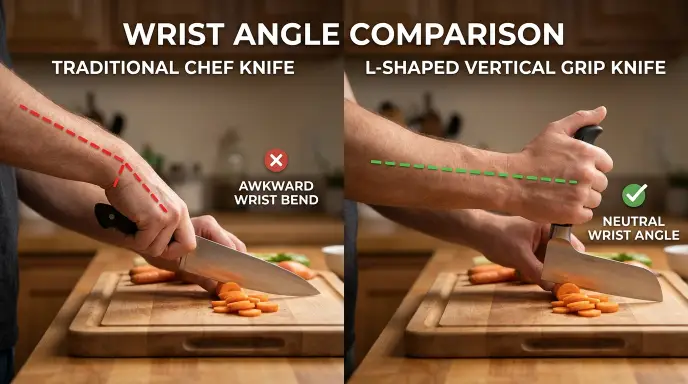
3.2. Best for Slicing: Ergonomic L-Shaped Vertical Grip Knife
Featured Pick: ROCOCO Effort-Saving Ergonomic Vertical Handle Chef Knife
- Problem Solved: Traditional horizontal handles force the wrist into an awkward sideways bend (ulnar deviation), which pinches the median nerve and aggravates carpal tunnel or rheumatoid arthritis pain.
- Biomechanics: The upright, angled red handle keeps your hand in a natural “handshake” posture. This locks your wrist at a neutral 90-degree angle, allowing the stronger muscles of your forearm and shoulder to drive downward slicing strokes rather than straining delicate finger tendons.
- Best For: Carpal tunnel syndrome, stiff wrist joints, slicing cooked meats, cutting firm vegetables (like potatoes and carrots), and everyday kitchen prep.
Pros
- Neutral wrist alignment: The high-arch vertical handle completely eliminates downward wrist drop and painful sideways bending.
- Effort-saving downforce leverage: Positioned directly over the blade spine, allowing you to use upper-body weight rather than tight grip squeezes.
- Solid stainless steel build: Provides the cutting performance of a full chef’s knife with an ergonomic, safety-first grip.
- High customer confidence: Highly rated with over 1,600 verified reviews for ease of use and joint relief.
Cons
- Right-hand optimized: The handle contour is primarily molded for right-handed users.
- Bulkier storage footprint: Because of the tall upright handle, it will not fit inside standard wooden countertop knife blocks (best stored on a magnetic strip or blade guard).
3.3. Best Traditional-Feel Knife: Contoured Soft-Grip Santoku
Featured Pick: OXO Good Grips 5-Inch Santoku Knife with Locking Sheath
Best For: Mild hand tremors, early-stage osteoarthritis, and individuals who want a familiar, non-clinical kitchen knife.
Problem Solved: Many home cooks with mild tremors or early joint stiffness want the natural cutting versatility of a traditional chef-style knife, but narrow, slick plastic or wooden handles cause cramping and slip out of weak fingers.
Biomechanics: The signature thick, oval-shaped Santoprene rubber handle expands the grip circumference. This allows you to hold the knife with a relaxed, open power grip rather than an aggressive pinch grip. The flat, low-curved 5-inch Japanese-style santoku blade promotes clean downward push-cuts, preventing fatigue during repetitive prep.
Pros
- Signature non-slip handle: Soft, cushioned rubber stays grippy and secure even when your hands are wet or greasy.
- Protective locking sheath: Snaps securely over the blade to prevent accidental cuts when reaching into crowded kitchen drawers.
- Compact 5-inch profile: Lighter and significantly easier to control for weak wrists than cumbersome 8-inch chef knives.
- Dishwasher safe: Easy to clean without needing tedious manual blade maintenance.
Cons
- Still requires functional grip: Not suitable for severe contractures or zero-grip hands (a rocker knife is safer for those conditions).
- Smaller blade reach: The 5-inch length is ideal for vegetables, fruit, and boneless chicken, but may struggle with oversized melons or large roasts.
3.4. Blade Maintenance: The Hidden Danger
A dull knife is the single biggest safety hazard for an arthritic hand. When a blade loses its razor edge, you are forced to apply excessive downward pressure, which frequently causes the edge to glance off slick food and slice toward your guide fingers.
Recommended Safe Tool: AERLIAN Magnetic Rolling Knife Sharpener Set
Traditional whetstones and sharpening steels demand precise wrist control and fine motor coordination to hold a constant angle. A guided rolling sharpener completely removes joint strain:
- Fixed Magnetic Angle Block: Powerful neodymium magnets hold your knife firmly at a fixed 15° or 20° angle on the counter, requiring zero wrist balancing.
- Effortless Rolling Motion: You simply roll the diamond-grit cylinder back and forth along the edge using palm contact rather than finger squeezing.
- Stable Sharpening Base: Both the magnetic block and roller operate flat on your countertop, eliminating slipping risks.
- Regular Maintenance: Hone your adaptive blades every 3 to 4 uses before excessive dullness sets in.
4. The Best Non-Slip Adaptive Cutting Boards
4.1. Best All-in-One: Swedish-Style Spiked Cutting Board with Clamps
Featured Pick: Etac Food Preparation System (One-Handed Adaptive Prep Board)
- Problem Solved: When arthritis weakens your non-dominant guide hand, holding down rolling onions, round potatoes, or jars requires intense, painful pinch pressure, often resulting in slips and severe cuts.
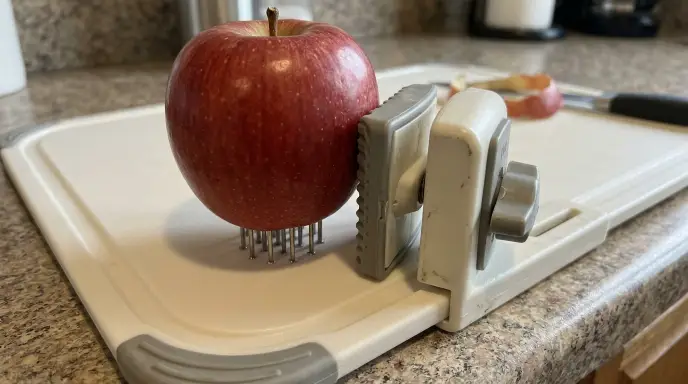
- Biomechanics: The Etac system acts as a mechanical second hand. Its integrated stainless steel spikes spear root vegetables directly in place, while a wide-jaw adjustable clamp firmly grips bowls, jars, and oddly shaped produce. This frees your affected hand entirely, allowing your dominant hand to slice safely using downward leverage.
- Best For: One-handed food prep, post-stroke recovery, severe joint deformity, tremors, and low grip endurance.
Key Features:
- Removable Stainless Steel Spikes: Anchor apples, potatoes, and bread firmly during peeling or cutting.
- Adjustable Friction Clamp / Vise: Holds mixing bowls, saucepans, cartons, and jars steady with an easy-turn lever.
- High-Adhesion Suction Cup Base: Four corner suction pads lock the lightweight board securely onto laminate, granite, and quartz surfaces without budging.
Pros
- Total independence for one-handed cooking: Fully immobilizes slippery, rolling ingredients without requiring any finger grip.
- Adjustable locking vise: Securely grips food, jars, and bowls of varying diameters.
- Removable spikes with safety guards: Easy to detach for thorough surface sanitizing and safe dishwasher cleaning.
- Clinically trusted design: Extensively utilized and recommended by occupational therapists worldwide.
Cons
- Higher initial price point: At around $69.99, it is an investment in medical-grade adaptive design
- Dedicated counter footprint: Its multifunctional layout requires dedicated counter storage space.
4.2. Best Everyday Value: Dual-Sided Non-Slip Gripper Board
Featured Pick: OXO Good Grips Plastic Utility Cutting Board
- Problem Solved: Traditional wood and smooth plastic boards slide easily across laminate and polished granite counters. When fingers lack the strength to pin a board firmly in place, even routine slicing can cause the cutting surface to slip, leading to dangerous blade slips.
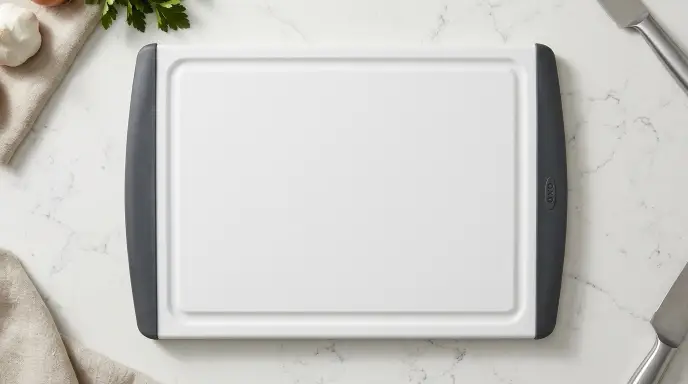
- Biomechanics: Broad, textured rubber borders anchored along both ends create natural friction against countertop surfaces. The board grips the counter securely under standard downward slicing weight, eliminating the need to clench your non-dominant hand in a tiring stabilizing grip.
- Best For: Mild hand tremors, early-stage arthritis, everyday meal prep, and cooks who want a familiar, lightweight board without mechanical spikes.
Key Features:
- Dual-Tapered Rubber Grippers: Soft, non-slip Santoprene rubber edges hold firm on smooth kitchen counters without sliding or scratching.
- Double-Sided Utility: One side features a deep perimeter juice groove to capture liquids from carving meats and ripe tomatoes; the reverse side is completely flat for chopping herbs and vegetables.
- Non-Porous Polypropylene Construction: Resists deep knife cuts, odor buildup, and stains while remaining gentle on sharp kitchen blade edges.
- Lightweight & Dishwasher Safe: Easy to lift, rinse, and load into standard dishwasher racks without straining stiff wrist joints.
Pros
- Instant, clamp-free stability: Holds fast on modern countertops without cumbersome suction cups or complex mechanical parts.
- Lightweight and manageable: Significantly easier to carry and clean at the sink than heavy butcher blocks.
- Exceptional social proof: Backed by over 14,000 verified reviews with Amazon’s “Overall Pick” recognition.
- Accessible price point: Excellent safety-first performance at an affordable, everyday budget.
Cons
- No food spikes: Relies on standard manual food positioning rather than mechanical spikes.
- Utility sizing: Best suited for routine everyday chopping rather than carving massive whole roasts.
5. Must-Have Safety Accessories
5.1. Best Safety Layer: Level 5 Food-Grade Cut-Resistant Safety Gloves
Featured Pick: NoCry Premium Food Grade Cut Resistant Gloves (Level 5 Protection)
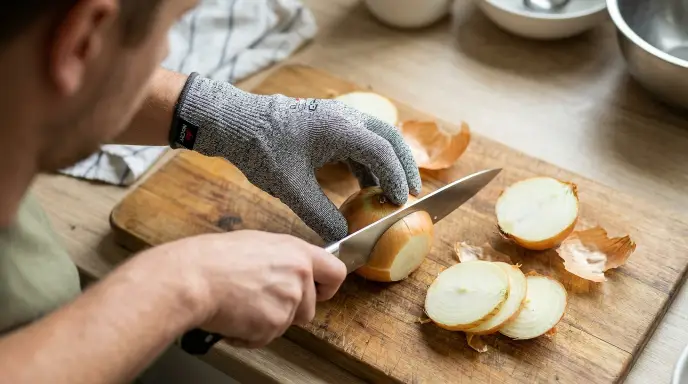
- Problem Solved: When arthritis causes sudden muscle fatigue or Parkinson’s tremors make fingers tremble, holding slippery onions, carrots, or squash becomes hazardous. A split-second twitch can send a sharp knife blade sliding into the guiding hand’s fingers.
- Biomechanics: Standard kitchen gloves lack protective fiber density, while heavy industrial chainmail gloves cause immediate hand fatigue. NoCry gloves utilize an ultra-high molecular weight polyethylene, glass fiber, and spandex blend that yields an EN388 Level 5 cut rating without adding rigid bulk. They act as a passive tactile shield, absorbing accidental blade contact without restricting fine knuckle flexion.
- Best For: Cooks with tremor-prone non-dominant hands, reduced finger sensation (neuropathy), or anyone transitioning back to sharp prep work after hand surgery or a stroke.
Key Features:
- Certified EN388 Level 5 Cut Protection: Engineered to withstand accidental slicing contact from sharp chef’s knives, mandolins, and paring knives without tearing through.
- 100% Food-Safe Material: Certified safe for direct food contact, keeping meal prep clean and free from chemical contaminants.
- Elastic Knuckle Snug Fit: Snug, stretchable fabric ensures your non-dominant hand retains full tactile feedback and grip sensitivity when pinning food flat against the board.
- Machine Washable: Easily tossed into the laundry on a standard gentle wash cycle to sanitize after raw meat or vegetable prep.
Pros
- Exceptional market trust: Over 40,000 verified Amazon ratings and the official “#1 Best Seller” distinction in kitchen safety gloves.
- Restores cooking confidence: Eliminates the mental hesitation and fear of blade slips for cooks managing shaky fingers.
- Lightweight dexterity: Much lighter and more flexible than bulky leather or metallic chainmail options.
- Budget-friendly safety upgrade: Delivers premium physical hand protection for under $10.
Cons
- Not puncture-proof: Protects against lateral slicing swipes and grazing slips, but will not prevent deep downward point punctures from an upright knife tip.
- Sizing precision needed: Must be purchased in the correct size (XS–XL) to ensure the fingertips fit snugly without loose excess fabric.
5.2. Best Mechanical Barrier: Adjustable Stainless Steel Slicing Shield
Featured Pick: HELIX 2-Piece Stainless Steel Finger Guard Set
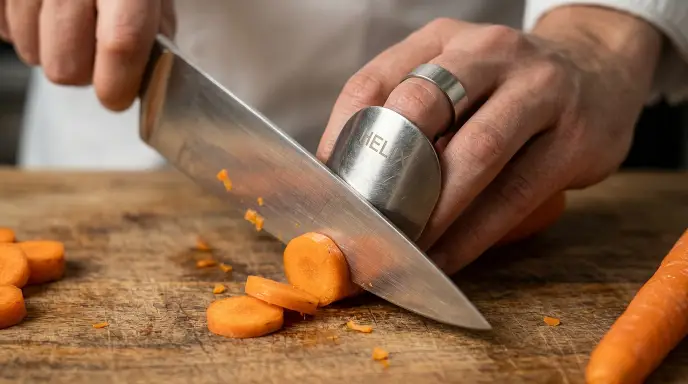
- Problem Solved: Proper culinary technique demands curling your guiding fingers into a protective “chef’s claw” to prevent cuts. However, stiff knuckle joints, rheumatoid nodules, and finger contractures often make maintaining a tight curl physically impossible. When fingers involuntarily flatten against the cutting board, the tips are directly exposed to descending knife blades.
- Biomechanics: The guard functions as an external armor plate. Slotted comfortably over your middle guiding finger, the broad, curved stainless steel shield hangs down over the surrounding fingertips. Downward knife strokes glide harmlessly against the smooth steel face rather than contacting delicate skin, eliminating the joint strain required to maintain an unnatural claw posture.
- Best For: Cooks with joint contractures, finger stiffness, or severe tremors who struggle with standard fabric gloves or cannot bend their fingers into a safe tuck.
Key Features:
- Curved 304 Stainless Steel Shield: Provides a rock-solid physical barrier that completely stops and deflects sharp slicing blades without bending or dulling edges.
- Adjustable Open-Ring Loop: The welded ring on the back features an open split design that easily expands or squeezes shut with light pressure to accommodate swollen, arthritic finger joints.
- Dual-Pack Convenience: Includes two shields, keeping an extra unit ready near your prep station or allowing custom adjustments for different fingers.
- Ultra-Lightweight & Dishwasher Safe: Adds practically zero hand fatigue during extended chopping sessions and cleans up effortlessly in the dishwasher.
Pros
- Absolute blade deflection: Unlike knit safety gloves that guard against lateral scrapes, rigid steel provides complete physical protection against direct downward blade strikes.
- Arthritis-friendly ring design: The open ring slides smoothly past enlarged knuckle joints without tight pinching.
- Compact and intuitive: Requires zero learning curve—slip it over your middle finger and chop immediately.
- Outstanding budget value: Complete two-piece stainless steel protection for around $6.
Cons
- Requires food contact awareness: Because the metal shield covers your fingertips, it takes a few minutes to get used to feeling food items through the steel barrier.
- Single-hand focus: Protects the guiding fingers holding the produce, not the hand gripping the knife handle.
6. Ergonomic Buying Guide: Choose for Your Mobility Level
Grip Type Matching Matrix
| Grip Type | Anatomical Motion | Joint Impact | Recommended Adaptive Tool |
| Pinch Grip | Pressing fingertips against thumb | High joint load on thumb base (CMC joint) | Avoid entirely when joints are painful or inflamed. |
| Power Grip | Wrapping all fingers firmly around a handle | Medium joint load distributed across palm | Large Contoured Santoku or L-Shaped Knife |
| Downward Leverage | Pressing with the palm heel, forearm, and shoulder | Very low joint stress on fingers and wrists | T-Handle Rocker Knife |
Countertop Compatibility
- Smooth Surfaces (Polished Granite, Quartz, Solid Surface, Smooth Laminate): Suction-base boards form an airtight seal and provide maximum stability.
- Textured Surfaces (Tile with Grout Lines, Wood Block, Matte Laminate): Suction cups will lose vacuum pressure. Instead, choose a rubber-bordered gripper board, or place a damp kitchen towel or commercial non-slip silicone mesh mat directly under a standard wooden or plastic board.
7. Step-by-Step Safe Cutting Strategy for Limited Mobility
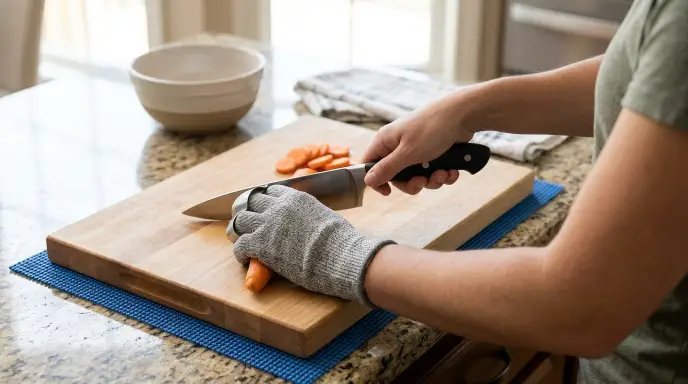
Follow this structured sequence to prepare food safely with reduced hand strength:
- Lock down your cutting surface. Never chop ingredients on a loose, slick board. Anchor your workstation using an OXO Good Grips non-slip cutting board or secure an existing wooden board over a rubber dampener mat before touching a knife.
- Anchor your ingredients mechanically. Impale round root vegetables onto the steel spikes or tighten the adjustable clamp vise of your Etac prep board. Do not rely on weak fingers to stabilize rolling produce.
- Lock the cutting board down: Verify that your suction cups have sealed or that your non-slip mat is completely flat before placing any ingredients on the board.
- Shield your stabilizing hand. If you experience tremors or numbness in your non-dominant hand, wear a NoCry Level 5 cut-resistant glove on that hand. This passive layer neutralizes accidental knife slips when pinning round vegetables against the cutting board.
- Suit up your guide hand: Wear your Level 5 cut-resistant glove on the hand holding or guiding the food.
- Let the knife do the work. Press down gently and avoid forcing it through firm vegetables. If you have to push hard, your blade is dull—touch it up safely using a guided magnetic rolling sharpener before continuing.
- Clean pins at arm’s length: Immediately wash the spiked board using your long-handled brush, keeping hands safely clear of the vertical pins.
The video below demonstrates how adaptive boards, food spikes, and rocker knives work together to keep food preparation steady and safe:
8. Related Kitchen Safety Guides
Continue building an accessible, pain-free kitchen setup with our companion resources:
- Kitchen Tools for Weak Hands: The Complete Guide: An overview of everyday ergonomic tools and meal prep modifications.
- Best Jar Openers for Arthritic Hands: Countertop and under-cabinet jar openers that eliminate painful twisting.
- Electric Can Openers for Seniors: Hands-free can opening solutions that remove sharp edges without requiring grip force.
- Aging-in-Place Kitchen Guide: Comprehensive kitchen layout recommendations, counter heights, and slip-fall prevention.
- Stove Safety for Seniors: Automatic shut-off valves, burner guards, and fire prevention essentials.
9. Frequently Asked Questions
Can someone with severe hand tremors or Parkinson’s safely use a rocker knife?
Yes, in many cases, provided it is paired with a stabilized cutting surface. Because a rocker knife maintains continuous contact with the cutting board and is driven by the larger muscles of the arm and shoulder, it is generally much steadier than a traditional chef’s knife. However, it must always be used with a suction-mounted or spiked cutting board and a Level 5 cut-resistant safety glove. If tremors are severe or unpredictable, an electric food processor or pre-cut groceries are safer alternatives.
How do you safely clean a spiked cutting board without puncturing your fingers?
Always use a stiff, long-handled dish brush and scrub away from your body. Never wipe across the stainless steel pins with a hand towel, thin rag, or sponge, as the spikes can easily pierce through fabric into numb or arthritic fingertips. Rinse the board under running water right after cutting so food does not dry on the pins, scrub with the long brush, and let it air-dry facing away from high-traffic counter edges.
Are electric carving knives safer than manual adaptive knives for weak hands?
No, electric knives are rarely safer for everyday kitchen prep. While an electric knife reduces back-and-forth sawing friction when carving large roasts, the units are heavy, vibrate aggressively, and require continuous trigger finger pressure that quickly fatigues arthritic joints. For standard daily vegetable and fruit chopping, a manual T-handle rocker knife on a stable board is significantly lighter, easier to control, and safer.
Do suction cup cutting boards adhere well to textured laminate countertops?
No, suction cups need a smooth, non-porous surface to maintain an airtight seal. Textured laminate, tile with grout lines, and unsealed wood countertops prevent suction cups from holding a reliable vacuum. If your kitchen has textured counters, choose a cutting board with a wide, non-slip rubberized border, or place a damp dishcloth or non-slip silicone shelf liner directly underneath a flat board to stop it from sliding.
Is a heavy wooden cutting board better than a plastic board with rubber feet?
It depends on your lifting ability. While a 10-pound end-grain wooden butcher block will naturally stay in place on your counter, it is often too heavy and awkward for individuals with joint pain to lift, wash, and oil safely. For people with limited upper-body strength, a lighter plastic board fitted with thick rubber perimeter feet or suction mounts delivers equal cutting stability while remaining easy to move to the sink.
Final Recommendation
If you are setting up your kitchen for safe, pain-free meal prep with limited grip strength, focus on this proven three-piece system:
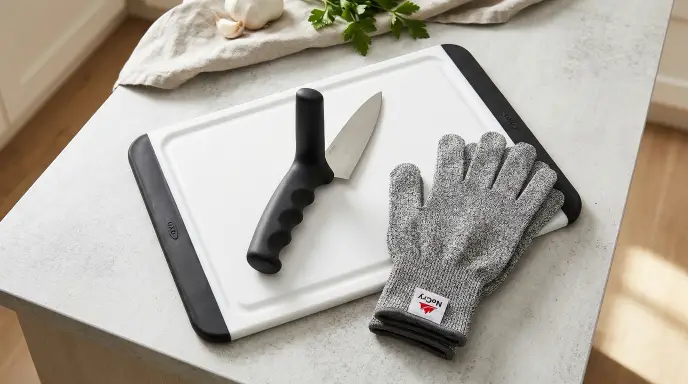
- A T-Handle Rocker Knife (such as the Adaptive Ulu Knife): Takes the stress off your fingers and wrist by using shoulder leverage to slice food. View on Amazon →
- A Swedish-Style Spiked Prep Station (such as the Etac Food Preparation System): Mechanically holds rolling vegetables, jars, and bowls so your vulnerable hand never risks a knife slip. View on Amazon →
- For Everyday Tremors & Mild Arthritis: The OXO Good Grips Non-Slip Utility Board keeps slicing surfaces locked in place without complex setups. View on Amazon →
- NoCry Food Grade Cut-Resistant Gloves: A small, high-impact investment that prevents knife injuries on tremoring or unsteady guiding hands during everyday meal preparation. View on Amazon →
- For Stiff Knuckles & Direct Blade Deflection: The HELIX Stainless Steel Finger Guard (2-Pack) acts as an effortless armor plate for cooks unable to curl their fingers safely. View on Amazon →
Addressing the blade, the food, and the work surface together eliminates the primary points of failure, keeping your cooking independent, enjoyable, and safe.





One Comment