
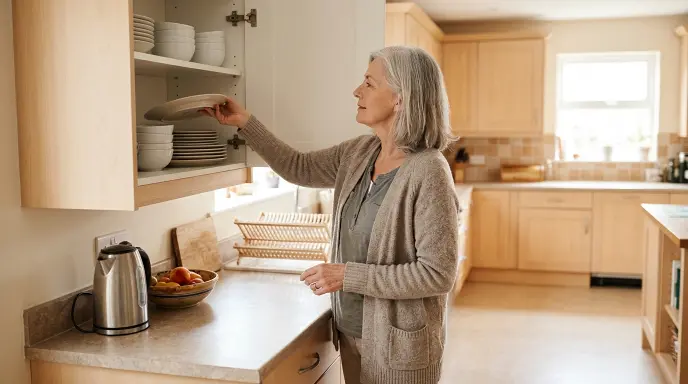
Accessible Kitchen Cabinets for Seniors: Safe Storage Solutions Without a Full Remodel
Creating accessible kitchen cabinets for seniors does not require tearing out a single cabinet or breaking down a wall. Retrofit hardware, pull-down shelving, and smart reorganization can eliminate most fall risks and stretching injuries in a single weekend — no contractor, no demolition, and no five-figure remodel required.
The Senior Safety Dilemma: Walk into almost any older adult’s kitchen, and you’ll see the same three danger signs repeating: stooping low to dig through a base cabinet, standing on tiptoes to reach a top shelf, and — worst of all — climbing onto a step stool to grab something that’s “always been up there.” Each of these movements asks an aging body to do something it was never designed to do under pressure: balance on one leg, hyperextend the spine, or support full body weight on unstable footing.
For seniors, these aren’t minor inconveniences. They’re the second-leading cause of in-home falls after bathroom slips. Unlike bathroom falls, kitchen falls often happen while someone is holding something heavy or hot — a cast iron skillet, a boiling pot, or a stack of dishes. That combination of poor balance and compromised hands makes kitchen storage one of the most overlooked safety hazards in an aging-in-place home.
What This Guide Covers: This guide walks through a complete, no-remodel plan to fix every danger zone in a kitchen: upper cabinets that are too high to reach safely, lower cabinets that force kneeling and deep bending, blind corner cabinets that waste reachable space, hardware that punishes arthritic hands, and lighting that hides hazards in dark cabinet interiors. Every solution here is retrofit-friendly, meaning it installs directly into cabinets you already own.
Table of Contents
The “Safe Reach Zone”: How Aging Bodies Interact with Kitchen Storage
Quick Summary: Accessible kitchen cabinets for seniors eliminate reaching, kneeling, and step stool hazards. Key modifications include 20–44 inch reach zones, pull-down upper shelves, full-extension lower drawers, and D-pull hardware.
Most kitchen design advice is written for 30-year-olds with full mobility and no joint pain. That’s the gap this section closes. Occupational therapists and ADA accessibility guidelines use specific height measurements to define where storage should live for anyone with reduced mobility, balance concerns, or arthritis — and those numbers matter more than most kitchen blogs admit.
The Golden Range: 20 to 44 Inches from the Floor
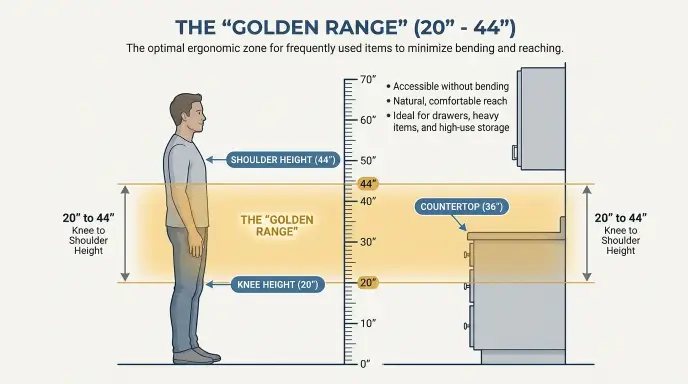
The “safe reach zone” for seniors sits between 20 and 44 inches off the floor — roughly the space between the knee and the shoulder when standing upright without stretching or bending. Anything stored in this band can be reached without a step stool, kneeling, or the spinal strain of looking up or bending down.
The rule of thumb: 90% of daily-use items — plates, glasses, mugs, everyday pots, cereal, coffee — should live inside this 24-inch window. Items used only occasionally (holiday dishes, large stockpots, small appliances used once a month) can stay in the higher or lower “overflow zones,” since the risk of reaching them is lower when you reach them rarely rather than three times a day.
Eliminating the Step Stool Hazard
Step stools are the single most preventable cause of kitchen falls among older adults. Unlike a staircase, a step stool offers no handrail, no second point of contact, and often sits on a floor that’s been waxed, tiled, or recently mopped. Add in the instinct to reach forward while standing on one — shifting body weight off-center — and you have a fall mechanism that combines height, instability, and distraction all at once.
The goal of every solution below is simple: make the step stool unnecessary. If nothing in daily use requires climbing, the stool eventually leaves the kitchen entirely. Reorganizing cabinet shelves solves storage reachability, but lifting heavy prep equipment can still cause accidents. Stocking your storage with compact adaptive kitchen aids keeps meal prep safe and manageable every day.
Upper Cabinet Solutions: Bringing High Storage Down to You
Pull-Down Cabinet Shelves (Drop-Down Racks)
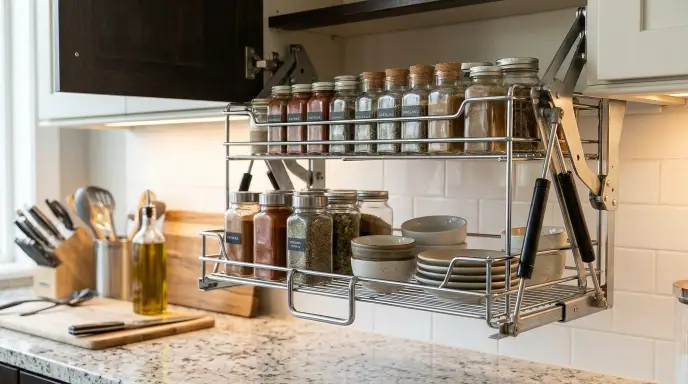
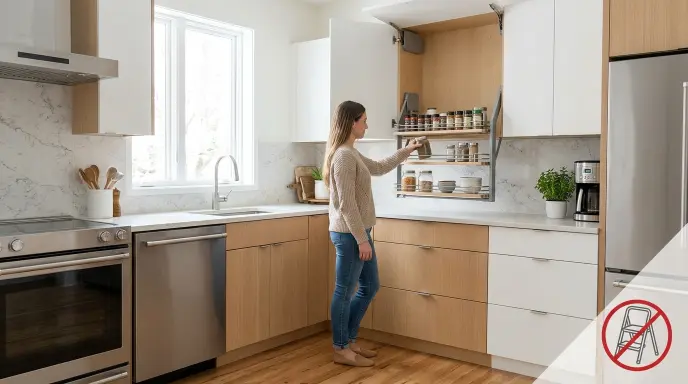
Pull-down cabinet shelves — sometimes called drop-down racks — use a gas-strut-assisted mechanism similar to the hydraulic hinge on a car’s hatchback. A gentle pull on the front of the shelf lowers the entire rack down to counter height, where items can be loaded or unloaded standing flat-footed. Release the shelf, and the strut gently guides it back up into the cabinet without slamming. For wall cabinets that sit too high for seated or standing comfort, standard fixed shelving creates constant overextension hazards. Instead of keeping upper tiers empty or reaching for an unstable stool, retrofitting your upper storage with pull-down cabinet shelves for seniors brings high, hard-to-reach items straight down into your comfortable mid-body reach zone with hydraulic or motorized assistance.
- DIY retrofit installation: Most standard-depth upper cabinets (12–24 inches deep) can accept a pull-down shelf kit without any carpentry. The unit mounts directly to the interior side panels using the included screws, and most kits are designed to fit cabinets with face-frame openings as narrow as 11 inches. No cutting, no rewiring, no cabinet replacement.
- Weight capacity limitations: Most retrofit pull-down shelves are rated between 15 and 25 pounds total load. They’re built for everyday dishware, cereal boxes, and canned goods — not cast iron cookware or small appliances, which should stay in the lower safe-reach zone instead.
2-Tier Pull-Down Spice Racks
Spice cabinets are notorious for forcing cooks to reach overhead mid-recipe, often while a stove burner is active. A 2-tier pull-down spice rack mounts inside a cabinet door or upper cabinet and swings or slides down to eye level with one hand, bringing every labeled jar into view simultaneously. This removes both the overhead reach and the guesswork of searching blindly through a dark shelf. Never store daily essentials directly above or behind cooking ranges where loose sleeves can brush against open flames; pairing accessible low-reach cabinets with dedicated stove safety devices and cooktop alternatives drastically cuts burn and fire hazards.
Open Shelving at Eye Level: Removing Cabinet Doors
Sometimes the simplest fix is removing the door entirely. Heavy cabinet doors — especially at eye level — require repeated pulling, pushing, and holding open with one hand while reaching with the other. For seniors with shoulder arthritis or limited grip strength, that repetitive motion adds up. Taking the doors off a few eye-level cabinets converts them into open shelving: everything stays visible, nothing needs to be pulled open, and there’s one less moving part to fight with multiple times a day. When retrofitting upper and base storage, swapping out small knobs for ergonomic cabinet pulls for arthritis ensures seniors can open heavy doors without joint strain.
Lower Base Cabinets: Eliminating Kneeling and Deep Reaching
Roll-Out Shelf Converters (Slide-Out Wooden/Wire Trays)
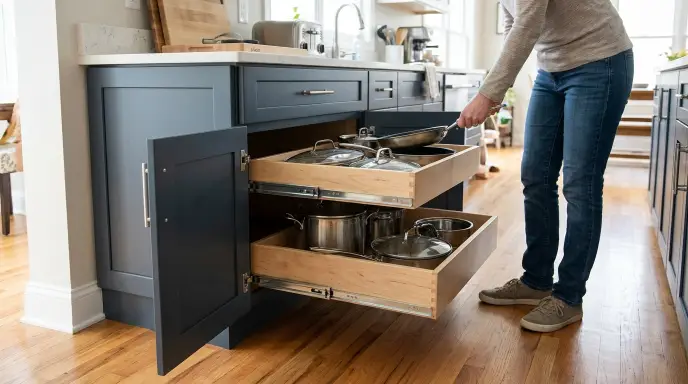
Base cabinets are typically 24 inches deep, which means anything stored in the back third is essentially invisible and unreachable without kneeling on the floor and reaching blind — a position that’s difficult to get into and even harder to get out of for anyone with knee or hip issues. Replacing standard fixed shelves with the best pull-out cabinet organizers for base cabinets brings cookware out into the open room, reducing lumbar spine strain and fall risks.
Roll-out shelf converters solve this by replacing the fixed cabinet floor with a sliding wooden or wire tray that extends the entire shelf contents out into the room. Instead of kneeling and reaching, the user simply pulls the tray toward them and looks straight down at everything inside.
Why full-extension ball-bearing glides matter: Cheaper roll-out trays use friction-based plastic rollers that only extend about 75% of the shelf’s depth — which still leaves items in the back out of easy reach. Full-extension ball-bearing glides pull the entire tray completely clear of the cabinet opening, so nothing stays hidden in the back corner.
Pot and Pan Organizers with Vertical Dividers
Stacking heavy pots and pans on top of each other creates two problems: lifting four pounds of cast iron off the bottom of a stack strains the wrist and shoulder, and the clattering, shifting stack is a tipping hazard when pulled out.
Vertical divider organizers store pots and pans standing on edge, like file folders in a filing cabinet. Each pan slides in and out independently, with no stacked weight to lift and no risk of the whole pile collapsing. This small change removes a surprising amount of daily wrist strain for anyone who cooks regularly.
Blind Corner Cabinet Solvers: Pull-Out Lazy Susans vs. Blind Corner Organizers
Every L-shaped kitchen has one unreachable blind corner cabinet — the space behind the adjoining cabinet wall that requires crawling halfway inside to access. Two retrofit options solve this without remodeling:
- Pull-out lazy Susans: Use rotating circular shelves that spin items around into reach, best suited for corner cabinets with a single door opening.
- Blind corner organizers: Use a sliding, articulating shelf system that pulls straight out and then swings into the open cabinet space, bringing the entire blind area forward in one motion — generally a better fit for deeper, more awkward blind corners.
Both kits install using the existing cabinet box and typically require only a drill and basic hand tools.
Easy-Grip Hardware Upgrades for Arthritic Hands
Why Round Knobs Fail Seniors with Arthritis
Standard round cabinet knobs require a pinch grip — thumb and fingers squeezing together to turn and pull. This is one of the first grip patterns lost to arthritis, and it becomes even less reliable when hands are wet, greasy, or trembling. A missed pinch grip on a round knob often means a hand sliding off entirely, sometimes mid-pull, which can throw off balance.
D-Pulls and Wide Loop Bar Handles (The 4-Inch Clearance Rule)
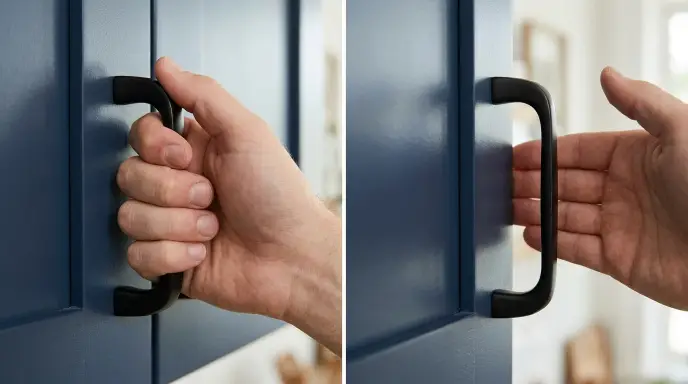
D-shaped pulls and wide bar handles solve this by allowing a full hand or even a closed fist to hook through and pull, rather than requiring a precise pinch. The key installation detail is clearance: handles should stand at least enough off the cabinet surface to fit three or four fingers comfortably underneath — generally a minimum of 1.5 inches of standoff space, with the handle itself spanning 3 to 4 inches in length for a secure hook-and-pull motion.
Push-to-Open Latches (Touch-Release Hardware)
For cabinets near the stove or sink where hands are often full, wet, or oven-mitted, push-to-open (touch-release) latches eliminate the need for a handle at all. A light push with a fist, forearm, or elbow pops the door open, which is especially useful for anyone carrying a hot dish or a stack of plates who can’t spare a free hand to grip a pull.
Interior Visibility: Under-Cabinet and Sensor Lighting Upgrades
Dim cabinet interiors don’t just make cooking inconvenient — they actively contribute to falls. Reaching into a dark cabinet forces the eyes and body to compensate with touch alone, often leading to overreaching, misjudged distances, or knocking items loose that then fall and need to be caught or stepped over. he underside of wall-hung cabinetry offers valuable functional space that remains within safe, neutral reach zones. Installing under-cabinet mounted jar openers directly beneath your upper shelves lets you use body leverage to twist stubborn lids loose without taking up precious countertop workspace.
Rechargeable Stick-On Motion-Sensor LED Strips
Battery-powered or USB-rechargeable LED strips with built-in motion sensors solve this instantly, with zero electrical work. They stick to the underside of upper cabinets or the interior roof of lower cabinets with adhesive backing, and switch on automatically the moment a door opens or a hand passes nearby. No electrician, no wiring, no permanent installation — just peel, stick, and charge every few weeks.
Under-Cabinet Task Lights for Glare-Free Countertop Vision
Separately, under-cabinet task lighting mounted beneath upper cabinets illuminates the countertop workspace itself, reducing shadows cast by overhead kitchen lighting. This matters most during food prep, when a clear, glare-free view of a cutting board or stovetop directly affects both safety and accuracy.
Senior Kitchen Cabinet Modifications: Retrofit Options vs. Costs
| Modification Type | Safety Problem Solved | DIY Difficulty | Avg. Cost Range |
| Pull-Down Upper Shelves | Prevents overhead reaching & step stool falls | Moderate | $120 – $280 |
| Roll-Out Base Drawers | Eliminates kneeling & deep bending | Easy – Moderate | $45 – $90 per shelf |
| D-Shape Handle Swaps | Relieves arthritis wrist & finger pain | Easy | $20 – $50 (pack) |
| Blind Corner Pull-Outs | Recovers wasted, unreachable corner depth | Moderate | $150 – $350 |
| Motion-Sensor LED Bars | Ends shadows & low-light missteps | Very Easy | $15 – $35 |
Step-by-Step: Reorganizing Cabinets in One Weekend (Zero Cost)
Before spending a dollar on hardware, a free reorganization pass can solve a surprising number of safety issues on its own.
- Step 1: Move heavy items into the safe reach zone. Cast iron skillets, large stockpots, and heavy mixing bowls should move to shelves close to counter height — never on a top shelf, where lifting them down risks losing control of the weight overhead.
- Step 2: Put everyday dishware at eye level. Plates, bowls, and glasses used daily should sit on the shelf directly at or just below eye level, within the 20–44 inch golden range, so nothing requires stretching or stacking a stool to reach.
- Step 3: Clear out duplicate and unused items. Most kitchens accumulate duplicate mixing bowls, extra travel mugs, or expired spices that quietly steal prime real estate from the safe reach zone. Removing them frees up low-effort shelf space for the items actually used every day — no new storage needed, just less clutter competing for the best spots.
Frequently Asked Questions
Can you install pull-down shelves in existing kitchen cabinets?
Yes. Most standard-depth cabinets can accept a drop-down shelf kit without any remodeling — the unit screws directly into the existing side or back panel using basic hand tools.
What is the best cabinet handle type for people with hand tremor or arthritis?
D-shaped pulls or wide bar handles measuring 3 to 4 inches long are generally the easiest to grip, since they allow a full hand or hooked fist to pull rather than requiring a precise pinch grip.
Does Medicare pay for accessible kitchen modifications?
Original Medicare typically does not cover kitchen cabinet modifications. However, some Medicare Advantage (Part C) plans and state-level aging waiver programs offer home safety grants or allowances that may apply. Checking with a local Area Agency on Aging is the fastest way to confirm eligibility.
Related Guides & Resources
For a complete room-by-room strategy, see our complete kitchen aging-in-place guide, which covers flooring, appliances, and layout changes beyond cabinet storage. If falls are a concern throughout the home, our guide to slip-resistant kitchen and bath flooring covers surface choices that pair well with these cabinet upgrades. And for help funding larger accessibility projects, see our breakdown on Medicare assistance for home accessibility for details on what’s typically covered and what isn’t.



8 Comments