
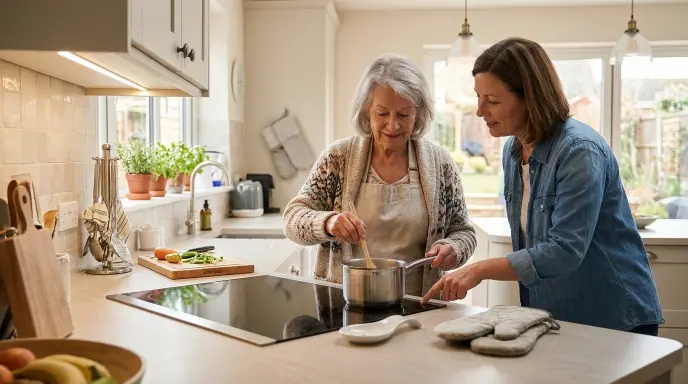
Stove Safety for Seniors: Auto Shut-Offs & Best Cooktops
Quick Answer: Stoves are dangerous for older adults mainly because of unattended cooking—often caused by memory lapses, reduced senses, or distraction—and loose clothing that can easily catch fire. The two most effective ways to prevent kitchen fires are an automatic stove shut-off device (best if keeping an existing stove) or an induction cooktop (best if replacing an appliance). Inexpensive accessories like knob locks and range-hood fire canisters add an essential secondary safety layer.
Key Takeaways
- Renting or keeping your current stove? Install a retrofit automatic shut-off device (motion-, smoke-, or thermal-triggered). Confirm power and fuel compatibility first, as many plug-in models support only electric ranges.
- Replacing or remodeling the kitchen? Induction cooktops offer the highest level of built-in safety: no open flame, no gas-leak risk, and automated pan-detection shut-offs.
- Tight budget? Stovetop fire canisters, safety knob locks, and keeping an organized, fire-safe clearance zone dramatically reduce hazards for minimal cost.
- Holistic Home Safety: Just as you prioritize grab bars or anti-scald valves for seniors in the bathroom, stove safety is the central pillar of any comprehensive aging-in-place kitchen guide.
Who This Guide Is For: Older adults aging in place independently, adult children assessing parental home safety, and professional caregivers. We distinguish clearly between renter-friendly plug-and-play devices and permanent homeowner upgrades.
Table of Contents
Why Kitchen Fires Are the #1 Hazard for Seniors Aging in Place
According to data compiled by the National Fire Protection Association (NFPA):
- Cooking remains the leading cause of home fires and home fire injuries across the country.
- Ranges and cooktops account for approximately 60% of all home cooking-related fire incidents.
- Unattended cooking is the single greatest contributing factor in fatal kitchen fires.
- Older adults face a disproportionately higher risk of fire-related fatalities compared to younger demographics. While loose clothing ignition accounts for a smaller percentage of overall fires, it accounts for a significant portion of fatal injuries.
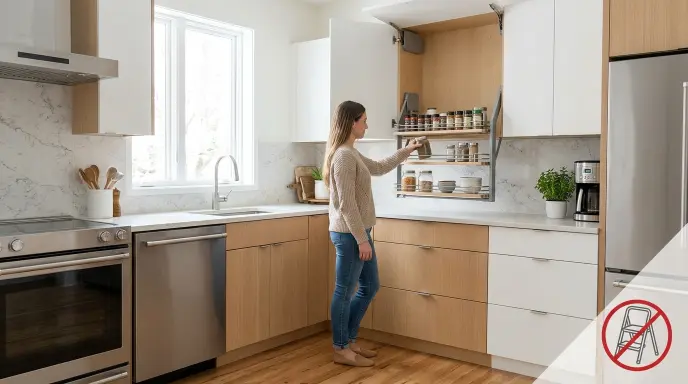
Planning an elder-friendly kitchen requires addressing physical surroundings—similar to organizing reachable tools with pull-out cabinet organizers for seniors so nobody has to reach precariously over an active burner. Burn accidents often happen when moving boiling water or heavy frying pans with a compromised grip. Along with automatic stove-shutoff devices, relying on specialized lightweight cookware with helper handles distributes weight across both arms and prevents accidental drops.
Age-Related Challenges That Increase Stove Hazards
- Memory Changes & Cognitive Decline: Early-stage dementia or mild cognitive impairment can cause a senior to turn on a burner and walk away, or forget the steps to turn it off.
- Reduced Visual Acuity: Faded dial markings, blue gas flames, and dark electric coils blend into the background, making it difficult to tell if a cooktop is hot.
- Diminished Sense of Smell: Normal sensory decline often prevents older adults from catching the smell of scorched food, smoke, or a leaking gas line early.
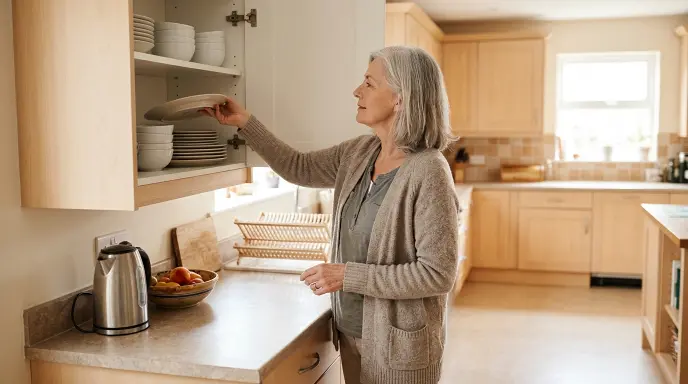
- Mobility, Balance, and Reflex Issues: Reaching across burners to grab spices or items from poorly positioned accessible kitchen cabinets for seniors risks loose robes or sleeves catching fire. Slower reaction times also make it harder to quickly extinguish grease flares.
Top Auto Shut-Off Devices for Stoves (Retrofit Solutions)
Retrofit auto shut-off mechanisms let seniors keep their existing appliance without costly cabinetry remodels. Always confirm whether your appliance is 120V, 240V, or natural gas before purchasing.
1. Motion-Sensor Cutoff: iGuardStove Review
How it works: A wall-mounted or shelf-mounted motion sensor monitors the area in front of the stove. When a burner is turned on, a countdown timer begins (typically 5 minutes). If no movement is detected in the kitchen during that window, the unit sounds an audible warning before automatically cutting electrical power or gas flow.
- Best For: Seniors with early-stage memory loss, wandering habits, and families wanting remote check-in capability.
- Caregiver Connectivity: Companion mobile apps can notify family members if the stove is left unattended or turned on during unusual nighttime hours.
- Trade-offs to Consider:
- Higher upfront cost ($300–$600+).
- Primarily engineered for electric appliances (gas models require specialized shut-off valves).
- Professional hardwiring or specialist setup may be required depending on your home’s electrical layout.
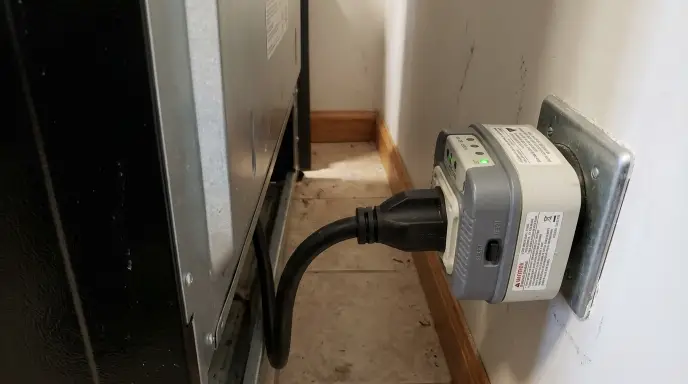
2. Smoke-Activated Cutoff: FireAvert (Plug-and-Play)
How it works: FireAvert synchronizes with your existing smoke detectors. It plugs directly into the 240V wall outlet behind an electric stove, and your stove plugs into the FireAvert unit. When the device hears the specific pitch of a smoke alarm, it immediately terminates electrical power to the range.
- Best For: Renters, independent seniors, and budget-conscious families looking for an install that requires zero tools.
- Key Advantages: Completely reversible, no Wi-Fi required, and easy to reset once the alarm silences.
- Trade-offs to Consider:
- Reactive, not proactive: It only triggers after smoke is generated, meaning food has already scorched or caught fire.
- Compatible only with electric stoves; it will not work with standard gas valves.
3. Thermal & Heat-Rise Sensors (Stove Guard Systems)
How it works: Mounted on the wall or inside the range hood, these sensors monitor the rate of temperature rise using thermal imaging logic. If heat spikes unnaturally—well before smoke forms—it automatically cuts the power circuit or triggers an electronic gas shut-off valve.
- Best For: Proactive fire prevention on both gas and electric stoves where budget permits custom installation.
- Trade-offs to Consider:
- High upfront cost ($300–$1,000+ including installation).
- Requires calibrated installation to avoid false alarms during normal, high-heat cooking techniques like searing.
Comparison Table: Best Senior Stove Safety Devices
| Device | Trigger Mechanism | Installation | Best For | Estimated Price |
| iGuardStove | Motion countdown timer + caregiver mobile alerts | Moderate (Electrician recommended) | Memory lapses, wandering, remote family monitoring | ~$300–$600+ |
| FireAvert | Smoke detector acoustic pitch recognition | Easy (Plug-and-play, no tools needed) | Renters, electric stove owners, quick setups | ~$100–$250 |
| Stove Guard Sensor | Thermal imaging / Rapid heat-rise detection | Moderate to Advanced (Professional setup) | Preventing damage before smoke forms (Gas/Electric) | ~$300–$1,000+ |
| StoveTop FireStop | Direct flame contact melts fuse, releasing powder | Very Easy (Magnetic mount inside range hood) | Secondary fail-safe on any stove type | ~$20–$40 |
| Safety Knob Locks | Physical barrier preventing burner dial turning | Very Easy (Snap-on cover) | Wandering dementia patients, avoiding accidental bumps | ~$10–$25 |
| Induction Cooktop | Pan detection, auto shut-off, cool surface | Professional (Appliance replacement) | Full kitchen remodels, maximum permanent safety | ~$800–$3,000+ |
Induction vs. Gas Cooktops: Which Is Safer for Seniors?
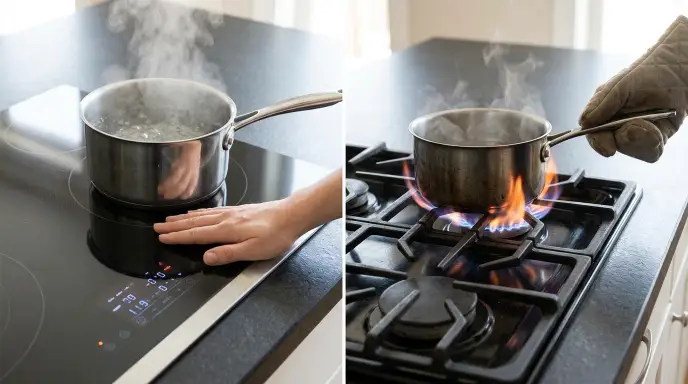
If you are replacing an old appliance, choosing the right cooktop technology makes an enormous difference in daily safety.
Induction Cooktops: The Gold Standard for Elderly Safety
Induction cooktops heat cookware directly using an electromagnetic field rather than heating an electric element or igniting a gas flame.
- Cooler Surface Temperatures: The cooktop glass only warms slightly from the residual heat of the pot. Once the pot is removed, it cools down rapidly, drastically cutting burn risks.
- Automatic Pan Detection: If a senior turns on the cooktop but forgets to put a pot down, it will not heat. If a pot is removed, the heating stops immediately and shuts down automatically after a few seconds.
- Zero Gas Hazards: Eliminates combustible leaks, pilot light blowouts, and indoor air pollution.
- Trade-offs to Note: Requires ferromagnetic cookware (cast iron or magnetic stainless steel). Seniors with tremors or severe arthritis may also find flat, touch-sensitive glass controls finicky compared to traditional physical knobs.
Gas Cooktops: Major Risks and Necessary Mitigations
While familiar to lifelong cooks, gas stoves present the steepest safety risks for older adults:
- Invisible Flames & Clothing Ignition: Reaching across a live burner to adjust ventilation or cabinets can ignite loose sleeves in seconds.
- Gas Leakage & Unlit Burners: Bumping a knob or failing to achieve an ignition spark releases natural gas or propane, which is dangerous for seniors who have lost their sense of smell.
- Indoor Air Quality: Gas burners emit nitrogen dioxide and carbon monoxide, which can worsen respiratory vulnerabilities.
If you must keep a gas range: Ensure your unit has an automatic Flame Failure Device (FFD) that cuts the gas supply if the flame extinguishes, and install both audible gas-leak and carbon monoxide detectors in the kitchen.
Decision Matrix: Induction vs. Gas
| Factor | Induction Cooktop | Gas Cooktop |
| Fire & Burn Safety | Superior: No open flame, surface cools quickly, automated shut-off. | Poor to Moderate: Open flame, grease flare-up risk, lingering grate heat. |
| Usability & Controls | Easy-wipe surface; digital touchpads can be difficult with tremors. | Tactile, familiar physical dials; visual flame feedback. |
| Operating & Upfront Cost | Higher upfront appliance price; highly energy-efficient. | Lower upfront cost; ongoing utility gas charges. |
| Cookware Compatibility | Strictly requires magnetic-bottom pots and pans. | Accommodates all materials (aluminum, copper, ceramic, glass). |
| Emergency Shut-Offs | Built directly into the internal electronic circuitry. | Requires specialized external mechanical gas valves. |
Key Features to Look for in a Senior-Friendly Cooktop
When shopping for an accessible, age-friendly cooktop, look for these design elements:
- Front-Mounted Controls: Dials or controls positioned along the front edge prevent seniors from reaching across hot pots and burners.
- Tactile, High-Contrast Knobs: For individuals with visual decline or hand tremors, physical knobs with clear off/on demarcations are much safer than flat, capacitive touch controls.
- Bright Residual Heat Indicators: Vibrant warning lights that stay lit until the cooking surface has cooled to a safe temperature.
- Auto-Off Safety Timers: Built-in programmable shut-off timers that turn off specific burners after a pre-selected cooking duration.
Low-Tech & Budget-Friendly Safety Adjustments
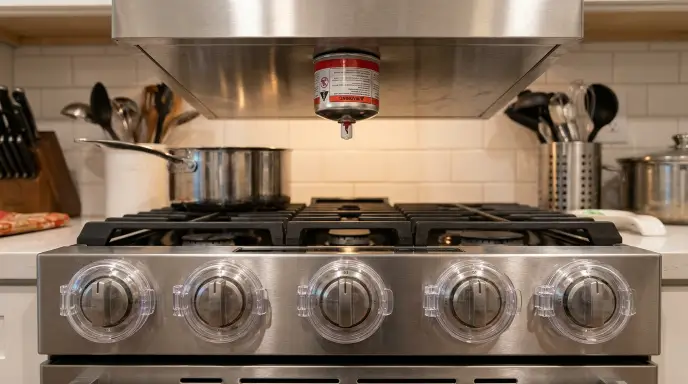
You do not need thousands of dollars to create a significantly safer cooking environment. Combine these budget-friendly adaptations:
- Stove Knob Covers: Clear, hinged plastic covers prevent accidental dial bumps and stop seniors with advanced dementia from turning burners on unattended.
- Range-Hood Fire Suppressors: Products like StoveTop FireStop attach magnetically under the exhaust hood. If a pan catches fire and flames touch the canister, it automatically drops non-toxic dry chemical powder to smother the blaze instantly.
- Maintain a 3-Foot “Clear Zone”: Remove dish towels, paper towel holders, loose recipes, and wooden utensils away from burner perimeters. When storing heavy utensils, use pull-down cabinet shelves for seniors in adjacent spaces to eliminate clutter around the range.
- Clothing Guidelines: Encourage cooking in short sleeves or fitted cuffs. Loose cardigans, flannel robes, and dangling aprons are primary drivers of cooking fire burns.
- Kitchen Emergency Monitoring: Just as families install bathroom fall alert placement guides near slippery tubs, place a medical emergency alert button or vocal intercom within reach of the kitchen floor.
Frequently Asked Questions (FAQ)
Can you put an automatic shut-off on a gas stove?
Yes, but the choices are more specialized than plug-in electric units. While electric stoves simply require interrupting power to a 240V plug, gas stoves need an electronically activated mechanical gas shut-off valve. Systems like iGuardStove provide gas-compatible configurations, but they must be installed by a licensed gas fitter or plumber to meet local fire and building codes.
Are induction cooktops safe for seniors with pacemakers?
Induction cooktops generate local electromagnetic fields. While modern pacemakers and implantable cardioverter-defibrillators (ICDs) are well shielded, major health authorities and manufacturers generally advise maintaining a distance of at least 1 to 2 feet (30–60 cm) between the cooktop surface and the cardiac implant. Anyone with a pacemaker should review their device manufacturer’s manual and consult their cardiologist before switching to an induction unit.
How do I stop a parent with dementia from using the stove?
Implement a layered approach rather than relying on a single method:
Physical Obstacles: Remove the stove dials entirely when cooking is unsupervised, or install lockable childproof stove knob covers.
Circuit Disconnects: For electric stoves, shut off the stove’s dedicated double-pole breaker in the main electrical panel, or have an electrician install a keyed lock-out switch.
Automated Monitoring: Place a motion-detecting auto shut-off device with remote family notification capabilities.
Safer Alternatives: Provide easy-access alternatives like an automatic shut-off microwave, an auto-stop electric kettle, or organized meal prep delivery.
Final Recommendation: Choosing Your Path Forward
- If Renting with an Electric Stove: Choose a plug-in FireAvert combined with stovetop fire canisters and knob covers.
- If Managing Memory Loss or Wandering: Install an iGuardStove to enforce strict inactivity shut-offs and keep family alerted.
- If Planning a Remodel: Invest in an Induction Cooktop equipped with front tactile knobs and built-in pan detection.
No single device replaces periodic supervision, operational smoke detectors, and a clear kitchen emergency plan.
Sources & Safety References
- NFPA (National Fire Protection Association): Home Cooking Fires Report
- Alzheimer’s Association: Safety in the Home: Kitchen Modifications & Dementia Care
- U.S. Consumer Product Safety Commission (CPSC): Stove and Range Fire Prevention Protocols
Medical & Safety Disclaimer
This guide is for informational and educational purposes only and does not constitute formal medical, electrical, or structural engineering advice. If you or a loved one has an implanted cardiac device (such as a pacemaker), consult a cardiologist before installing or using an induction cooktop. Gas shut-off valves, 240V lines, and hardwired electrical modifications should always be completed by a licensed professional in compliance with local safety codes.

6 Comments