
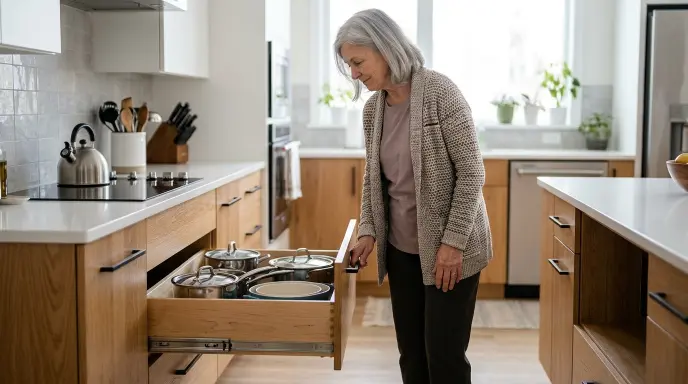
Best Pull-Out Cabinet Organizers for Seniors: Stop Bending & Kneeling
Disclosure: If you buy through links on this page, we may earn an affiliate commission at no extra cost to you. It never influences our recommendations.
Installing pull-out or roll-out shelves in lower base cabinets brings your kitchen supplies directly to you, eliminating the need to kneel, squat, or blindly grope inside a dark 24-inch-deep cavity. For older adults, the safest setup pairs 100% full-extension steel ball-bearing glides with a load rating of at least 75–100 lbs, smooth low-effort glide resistance, and 2.5 to 3.5-inch sidewalls to keep items secure without making them hard to lift out.
Table of Contents
The “Zero-Bending” Reach Zone: Why Deep Base Cabinets Are a Serious Fall Risk
Standard kitchen base cabinets measure 24 inches deep. Reaching items stored on a fixed, deep shelf requires a risky sequence of physical movements:
- Stooping, squatting, or dropping down to floor level.
- Kneeling on hard tile while bracing one hand on the edge of the door or laminate counter.
- Twisting and reaching into a dark enclosure with your head positioned below your hip level.
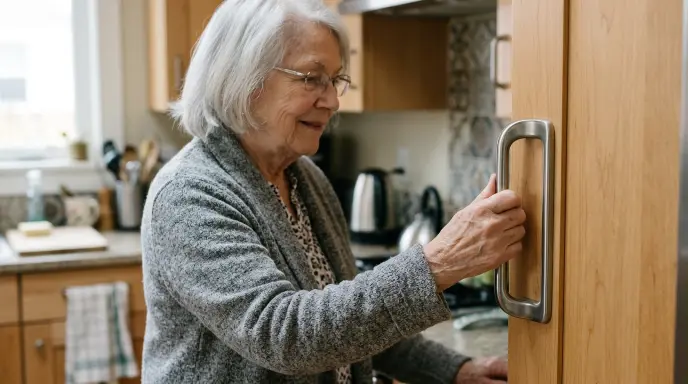
Each of these movements strains aging knees, hips, and the lumbar spine. More critically, moving from a stooped posture back to standing often triggers orthostatic balance shifts or sudden dizziness. According to the CDC, approximately one in four older adults experiences a fall each year. Kneeling on hard floors while wrestling a heavy cast-iron skillet creates an entirely avoidable injury risk. To get the most out of your sliding shelves, pair them with wide D-pull handles so pulling out heavy pantry items requires minimal wrist effort.
Understanding the Ergonomic Reach Zone
The ideal functional reach zone for daily household activities sits roughly between knee and shoulder height. The Americans with Disabilities Act (ADA) accessibility guidelines highlight an unobstructed forward reach range between 15 and 48 inches above the finished floor.
A roll-out tray converts deep dead storage into an accessible sliding drawer, sliding items right into this safe operational zone.
Safety Note: Physical mobility, spinal flexibility, and hand grip strength differ for everyone. If you live with arthritis, osteoporosis, neuropathy, or vestibular balance disorders, consult an occupational therapist (OT) or physical therapist before reconfiguring your storage spaces.
Quick Comparison: Best Roll-Out Trays for Seniors at a Glance
| Organizer Type | Best For | Typical Weight Rating | Slide Mechanism | Arthritis-Friendly Score |
| Solid Wood Dovetail Roll-Out Tray (Soft-Close (Soft-Close, 3″ Lip) | Heavy pots, pans, stand mixers, small appliances | 75–100 lbs | Full-extension soft-close ball-bearing glides | ★★★★★ (5/5) |
| Two-Tier Wire Basket System (Independent Dual Slide) | Canned goods, boxed pantry items, dry staples | 50–100 lbs | Dual independent full-extension ball-bearing slides | ★★★★☆ (4/5) |
| Expandable Adhesive Slide-Out Trays (2-Pack, No-Drill) | Snacks, light pantry items, renters | Light to medium (up to ~30 lbs) | Smooth slide rail with adhesive base | ★★★☆☆ (3/5) |
| Blind Corner Swing-Out Organizer (Soft-Close) | Corner dead space, pots, mixing bowls | 25–45 lbs per tray | Heavy-duty articulating swing arm with soft-close | ★★★☆☆ (3/5) |
| L-Shaped Under-Sink Sliding Organizer (2-Tier) | Cleaning supplies, dish soaps, around plumbing pipes | 40–50 lbs | Smooth pull-out glide track | ★★★★☆ (4/5) |
Note: Weight ratings are general category standards; verify specific manufacturer ratings before loading. The Arthritis-Friendly Score (1–5) reflects ease of pull, grip clearance, and minimal body torque.
What to Look for in a Senior-Friendly Cabinet Organizer
Generic product roundups evaluate organizers based on aesthetic appearance alone. For aging in place, hardware specifications and resistance to movement determine whether an organizer protects joints or creates extra frustration.
1. 100% Full-Extension vs. 3/4 Extension Glides
- 3/4 Extension Slides: Stop rolling when 4 to 8 inches of the tray remain tucked inside the cabinet box. You are still forced to crane your neck and reach into the dark cabinet interior.
- 100% Full-Extension Slides: The entire tray clears the cabinet face frame, fully presenting every item in open light and within easy reach.
For aging hands and restricted backs, full extension is a non-negotiable safety baseline.
2. Soft-Close Mechanisms and Low Pull Resistance
- Soft-close damping: Prevents shelf slamming, keeps stacked pots from clattering, and protects fingertips from sudden pinches.
- Low Initial Pull Force: Arthritic fingers struggle with stiff opening catches. Opt for precision steel ball-bearing tracks.
- ADA Benchmarking: The ADA recommends that accessible operable parts operate with no more than 5 pounds of force (lbf). When fully loaded, your organizer should glide open with a light, single-handed pull.
3. Sidewall Height (Tray Lip Depth)
- Too Shallow (under 2 inches): Tall cereal boxes, glass condiment bottles, and stacked pans can tip over the side when pulled.
- Too Deep (over 4 inches): Requires lifting heavy cookware straight upward above shoulder-safe angles, irritating rotator cuffs and wrists.
- The Sweet Spot: A rim height between 2.5 and 3.5 inches provides lateral retention while allowing you to slide items out with minimal vertical lifting.
4. Heavy-Duty Steel Ball-Bearing Slides
Cookware adds up fast: an enameled Dutch oven weighs 10–12 lbs, a 12-inch cast-iron pan weighs 8 lbs, and a row of canned food quickly adds 15–20 lbs. Select glides rated for at least 75 to 100 lbs. Avoid plastic friction glides or nylon wheels; they bind, wobble, and stick under load.
The 5 Best Pull-Out Organizer Styles for Aging Kitchens
1. Best Overall Heavy-Duty Shelf: Wood Dovetail Roll-Out Tray (Soft-Close)

Pros:
- Very durable solid wood with a flat bottom that stays stable under heavy cookware
- Soft-close slides prevent slamming, tipping pots, and jarred fingers
- 3-inch sidewalls keep items from sliding off without straining shoulders to lift them out
- Smooth natural finish with no wire edges to catch or cut sensitive hands
Why it’s senior-friendly:
There are no sharp wire ends and no gaps for small items to fall through. The smooth ball-bearing glides bring heavy cast-iron pots fully out into the light with a light pull, eliminating painful bending and kneeling.
Cons:
- Usually more expensive than wire options
- Requires precise cabinet width measurement (measuring between hinges)
- Unfinished wood may need sealing near a sink
Best for: Daily cookware, heavy cast iron, and small appliances in lower base cabinets.
Check Current Price & Size Options:
👉 View the Soft-Close Wood Dovetail Roll-Out Cabinet Drawer on Amazon
(Tip: Available in standard widths from 12″ up to 26″ wide; be sure to measure your cabinet opening between the hinges before ordering).
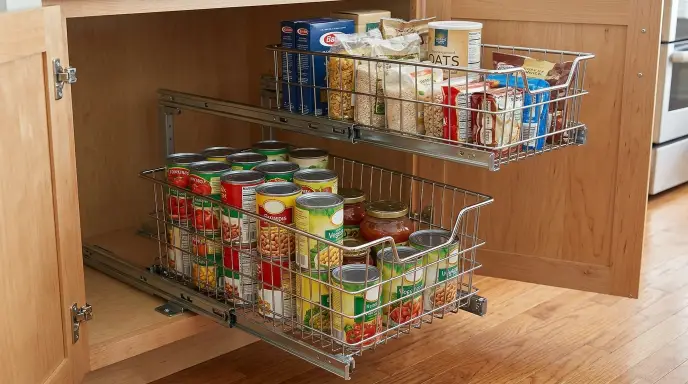
2. Best Two-Tier Wire Basket Organizer: Upper & Lower Glide System
Pros:
- Dual-slide mechanism lets both top and bottom wire baskets slide out independently
- High side wire guards keep tall boxes, jars, and produce securely contained
- Full-depth 21.5″ extension brings back-row items fully into view from a standing position
- Excellent vertical space utilization for pantry items and daily dinnerware
Caution:
Narrow wire gaps can cause small spice jars or narrow bottles to tip. Add a solid acrylic or flat plastic shelf liner to maintain a stable base.
Cons:
- Lower tier still requires some bending if installed at the absolute floor level
- Wire edges can feel firm on delicate or arthritic hands
Best for: Canned goods, dry pantry staples, and lightweight daily dishes in tall base cabinets.
Check Current Price & Dimensions:
👉 View the 2-Tier Heavy Duty Dual Slide-Out Organizer on Amazon
(Tip: Ideal for standard 24-inch deep base cabinets; measure your interior opening to ensure the 19.5″ width clears your door hinges).
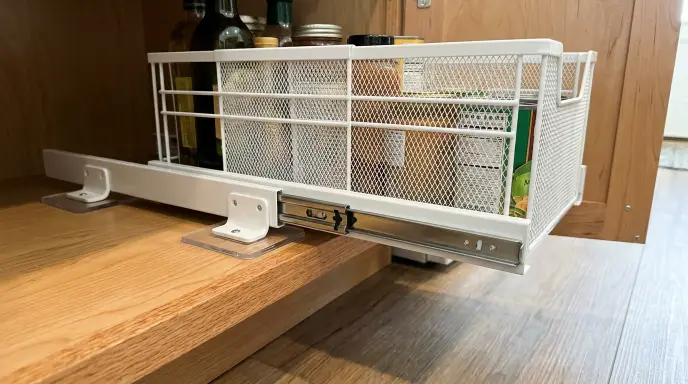
3. Best No-Drill / Easy-Install Adhesive Organizer: Expandable Pull-Out Shelf (2-Pack)
Pros:
- Expandable width design adjusts easily to fit different cabinet widths without custom ordering
- Tool-free peel-and-stick installation with high-strength nano-adhesive strips (no power drill required)
- Includes raising pads to clear raised cabinet face frames and door lips smoothly
- Comes as a 2-pack, making it highly cost-effective for organizing multiple pantry shelves
Who it’s for:
Renters, seniors living independently who cannot handle power tools, and for storing lightweight staples, spices, tea boxes, and snacks.
Honest limits:
Adhesive mounting is designed strictly for light to medium loads (typically up to 25–30 lbs). Do not use this organizer for heavy cast iron skillets, Dutch ovens, or stacks of heavy ceramic dishes.
Cons:
- Not meant for heavy appliance loads
- Requires a completely flat, grease-free cabinet floor to ensure the adhesive grips properly
Best for: Lightweight pantry items, dry snacks, plastic containers, and quick DIY setups.
Check Current Price & Reviews:
👉 View the 2-Pack Expandable Adhesive Pull-Out Cabinet Organizer on Amazon
(Tip: Includes raising pads so the drawer slides freely over raised front cabinet lips without catching).
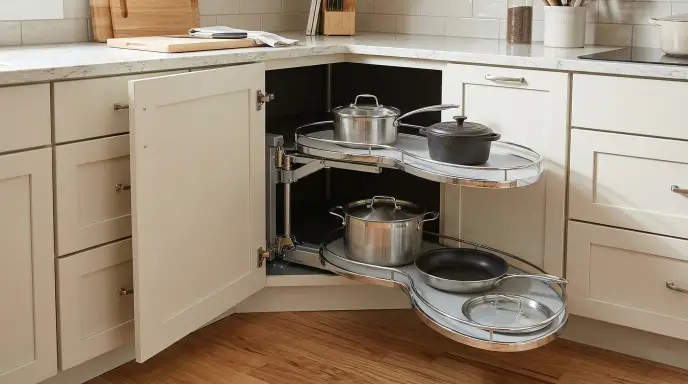
4. Best Blind Corner Solution: Soft-Close Swing-Out Organizer
Pros:
- Articulating swing-out shelves glide completely out of the cabinet, bringing deep corner items directly to standing height
- Soft-close mechanism prevents heavy pans and trays from slamming or rattling
- Integrated side railings prevent tall pots, blenders, and jars from sliding off during rotation
- Two independently moving tiers maximize awkward L-shaped dead corner storage
The Reality of Installation:
Blind corner mechanisms are complex and require precise alignment. Ensure you check door swing orientation (left-hand vs. right-hand opening) and clear opening width. Because proper leveling is critical, hiring a handyman or carpenter is recommended for this setup.
Cons:
- Highest price point among pull-out styles
- Complex installation compared to simple bottom-mount roll-out shelves
- Weight capacity per tray is lower than fixed straight shelves (typically 25–45 lbs per tray)
Best for: Eliminating dead corners in L-shaped kitchens and preventing seniors from crawling or reaching into deep corner cabinets.
Check Current Price & Hand Opening Options:
👉 View the Soft-Close Blind Corner Pull-Out Organizer on Amazon
(Important: Verify whether your cabinet requires a Left-Swing or Right-Swing configuration before ordering).
5. Best Under-Sink Option: L-Shaped Sliding 2-Tier Organizer
Pros:
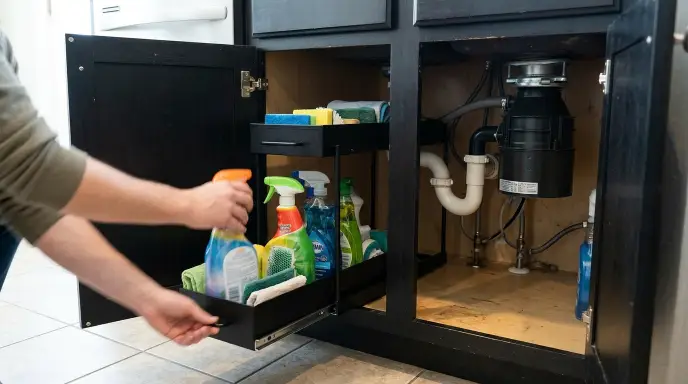
- Clever L-shaped tiered structure wraps neatly around plumbing traps and garbage disposal units
- Bottom basket slides out smoothly on glides, bringing cleaning supplies directly to you without painful reaching
- High basket sidewalls prevent tall dish soaps, bleach bottles, and scrub brushes from toppling over
- Rust-resistant coated carbon steel handles wet, high-humidity under-sink environments
Senior Safety Benefit:
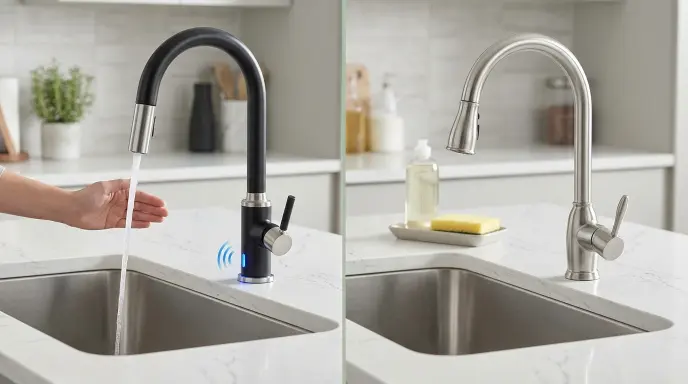
Under-sink spaces are prone to chemical leaks and poor lighting. This pull-out keeps harsh cleaners organized and visible from a standing position, eliminating the risk of accidental chemical spills or losing balance while reaching under pipes. Before installing lower shelving under a kitchen sink, take measurements around the water supply lines, shut-off valves, and drain traps. This clearance is especially critical if you plan on installing anti-scald touchless or lever faucets that require under-sink mixing valves and solenoid battery packs.
Cons:
- Narrower top tier has limited space for larger gallon-sized jugs
- Must be measured carefully to ensure clearance around specific pipe configurations
Best for: Dishwasher pods, cleaning sprays, dish soaps, and sponges stored in kitchen or bathroom sink base cabinets.
Check Current Price & Fit:
👉 View the 2-Tier L-Shaped Under-Sink Pull-Out Organizer on Amazon
(Tip: Check the clearance height of your sink drain pipe before ordering to ensure the narrow top basket fits smoothly).
Installation Realities: DIY vs. Retrofit vs. Handyman
Most quality pull-out organizers are designed to retrofit into standard existing cabinet boxes without tearing out your kitchen:
- DIY Friendly: Floor-mount units simply screw downward into the cabinet base shelf using 4 to 8 wood screws.
- When to Hire a Handyman: If you experience limited hand grip, struggle with balance, or need to secure slides into older particle-board side panels, hire an installer or certified aging-in-place specialist.
Measuring Checklist (Avoid Common Returns)
Before placing an order, take these six precise measurements:
- Clear Opening Width: Measure between the narrowest points (account for hinges, protruding face frames, and open door thickness).
- Internal Depth: Measure from the back cabinet wall to the back of the closed cabinet door.
- Door Clearance Angle: Ensure the cabinet door swings open to at least 90 degrees without snapping back.
- Floor Structural Condition: Confirm the cabinet floor is flat, solid, and free from historical moisture rot or sagging.
3 Smart Organization Upgrades to Pair with Pull-Out Shelves
- Vertical Weight Zoning: Place heavy daily cookware (cast-iron skillets, stockpots) on the upper tier of base cabinets (around waist height). Keep light Tupperware or paper items at the bottom.
- Motion-Activated LED Cabinet Strips: Aging eyes require higher contrast and more ambient light to differentiate items. Add battery-operated magnetic light strips that turn on the instant the cabinet door swings open.
- Ergonomic D-Pull Hardware: Replace small, slippery round knobs with 4-inch to 5-inch D-shaped cabinet pulls. These allow you to loop four fingers or an entire hand through the handle without a tight pinch grip.
Frequently Asked Questions
What is the difference between a roll-out tray and a deep drawer?
A roll-out tray installs behind an existing standard hinged cabinet door, leaving the exterior appearance of your kitchen unchanged. A true drawer box replaces the door completely, with the front drawer face attached directly to the slide box. Drawers provide slightly faster one-step access, but roll-out trays are significantly more affordable and easier to retrofit into existing cabinetry.
Can pull-out shelves be installed in older existing cabinets?
Yes. Most aftermarket roll-out systems mount straight down to the existing cabinet floor or fixed middle shelf with mounting brackets. You simply need to confirm that your cabinet base wood is free from water damage, is level, and that interior hinges do not obstruct the path of the sliding frame.
What is the best weight capacity for elderly kitchen storage?
For daily pots, pans, and canned food storage, select slides rated for 75 to 100 lbs. This provides a safety margin that prevents glide tracks from bending or jamming over time. For light spice, tea, or snack organizers, a 25 to 35-lb rating is sufficient.
Are adhesive pull-out shelves strong enough for canned goods?
Adhesive pull-outs work reliably only for lightweight dry goods, spices, snacks, and plastic containers. Heavy stacks of canned vegetables or ceramic baking dishes can eventually cause adhesive pads to peel off cabinet surfaces. For cookware or heavy items, mechanical screw-down installations are always the safer option.
Related Aging-in-Place Guides
- Upper Cabinet Access: Pull-Down Cabinet Shelves for Seniors (Eliminate dangerous overhead reaching and step stools)
- Full Remodeling Plan: Aging-in-Place Kitchen Safety Guide
- Ergonomic Design: Accessible Kitchen Cabinets for Seniors
- Lighting Optimization: Bathroom & Kitchen Lighting for Aging Eyes
Medical & Safety Disclaimer: This content is intended for informational and educational purposes only and should not replace clinical medical advice. Individuals with mobility, vestibular balance, or grip limitations should evaluate modifications with an Occupational Therapist (OTR/L) or Certified Aging-in-Place Specialist (CAPS).


6 Comments