
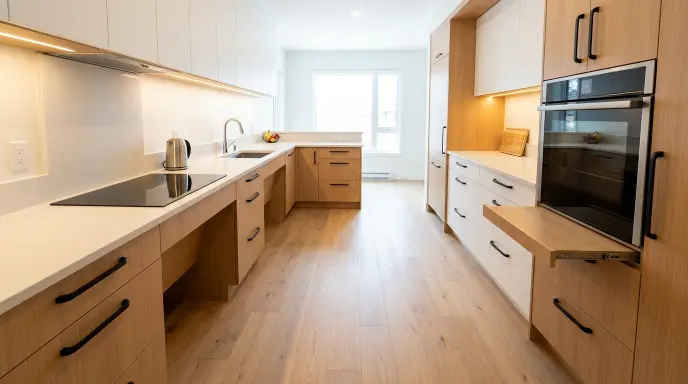
Aging in Place Kitchen Design: How to Build a Safe, Independent Kitchen (Without a Costly Remodel)
The bathroom gets all the attention in fall-prevention articles, but the kitchen is quietly the second most dangerous zone in a senior’s home. Between scalding liquids, fire risk from unattended stovetops, and the simple act of reaching for a coffee mug on a high shelf, the kitchen combines three hazard types that bathrooms don’t: fire, tripping, and burns—all in one room, often multiple times a day.
Here’s the good news: you do not need a $40,000 kitchen gut renovation to fix this. Full remodels are the default advice most articles give, but the reality is that roughly 85% of kitchen accessibility problems can be solved with strategic retrofitting, smarter appliance placement, and ergonomic repositioning—most of it reversible, rental-friendly, and completed in a single weekend.
Just as setting up a safe bathroom for aging in place relies on targeted adjustments rather than rebuilding walls, this guide walks through exactly how to secure your kitchen step by step.
Quick Answer: What Makes a Kitchen “Aging-in-Place Ready”?
A kitchen is considered safe for aging in place when it eliminates step-stool dependency, maintains clear 36–42 inch pathways for walkers or wheelchairs, uses glare-free 4000K task lighting, places cooktop controls at the front (not the back), and stores daily-use items within the 20-to-44-inch reach zone. No demolition required.
Table of Contents
1. Mastering the 20″ to 44″ Golden Zone (Ergonomic Storage)
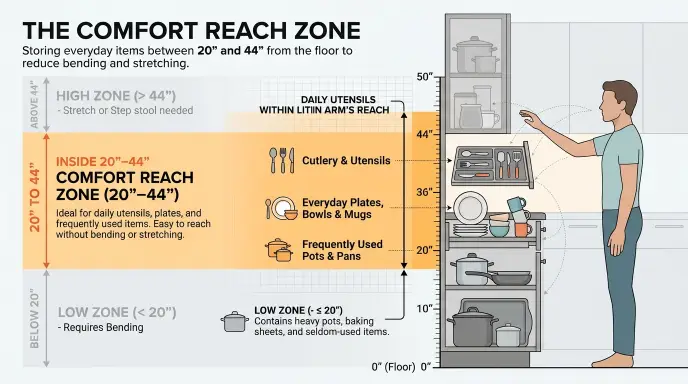
Direct Answer: The “Golden Zone” is the vertical space between 20 inches and 44 inches from the floor—everything a person can reach while standing or seated without stretching, bending, or climbing. Relocating daily-use items into this zone eliminates most cabinet-related fall risk.
Why the Step Stool Is Kitchen Enemy #1
Step stools are responsible for a disproportionate number of home fall injuries among adults over 65. The combination of an unstable surface, overhead reaching (which shifts the body’s center of gravity backward), and often a loss of balance mid-reach makes this one of the most preventable hazards in the home. The fix isn’t “don’t use a step stool”—it’s removing the need for one entirely.
The Retrofit Fix: Drop-Down Shelving Kits
Instead of lowering an entire upper cabinet (a carpentry job), install a pull-down shelf bracket kit. These spring-loaded or hand-pulled mechanisms mount inside an existing upper cabinet and bring shelf contents down to counter height with one hand. Installation typically takes under an hour with a screwdriver, no cabinet replacement needed, and most kits cost between $40 and $120 depending on load capacity and shelf width.
Deep Lower Cabinets: End the Kneel-and-Search Problem
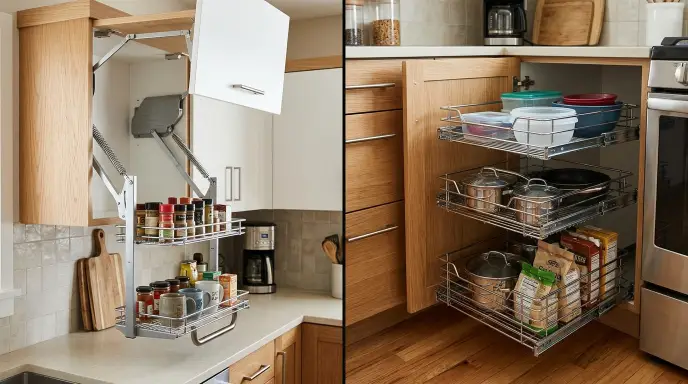
Base cabinets with deep, dark interiors force people to kneel or crouch to find a pot buried in the back—a major trigger for loss of balance when standing back up. Two low-cost fixes:
- Slide-out wire baskets that retrofit into existing cabinet frames (no new cabinetry required).
- Drawer conversion kits that transform a fixed shelf into a pull-out drawer using the existing cabinet box.
Both options bring the entire contents forward to arm’s reach instead of requiring a search-by-touch in a dark corner.
D-Shaped Hardware: Small Swap, Big Grip Difference
Round knobs require fine motor control and a pinching grip—difficult for anyone with arthritis, tremors, or reduced hand strength. Replacing them with 3–4 inch D-pulls or C-handles allows a whole-hand or even a closed-fist grip to open drawers and cabinets. This is one of the cheapest fixes on this list (often under $3 per handle) and takes a few minutes per cabinet with a screwdriver.
2. High-Heat Safety: Preventing Burns and Kitchen Fires
Direct Answer: Most stovetop fires and scalds in senior households come from three sources: unattended back burners, forgotten “on” knobs, and microwaves mounted above eye level. Each has a low-cost fix that doesn’t require replacing the range.
The Stovetop Dilemma: Gas vs. Induction
Gas stovetops carry open-flame risk and continue heating cookware even after it’s removed. Induction cooktops only generate heat when they detect a compatible pan and cool down almost immediately once removed—a meaningful safety advantage for anyone prone to distraction or memory lapses.
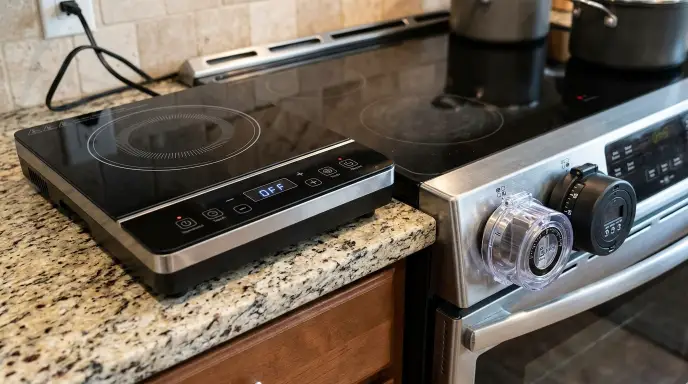
If replacing a built-in range isn’t in the budget, a portable single-burner induction cooktop ($60–$80) can supplement or replace stovetop use for most daily cooking tasks, especially for single-serving meals. It plugs into a standard outlet and can sit directly on a counter at a comfortable working height.
Smart Safety Cut-Offs
For households not ready to switch cooking methods, two retrofit devices significantly reduce fire risk:
- Auto-shutoff stove knob guards that cut gas or power if a burner is left on beyond a set time, or if no motion is detected nearby.
- Motion-sensor shutoff plugs for countertop appliances like toasters, kettles, and slow cookers, which cut power automatically if the appliance is left unattended.
Microwave Placement: The Overlooked Scald Risk
A microwave mounted above the range or at eye level requires lifting hot liquids overhead to remove them—one of the most common causes of scalding burns in older adults, since a spill at that height lands directly on the face, chest, or hands.
The fix: relocate the microwave to counter height. If a built-in over-range unit can’t be removed, a simple $100–$150 countertop microwave placed on a stable, uncluttered section of counter eliminates the overhead lift.
Anti-Scald Water Control
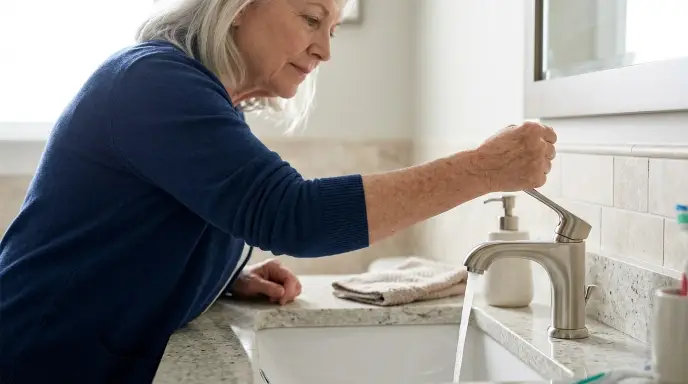
Faucet water that’s accidentally set too hot is a leading cause of kitchen burns for anyone with reduced sensation in their hands (common with diabetes or neuropathy). A thermostatic mixing valve installed under the sink caps the maximum output temperature regardless of how the handle is turned. For a lower-cost option, faucets with a built-in temperature-indicator light (glowing red above a safe threshold) offer a visual warning without any plumbing changes.
3. Creating a Seated Workstation (Energy Conservation)
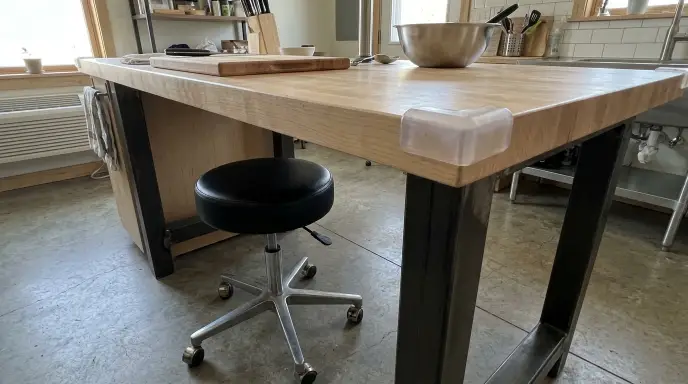
Direct Answer: A seated prep station reduces fatigue and balance risk during long tasks like chopping vegetables or washing dishes. It requires only knee clearance under a counter—achievable by removing a single base cabinet door or drawer, not a full counter replacement.
Standing for extended periods is one of the biggest hidden drains on energy and balance for older adults, and fatigue itself is a major fall risk factor. Many seniors don’t realize how much standing time a simple task like dishwashing or chopping requires until it’s broken into a seated task.
Building Knee Clearance Without Renovation
Most base cabinets can be converted into a makeshift seated workstation by:
- Removing the cabinet door and any fixed shelf inside.
- Leaving the cavity open to create leg room (aim for at least 27 inches of clearance height and 30 inches of width for wheelchair or rolling-chair access).
- Rolling a stable chair or wheeled task stool into the open gap.
This creates an instant sit-down prep zone at an existing counter without cutting, replacing, or relocating any cabinetry.
Edge Visibility & Softening
Sharp countertop corners are a collision risk for anyone using a walker or experiencing balance instability, and low-contrast countertop edges are difficult for aging or low-vision eyes to judge accurately. Two inexpensive add-ons address both issues:
- Silicone rounded corner guards that adhere directly to existing countertop edges.
- High-contrast edge tape along counter borders, which helps individuals with low vision or early-stage dementia visually locate where a surface ends.
4. Overcoming Aging Eyes: Task Lighting Without Electricians
Direct Answer: A 70-year-old eye typically requires roughly three times more light than a 20-year-old eye to see the same task clearly. The fix is a combination of brighter, glare-controlled bulbs (4000K) and shadow-free under-cabinet lighting—most of which can be installed without an electrician.
Glare vs. Brightness
More light isn’t automatically better—glare off glossy countertops or tile backsplashes can actually worsen visibility for aging eyes. The target is 4000K (natural white) LED lighting, which provides strong clarity without the harsh blue-white glare of cooler bulbs or the dim yellow cast of warm bulbs.
Puck Lights & Peel-and-Stick LED Strips
Upper cabinets cast shadows directly onto the counter workspace below—exactly where most knife work and hot liquid handling happens. Battery- or USB-powered peel-and-stick LED strip lights or puck lights mounted under cabinets eliminate this shadow zone instantly. Look for strips with built-in motion sensors so lights activate automatically when hands move into the workspace, removing the need to locate a switch.
Switches & Controls
Traditional flip switches require pinching precision that can be difficult with arthritis. Two simple swaps:
- Rocker paddle switches, which can be activated with a closed fist, elbow, or the back of the hand.
- Voice-activated smart plugs for under-cabinet lighting, allowing hands-free control when carrying items.
5. Slip-Proofing the Floor Without Tearing Up Tiles
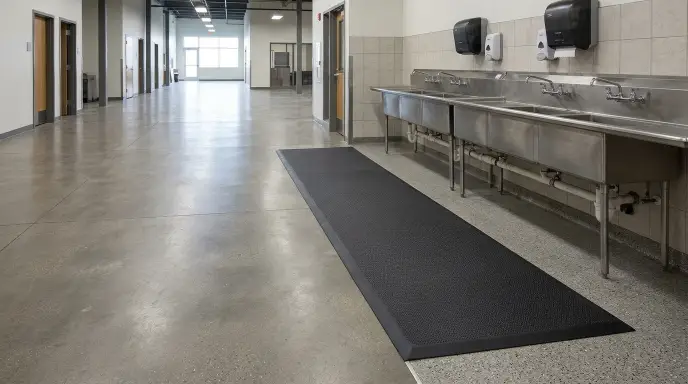
Direct Answer: Kitchen floors need a minimum 36-to-42-inch clear walking path, slip-resistant surfaces, and zero loose rugs. None of this requires replacing existing flooring—it requires removing obstacles and adding traction.
Rug Danger
A single kitchen throw rug or cushioned anti-fatigue mat with a curled or unsecured edge is a textbook tripping hazard, particularly when wet floors cause it to shift underfoot. Replace standard mats with a beveled-edge, anti-fatigue rubber mat that lies flush to the floor with tapered edges on all sides, eliminating the lip that causes trips.
Non-Slip Floor Coating Tricks
Existing tile or vinyl floors don’t need to be replaced to improve traction. Non-skid floor sealers—a clear coating applied like a wax—add microscopic texture to smooth tile or laminate without changing its appearance. These are especially useful near the sink and stove, where grease and water spills are most frequent.
Clearance Requirements
For anyone using a walker, cane, or wheelchair, a minimum of 36 to 42 inches of clear walkway is needed to move safely through the kitchen. Common obstructions to remove or reposition:
- Freestanding kitchen islands or carts that narrow the path
- Extra dining chairs pushed into walkways
- Trash cans or recycling bins placed in corner turns
A quick walk-through with a tape measure often reveals that the real obstacle isn’t the floor—it’s the furniture placed on it.
6. Budget vs. Full Renovation: Kitchen Modification Cost Breakdown
Direct Answer: Most kitchen accessibility problems fall into three budget tiers—under $100, $100–$500, and $2,000+ for full remodels. The table below maps each common problem to its solution at every budget level.
| Feature | Low-Cost Retrofit (<$100) | Mid-Tier Upgrade ($100–$500) | Full Remodel ($2,000+) |
| Cabinet Access | Pull-out wire baskets / Lazy Susan | Pull-down upper shelf hardware | Custom lowered motorized cabinetry |
| Faucet Access | Lever handles or aerator extension | Touchless/hands-free motion sensor faucet | Relocated shallow sink with knee clearance |
| Cooktop Safety | Auto-shutoff stove knob alert guards | Portable countertop induction cooktop | Built-in smart induction range |
| Lighting | Peel-and-stick motion LED strips | Hardwired under-cabinet LED bars | Recessed ceiling grid + skylights |
| Drawer Pulls | D-shaped pull handle replacement | Touch-latch mechanical push drawers | Motorized push-to-open custom units |
Start at the left column. Most households can address 80% of their safety risk without ever reaching the right-hand column.
7. 5 Everyday Gadgets That Prevent Hand & Wrist Strain
Direct Answer: Reduced grip strength is one of the most common and overlooked causes of kitchen accidents—dropped knives, spilled pots, and jar-opening injuries. A handful of inexpensive gadgets remove the strain entirely.
- Electric one-touch can/jar opener: Removes the twisting motion that’s often painful or impossible with arthritic hands.
- Rocker knife and cut-resistant gloves: A rocker knife uses a rolling motion instead of a sawing grip, reducing wrist strain, while cut-resistant gloves add a safety buffer for reduced sensation or grip.
- Lightweight melamine or bamboo dishware: Standard ceramic or glass dishware is heavy and shatters on drop; lightweight alternatives reduce both strain and injury risk if dropped.
- Two-handled or front-grip pans: A secondary handle near the pan’s front allows two-handed lifting, distributing weight and reducing the chance of a tip or spill.
- Lift-out dish drainers: Drainers that lift directly out of the sink basin remove the need to reach down and twist while holding wet, heavy dishware.
None of these items require installation—they can be ordered online and used immediately.
8. Step-by-Step Weekend Safety Audit (Checklist)
Use this checklist room-by-room. Each item takes under 30 minutes and requires no professional help.
Storage & Reach
- Daily-use items relocated to the 20″–44″ reach zone
- Step stool removed or stored out of daily rotation
- Round knobs replaced with D-pulls on top 5 most-used cabinets/drawers
- Deep lower cabinets fitted with slide-out baskets
Heat & Water Safety
- Stove knobs checked for auto-shutoff compatibility
- Microwave relocated to counter height (if currently overhead)
- Faucet temperature capped via mixing valve or indicator light installed
- Motion-sensor shutoff plug added to at least one countertop appliance
Lighting
- Under-cabinet LED strip installed over primary prep area
- Bulbs checked/replaced for 4000K rating
- At least one switch converted to rocker-paddle style
Floor & Movement
- All loose throw rugs removed from kitchen floor
- Beveled-edge mat installed at sink and stove zones
- 36″–42″ walkway confirmed with tape measure
- Non-skid sealer applied to high-traffic tile areas
Seated Workstation
- One base cabinet converted to open knee clearance
- Rolling chair or stool identified for seated prep tasks
- Sharp counter corners fitted with silicone guards
Frequently Asked Questions (FAQ)
Does Medicare pay for kitchen modifications for seniors?
Traditional Medicare (Part A and Part B) generally does not cover home modifications or kitchen renovations, as they are not classified as Durable Medical Equipment (DME). However, certain Medicare Advantage (Part C) plans offer specialized supplemental benefits for home accessibility and safety retrofits. Additionally, local Medicaid Home and Community-Based Services (HCBS) waivers and VA grants (such as the SAH or HISA grants) frequently help finance accessible home modifications.
What is the ideal countertop height for an aging adult?
Standard kitchen counters stand at 36 inches, which works well for standing prep work but causes strain when seated. An accessible, aging-in-place kitchen benefits from multi-height surfaces: maintaining a 36-inch counter for standing tasks, while adding or converting a section to 30–32 inches (with at least 27 inches of vertical knee clearance) for comfortable, fatigue-free seated work.
Are gas or induction cooktops safer for seniors?
Induction cooktops are significantly safer than gas ranges. Induction units use electromagnetic energy to heat only the cookware, meaning the surrounding glass surface stays relatively cool to the touch and cools down rapidly once pans are removed. They eliminate open flames, unburned gas leak risks, and fire hazards from loose clothing catching fire across a burner.
How wide do kitchen walkways need to be for walkers and wheelchairs?
A safe walkway requires a clear width of at least 36 inches for a standard walker or cane, and 42 to 48 inches if accommodating a wheelchair or allowing two people to pass comfortably. Maintaining a 60-inch turning radius in central open areas allows full, unhindered wheelchair navigation.
What is the safest way to store heavy pots and pans?
Heavy pots, pans, and appliances should never be stored above shoulder height or below knee level. The safest location is between 24 and 36 inches from the floor in base cabinets equipped with full-extension slide-out wire drawers. This setup allows you to lift heavy cookware using close-to-body leverage without dangerous overhead lifting or deep kneeling.
Connecting the Rest of the Home
Kitchen safety doesn’t exist in isolation—it’s part of a whole-home fall-prevention strategy. Just as you secured your slippery bathroom floor against slips, kitchen grease and water spills require the same level of attention to traction and clear pathways.
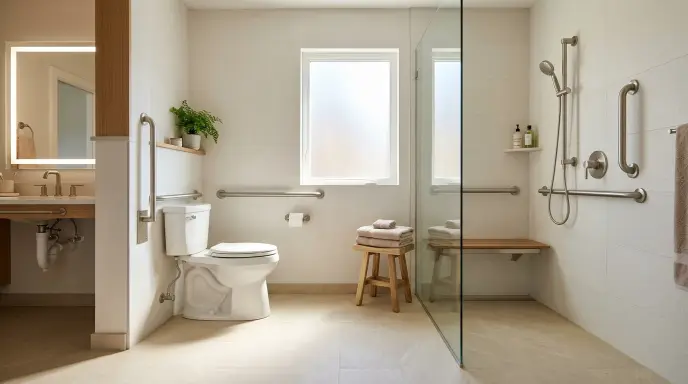
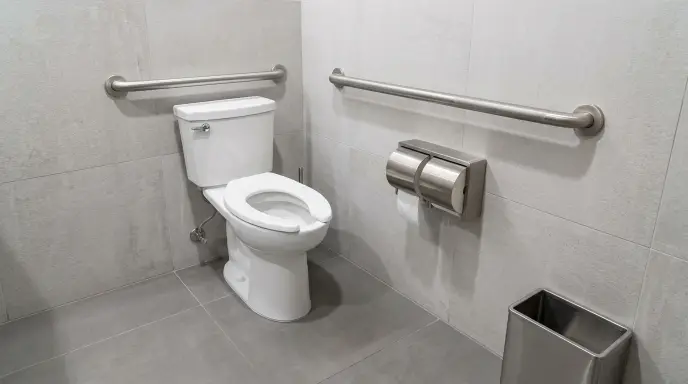
If your loved one already relies on bathroom grab rails for stability, applying that same logic to kitchen counter edges and seated work stations extends that protection into the room where injuries happen just as often, if not more.
A safe kitchen isn’t about ripping out cabinets—it’s about meeting the body where it already is: within arm’s reach, below eye-strain level, and clear of anything that could cause a fall.


3 Comments