
Prevent Bathroom Door Traps: Outswing Hinges & Locks
Key Takeaways (Quick Safety Summary):
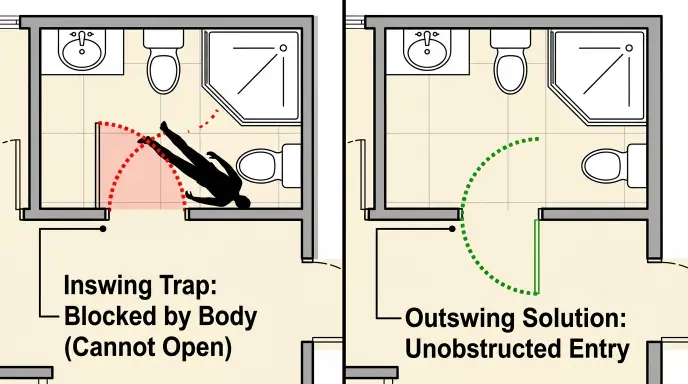
- The Core Danger: Standard doors swing inward. When a senior falls, their body physically jams the door shut against the frame (“Door Blockade”).
- Structural Fix: Install Swing-Clear (Offset) Hinges or convert to an Outswing Door so rescue teams never push against an injured body.
- Lock Fix: Replace standard interior twist locks with Slotted Privacy Levers or ADA Indicator Locks that allow 5-second coin-turn bypass from the hallway.
Table of Contents
Introduction: The “Deadbolt Dilemma”
When a senior falls in the bathroom, they usually fall directly behind the door.
Residential bathrooms are spatially restricted, and standard doors swing inward—aimed straight at the primary open floor space. The result is what first responders and occupational therapists (OTs) refer to as the “Deadbolt Dilemma”: an individual is conscious and calling for help, yet caregivers cannot open the door because the fallen person’s body creates an impassable wedge from inside. When setting up an accessible home, families often prioritize grab bars or mats, but modifying doorways is just as crucial for comprehensive senior bathroom safety to prevent irreversible rescue delays.
Why This Matters: An Occupational Therapist’s Perspective
In standard home accessibility assessments, inward-swinging doors paired with mechanical privacy latches are consistently ranked among the most critical environmental hazards.
Emergency responders report that attempting to access a room blocked by an incapacitated occupant adds 15 to 20 critical minutes to a rescue. Pushing through a partially blocked inward-swinging door risks crushing hands, fracturing hips, or worsening head trauma. Eliminating this structural bottleneck ensures immediate extraction.
The “Door Blockade” Hazard: Why Standard Bathroom Doors Fail
Standard residential construction uses inward-swinging doors for privacy and hallway clearance. However, the physical geometry of small bathrooms (often 5×8 feet or less) turns this standard design into an active trap:
- Direct Fall Path: When slipping off a raised toilet seat or exiting a shower threshold, the center of gravity falls toward the largest clear perimeter—the door swing area.
- Leverage Disadvantage: Rescuers attempting to push inward are fighting dead weight wedged directly against the door’s lower third.
- Secondary Injury Risk: Forcing an inward door open pushes directly against limbs or causes spinal injuries.
Related Resource: If your home utilizes a wall-mounted pull cord or medical pendant, remember that signaling for help is only half the battle. Many families realize this limitation only after a loved one is delayed rescue even after activating a bathroom fall alert system. Alert devices must be paired with barrier-free entry points.
Solution 1: Outswing vs. Swing-Clear Hinges (Hardware Breakdown)
Selecting the correct hinge configuration depends on hallway dimensions, frame construction, and user mobility aids.
1. Swing-Clear (Offset) Hinges

Swing-clear hinges (also called expandable or offset hinges) swing the door completely outside the perimeter of the frame, rather than allowing the door slab to take up 1.5 to 2 inches of doorway width.
- Primary Benefit: Creates a completely flush, unobstructed 32-inch clear opening for walkers and wheelchairs without structural framing alteration.
- Fall Safety Benefit: Reduces narrow pinch points, allowing caregivers to slide their hands or diagnostic equipment through wider initial frame gaps.
2. Full Outswing Conversion
Converting the door to swing entirely outward into the hallway is the ultimate prevention against internal wedges.
- Door Stop Trim: The interior 3/8-inch wood door stop must be detached from the inside jamb and repositioned on the exterior (hallway) jamb.
- Latch Inversion: The latch bevel direction must be reversed 180 degrees so the strike plate engages smoothly from the exterior approach.
- Hallway Clearance Check: Verify that an open 30- to 36-inch slab leaves at least 36 inches of clear passage in the adjoining corridor.
3. Double-Action Spring Hinges (Two-Way Swing)
Double-action hinges permit bidirectional movement (opening inward during daily routines, pulling outward in an emergency).
- Limitation: Standard latch bolts will not work with bidirectional swing paths; a roller-latch or custom directional privacy stop must be integrated.
Solution 2: Emergency Release Locks (Privacy Without Entrapment)
Modifying the hinge orientation resolves structural wedges, but the locking mechanism dictates entry speed during an acute crisis. If a fall occurs inside the stall, review the critical differences in shower curtain and glass door emergency access to ensure first responders can reach the person without mechanical blockage.
Privacy Knobs with Exterior Slotted Release
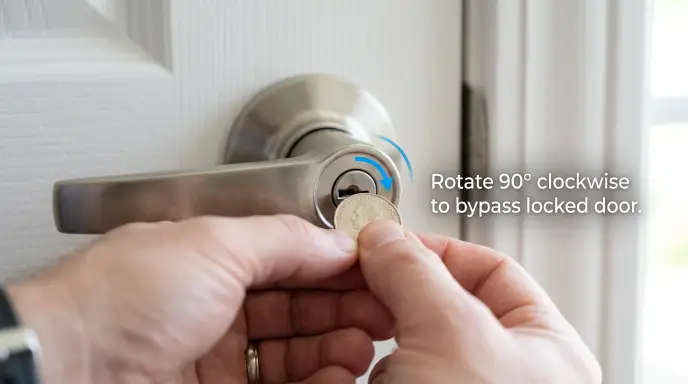
Most residential tubular privacy locks feature an exterior rosette with a slotted center pinhole:
- Emergency Operation: Rescuers can insert a coin, washer, or flathead screwdriver into the slot and twist 90 degrees to bypass the interior button in under 5 seconds.
- Best Practice: Keep an emergency release key or marked flat washer magnetic-mounted on the hallway frame header.
ADA Commercial Indicator Locks
Commonly deployed in institutional memory care, these locks feature an external occupancy window (Red = Occupied, Green = Vacant):
- Cognitive Clarity: Reduces disorientation for seniors experiencing memory decline by clearly confirming whether the room is locked.
- External Override: Includes an integrated quick-turn thumb-lever or wide coin release on the faceplate for instantaneous exterior unlocking.
Magnetic Latch Systems with Push Plates
Magnetic latches replace mechanical strike bolts entirely.
- Dexterity Solution: Requires zero wrist torque or grip strength—beneficial for severe arthritis or Parkinson’s symptoms.
- Emergency Push-Through: A steady outward pull from the hallway effortlessly overcomes the magnetic hold when an occupant is unable to operate a handle.
Hardware Comparison: Best Emergency Access Retrofits
| Hardware Type | Primary Function | Installation Difficulty | Approx. Cost | Best Suited For |
|---|---|---|---|---|
| Swing-Clear Hinges | Clears 1.5″–2″ door width | DIY / Moderate | $25 – $45 | Wheelchairs & Walkers |
| Double-Action Hinges | Swings 2-way (in & out) | Moderate / Professional | $40 – $80 | Narrow Hallways |
| Slotted Privacy Lever | Coin-turn outside bypass | Easy (DIY) | $20 – $35 | Budget-Friendly Retrofit |
| ADA Indicator Lock | Visual status + override | Moderate | $45 – $75 | Caregivers & Memory Care |
| Magnetic Catch System | Zero-twist push/pull release | Moderate | $35 – $60 | Hand Arthritis / Tremors |
How to Install an Outswing Retrofit Without Frame Removal
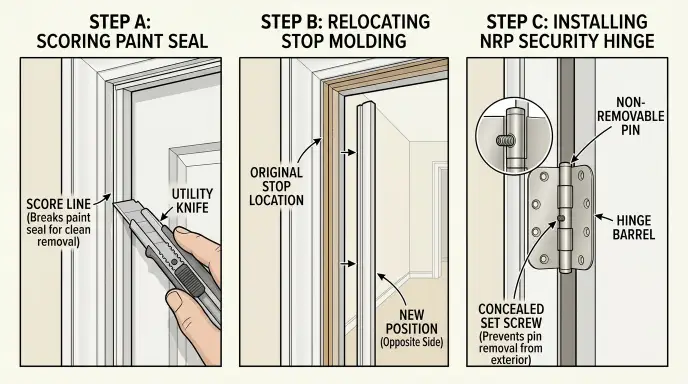
Homeowners can reverse an existing door swing without tearing out the drywall or door jamb:
- Dismantle the Slab: Extract the hinge pins using a nail set and hammer. Lift the door off the frame and set it securely aside.
- Remove Door Stop Molding: Carefully score the paint line along the interior stop molding with a utility knife. Use a flat pry bar to remove the trim strips without splitting the wood.
- Chisel Hinge Mortises: Mortise the opposite edge of the jamb to receive the hinge leaves for the new outward swing direction.
- Reinstall Stop Molding on Hallway Side: Close the door to its new flush position against the frame, then re-nail the stop molding on the hallway side of the jamb.
- Install Non-Removable Pin (NRP) Hinges: Because outswing hinges expose their pins to the hallway, install NRP hinges featuring set screws to prevent unauthorized removal of the door slab.
- Reverse Latch Mechanism: Rotate the handle latch bolt 180 degrees so the curved bevel faces the strike plate as the door closes outward.
Building Codes and ADA Compliance Considerations
- Residential Code (IRC): The International Residential Code does not prohibit outward-swinging interior doors. It is entirely compliant for residential installations.
- Clear Width Mandates: When modifying access points, aim to preserve a minimum 32-inch clear opening width measured between the face of the door and the opposite jamb stop when opened at 90 degrees.
- Wall Fixture Clearance: Confirm that the altered swing arc does not strike nearby hallway grab bars or light switches. Review optimal fixture spacing in our senior grab bar placement guide.
Common Mistakes That Leave Seniors Trapped
- Installing Keyed Deadbolts: Requiring a physical key to enter a bathroom creates lethal delays. Never install single-cylinder or double-cylinder keyed deadbolts on interior bathroom doors.
- Neglecting Corridor Clearance: Opening a 36-inch solid core door into a busy, dark hallway can inadvertently knock over a caregiver or block walker access.
- Failing to Rehearse the Bypass: An emergency lock is only effective if family members know how to engage the release. Practice the coin-turn mechanism twice a year alongside routine smoke detector checks.
Fixing door clearance and latch access is a vital cornerstone of our complete aging-in-place bathroom guide, ensuring that every safety modification works together seamlessly.
Frequently Asked Questions
Can you change a bathroom door to open outward without replacing the frame?
Yes. You do not need to replace the jamb. By removing the wood stop molding, mortising hinges on the outer edge, reversing the latch direction, and reinstalling the stop molding on the exterior side, an existing frame can be fully retrofitted.
What is the fastest way to open a locked bathroom door during an emergency?
Insert a coin, flathead screwdriver, or rigid key into the external slot located at the center of the privacy knob and rotate 90 degrees. This disengages the internal push-button instantly without damaging the hardware.
Are outswing bathroom doors safe from outside intruders?
Yes. For interior doors, outswing setups use Non-Removable Pin (NRP) hinges. These specialty hinges have an internal set-screw accessible only when the door is wide open, preventing anyone from tapping out the hinge pins from the hallway.


3 Comments