
5 Ways to Make a High-Step Bathtub Safe for Seniors (Without Remodeling)
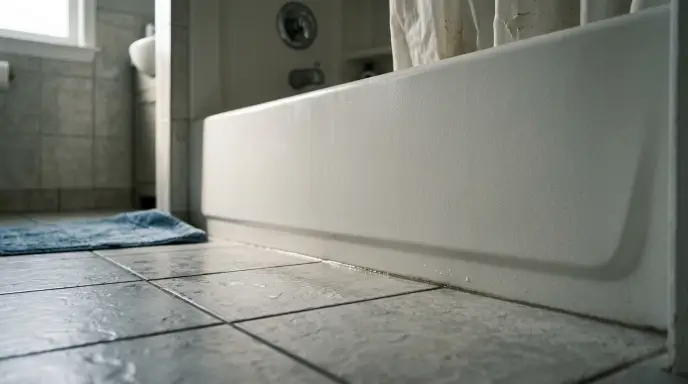
If you need to make a high-step bathtub safe for seniors, the challenge starts with the rim: standard tubs sit 15 to 19 inches off the bathroom floor. For a healthy adult, that’s not an issue. For an aging parent, spouse, or client with declining balance, it’s one of the most dangerous obstacles in the entire home.
Here’s why: stepping into a high-walled tub forces a person to shift their entire center of gravity onto one leg while the other leg swings up and over a slick, wet surface. That single moment—standing on one foot, on a wet floor, with nothing sturdy to hold onto—is where most bathroom falls happen among older adults.
The obvious “fix” that contractors will sell you is a full walk-in shower conversion or a low-threshold tub replacement. Those are legitimate long-term solutions, but they typically cost $4,000 to $12,000, take days of construction, and require permits. That’s simply not realistic for renters, for families managing a tight caregiving budget, or for anyone who needs a safe bathing solution this week, not next quarter.
The good news: you don’t need to remodel anything to dramatically reduce fall risk. By adding a transfer bench, clamp-on grab bars, a step-through cut-out kit, and slip-resistant surfaces, you can make an existing high-step tub significantly safer without touching the plumbing or the tile—an essential step in building a complete bathroom safety setup for seniors.
Editorial Note: This guide provides non-structural accessibility recommendations based on ADA guidelines and general occupational therapy principles. It is not a substitute for a personalized home safety assessment. Always evaluate an individual’s specific mobility limitations—ideally with input from a physical or occupational therapist—before installing any equipment.
Table of Contents
The Biomechanics of Bathtub Falls: 3 Critical Failure Points
Most articles on this topic jump straight to product recommendations. Before we do that, it’s worth understanding why high-step tubs are so risky in the first place—because that understanding directly informs which safety products actually solve the problem.
1. The Single-Leg Stance Hazard
To get into a standard tub, a person must balance entirely on one leg while lifting the other over a rim that can be 15+ inches high. On a wet, soapy surface, this single-leg stance is inherently unstable. Any minor loss of balance during that transition has no easy recovery point—there’s nothing to catch a fall except the hard edge of the tub or the floor.
2. The Unreliable “Towel Bar” Reflex
When people feel unsteady, instinct tells them to grab the nearest fixed object. For many seniors, that’s a towel bar mounted a few feet away. The problem: towel bars are designed to hold a wet towel, not 150+ pounds of body weight during a fall. They’re often anchored with hollow-wall fasteners that pull straight out of the drywall under real load—turning a minor stumble into a serious fall.
3. The Wet Rim Friction Deficit
Acrylic and fiberglass tub rims are manufactured to be smooth and easy to clean. Combine that smooth surface with soap residue, shampoo runoff, and water, and you get a friction coefficient that’s dangerously low exactly where a person needs the most grip—the moment their foot is planted on the rim mid-transfer.
Understanding these three failure points is the key to choosing the right combination of fixes below.
5 Non-Remodel Ways to Make a High-Step Tub Safe
Way 1: Slide-In Tub Transfer Bench (Best for Zero-Standing Transfers)

A transfer bench is the single most effective solution for anyone who struggles to lift a leg over the tub wall at all. If stepping over a high bathtub ledge becomes too hazardous even with transfer benches, switching to a walk-in unit is the safest long-term solution. Be sure to review proper walk-in shower grab bar placement before starting the install. When modifying tub entry without construction, deciding between a shower chair vs. transfer bench comparison helps determine whether you need a seated sliding transfer or standard in-tub seating.
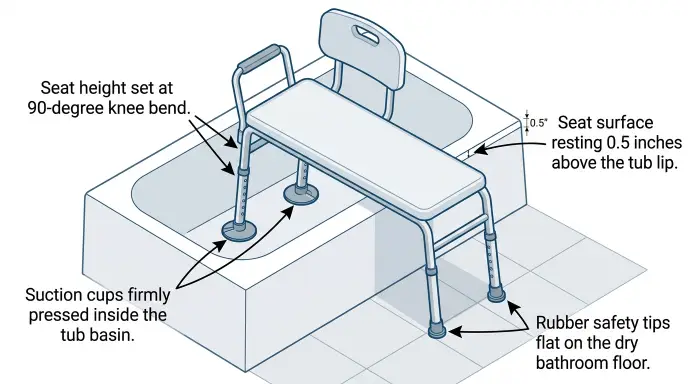
How it works: The bench straddles the tub wall—two legs sit inside the tub, two legs sit outside on the bathroom floor. The user sits down on the outside portion first, then slides sideways across the bench seat into the tub: no leg-lifting, no single-leg balance moment, and no standing transfer required at any point.
A step stool or tub cut lowers the hurdle, but pairing it with strategic grab bar positioning for bathtubs gives seniors an essential leverage point when stepping over high edges. Adding a freestanding seat eliminates the need to stand while washing, provided you take measures to prevent the chair from sliding on the sloped tub basin.
What to buy:
- A padded backrest for spinal support during the seated transfer
- Drainage holes in the seat so water doesn’t pool during bathing
- A reversible frame so the bench can be configured for either side of the tub, depending on bathroom layout
Safety protocol: One detail almost every buyer misses—your shower curtain needs to hang inside the bench’s frame, not outside it. Most quality transfer benches have a small slit or channel cut into the seat specifically so the curtain liner can be threaded through it. Skipping this step allows water to escape and saturate the tile; to prevent puddles entirely, make sure you know how to keep the bathroom floor dry after a shower.
Look for models with a weight capacity of at least 300 to 400 lbs and anodized aluminum legs to resist corrosion from repeated water exposure over time.
Way 2: Tub Cut-Out Conversion Kit (The Step-Through Alternative)
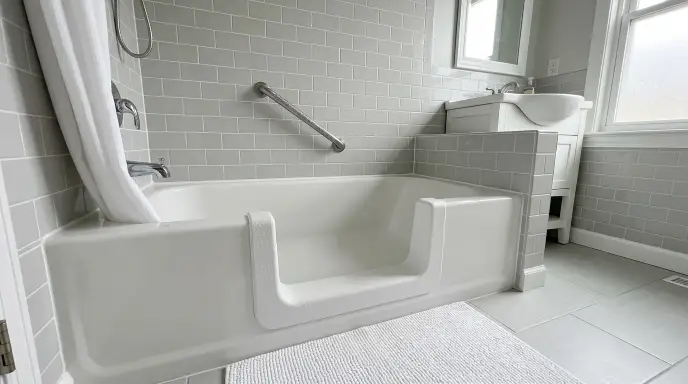
This is the biggest content gap in most “senior bathtub safety” articles—most sites don’t mention it at all, despite it being one of the most effective middle-ground solutions available. Instead of stepping over high edges, seniors can eliminate the fall barrier by learning how to safely enter the tub using a transfer bench.
How it works: A trained installer (or a confident DIYer) cuts a small, precisely measured section out of the front wall of an existing tub—typically lowering the entry point from 15–19 inches down to 3–7 inches. A pre-formed step-through insert is then bonded into the cut opening, creating a low-threshold “door” while the rest of the tub remains fully intact and watertight.
Cost versus full remodeling: A cut-out kit runs roughly $250 to $600 for materials, or a few hundred dollars more if you hire a handyman for the cutting and sealing work. Compare that to a $4,000+ full tub-to-shower conversion, and you’re looking at a fraction of the cost for a large portion of the safety benefit.
Important material limitation: Cut-out kits only work on acrylic, fiberglass, or steel tubs. They are not suitable for cast iron tubs without specialized professional industrial diamond saws—which defeat the entire low-cost purpose of this option. Before ordering a kit, confirm your tub’s material. If you’re unsure, a magnet test can help: a magnet will stick to enameled steel but not to cast iron or acrylic.
The rental limitation: This is a semi-permanent modification—you’re literally cutting into the tub. It’s an excellent option for homeowners planning to age in place, but it is not appropriate for renters, since it permanently alters a fixture you don’t own. Renters should focus on Ways 1, 3, and 4 instead.
Way 3: Heavy-Duty Clamp-On Tub Rails (Tool-Free Leverage)
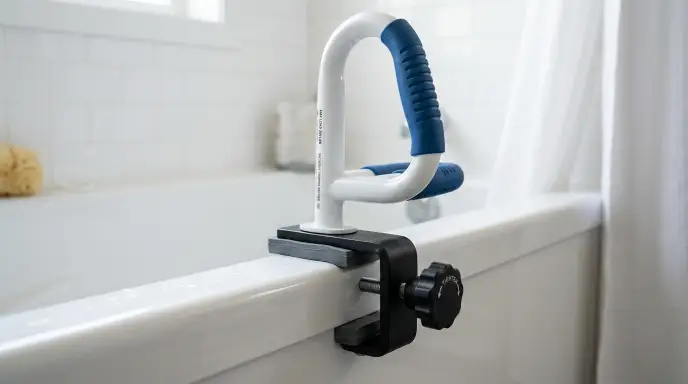
Suction cups vs. clamp-on: choose carefully. Suction-cup “grab bars” are widely sold online and in pharmacies, but they should be avoided for weight-bearing support. Suction seals can silently degrade with humidity, temperature swings, and mineral buildup on the tub surface—meaning the bar can release its grip at the exact moment someone leans on it. If you only take one warning from this article, make it this one. While looking for drill-free tub entry aids, be cautious with suction cups; learn why suction bars pose hidden fall risks compared to anchored bars.
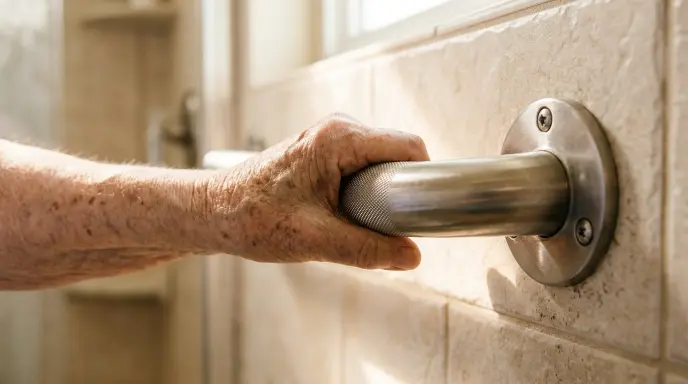
How proper mounting works: A genuine clamp-on tub rail attaches by clamping directly onto the tub wall (both the inside and outside lip), tightened down with a screw mechanism until it’s locked in place. Quality models use non-marring rubber pads at the contact points so they don’t scratch acrylic or fiberglass finishes, but the actual holding force comes from mechanical clamping pressure—not adhesion.
Weight rating matters: Look for bars rated to hold a minimum of 300 pounds. This isn’t about the user’s body weight alone—it accounts for the sudden dynamic force generated during an actual stumble, which is significantly higher than static body weight.
Way 4: Permanent Textured Treads (Eliminating In-Tub Slip Hazards)
Inside the tub: Traditional rubber bath mats are a mixed bag—they help with grip but can trap moisture underneath, leading to mold growth, and their own suction cups can fail over time just like grab bars. Two better alternatives:
- Etched chemical treatments that permanently texture the tub floor at a microscopic level (professionally applied, long-lasting, no removable parts to fail)
- Peel-and-stick textured tread strips, which are cheaper, DIY-friendly, and easy to replace when worn
Outside the tub: The moment right after stepping out—wet feet hitting a bathroom floor—is another major slip point that gets overlooked. To prevent a wet foot from slipping immediately upon exit, skip thick, plush rugs that bunch up or slide underfoot. Addressing this transition zone is critical to managing a slippery bathroom floor for elderly safety. Instead, use an ultra-low-profile, rubber-backed transition mat that stays perfectly flat against the tile. For full details, see our guide on Safe Bathroom Rug Alternatives.
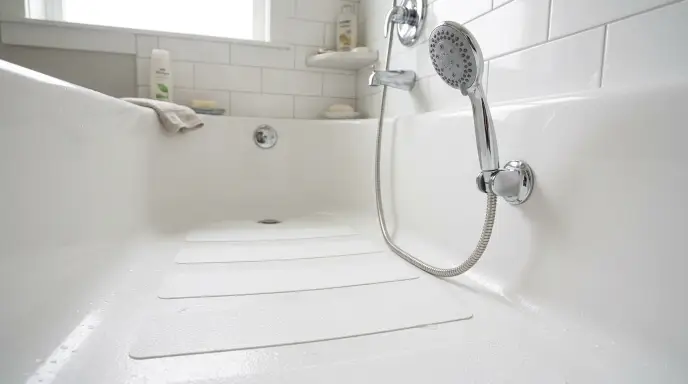
Way 5: Dual-Mount Handheld Showerhead Extension (True Seated Bathing)
Why this matters: Even with a transfer bench and grab bars installed, standing up to reach a fixed, wall-mounted showerhead reintroduces the exact balance risk you’ve been working to eliminate. A handheld showerhead lets a person bathe entirely from a seated position with full control over water direction.
Feature checklist to look for:
- A 6–8 foot long, no-kink metal hose (cheap rubber hoses crack and kink within months)
- A pause/slider shut-off button on the handle, so the user can stop water flow mid-task without fumbling for the main valve
- A low-mounted bracket using either a screw-on plumbing connection or a heavy-duty adhesive mount, positioned within easy seated reach
If tub cut-outs and step modifications aren’t enough for long-term safety, consider full bathroom conversions such as zero-threshold curbless shower options for complete roll-in accessibility.
Tub Safety Solutions Compared: Cost vs. Installation Effort
| Solution | Est. Cost | Installation Type | Best For | Mobility Level Needed |
|---|---|---|---|---|
| Transfer Bench | $50 – $120 | No tools (instant) | Severe balance issues | Low |
| Tub Cut-Out Kit | $250 – $600 | Minor DIY / handyman | High-rim tubs (homeowners) | Moderate |
| Clamp-On Rail | $30 – $70 | Clamp lock (5 minutes) | Extra pull support | Moderate to High |
| Non-Slip Treads | $15 – $35 | Peel & stick | In-tub footing | All levels |
| Handheld Wand | $25 – $60 | Screw-on plumbing | Seated bathing | All levels |
Dangerous “Fixes” to Avoid at All Costs
Not every home remedy is a safe one. Before you improvise a solution, know which shortcuts create more risk than they solve.
Suction-Cup Grab Bars: As mentioned above, humidity and temperature changes can cause suction seals to release without warning—often at the exact moment someone puts their full weight on the bar.
Stepping Stools Inside or Outside the Tub: A small plastic step stool seems like an easy fix for a high rim, but these stools have a narrow base and no stability on a wet floor. They tip easily, and unlike a properly mounted product, there’s nothing to grab if it starts to slide.
Improvised Shower Chairs: A plastic patio chair or a kitchen dining chair might seem like a reasonable stand-in for a shower seat, but these are not designed for wet environments. They lack rubberized, non-slip feet and can slide across a wet tub floor under body weight, especially when a person sits down or stands up.
Decision Framework: How to Pick the Right Setup for Your Home
Renter vs. homeowner: If you’re in a rental property, stick to Way 1 (transfer bench) and Way 3 (clamp-on rail)—both are fully removable and leave no permanent marks. If you own the home and are planning for long-term aging in place, the tub cut-out kit (Way 2) offers a durable, semi-permanent entry solution. Pairing a low-step tub with the safest bathroom flooring for seniors ensures high traction across the entire room, not just at the tub edge.
Assess mobility honestly: Can the person walk independently but just needs extra balance support? A clamp-on rail plus non-slip treads may be enough. Do they need help with most transfers, or use a walker/cane regularly? Start with a transfer bench—it removes the standing transfer altogether.
If your budget allows for a long-term home modification and you’re ready to consider more permanent changes, check out our Complete Aging in Place Bathroom Guide for a full breakdown of remodeling options. While tub cuts and transfer steps reduce threshold heights temporarily, they do not solve all mobility concerns. If you are ready for a permanent solution, evaluating a full walk-in tub vs. walk-in shower remodel is the safest long-term investment for aging in place.
Frequently Asked Questions About Non-Remodel Tub Safety
Will a clamp-on grab bar damage my acrylic or fiberglass tub?
When properly fitted with non-marring rubber pads and correctly sized to the tub wall thickness, clamp-on bars generally don’t damage the surface. Avoid over-tightening beyond the manufacturer’s recommended torque, and check the tub wall for hairline stress cracks periodically.
Does Medicare cover bathtub transfer benches or tub cut-outs?
Generally, Original Medicare classifies these as “convenience items” and does not cover them under standard Durable Medical Equipment (DME) benefits. However, some Medicare Advantage plans include supplemental allowances for home safety equipment—check with your specific plan provider directly.
What is the minimum tub wall width required for a clamp-on rail?
Most clamp-on rails are designed to fit tub walls between roughly 2 and 4 inches thick. Measure your tub’s wall thickness at the mounting point before purchasing, since undersized clamps won’t achieve a secure grip.
How do you prevent water from spilling with a transfer bench?
Route your shower curtain liner through the designated slit or channel in the bench seat (most quality benches include one). This keeps the curtain positioned correctly so water drains back into the tub rather than pooling on the bathroom floor.
Final Safety Checklist
You don’t need a construction crew or a five-figure budget to make a dangerous bathtub dramatically safer. For under $200, a transfer bench, a properly rated clamp-on rail, and textured grip treads can address the three biggest fall risks—the single-leg stance, the unreliable towel-bar grab, and the slick, wet rim—starting today. While temporary steps and benches work for minor mobility limitations, progressive conditions may require permanent changes. Compare budget fixes vs. full renovation costs to plan your next step. If a full remodel is too expensive and that is why you are looking for non-invasive solutions, check out our breakdown of government grants and Medicare bathroom assistance to see if you qualify for funded modifications. For additional peace of mind without a full plumbing overhaul, adding screw-on shower adapters or anti-scald valves for older adults prevents rapid water temperature spikes. If your situation allows for it down the road, a tub cut-out kit or full remodel can take safety even further. But the first, most important step is simply removing the highest-risk moments from your daily routine—and that’s something you can start doing this afternoon.


9 Comments