
Senior Bathroom Safety: The Complete Fall-Prevention Checklist
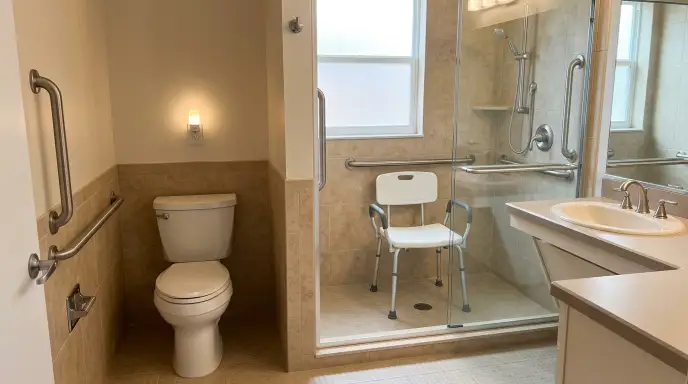
Quick answer: A genuinely safe senior bathroom comes down to six fixable things: grab bars mounted 33 to 36 inches high and anchored into studs, a shower or tub floor with real slip resistance, a comfort-height toilet (17 to 19 inches), a shower seat with a weight rating you can trust, motion-sensor night lighting at floor level, and a door that won’t trap someone if they fall against it. None of this requires a full remodel. Most of it can be done in a weekend for a few hundred dollars, and it addresses the specific mechanics of how older adults actually get hurt in this room, not just the vague idea that bathrooms are “dangerous.”
For the full picture — including remodeling costs, financing options, and dementia-specific design — see our complete aging-in-place bathroom guide.
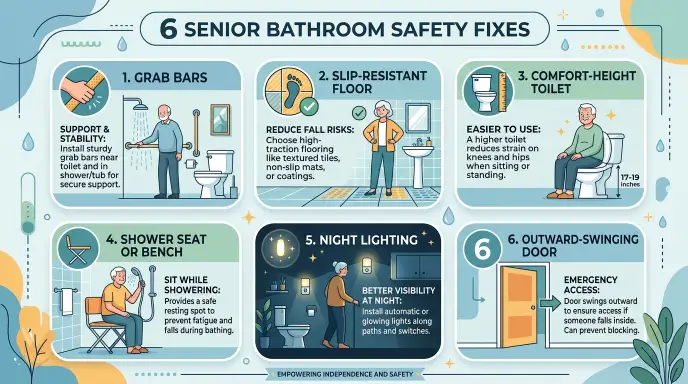
Table of Contents
Hidden Danger Nobody Talks About
Wet tile, steam, and a thin film of soap residue turn a floor that feels perfectly normal when dry into something closer to an ice rink. That’s the physical reality of a bathroom. But the bigger issue is behavioral, not architectural. If you can’t replace the tile, our guide to slippery bathroom floor fixes without retiling covers six options, from chemical etching to deep cleaning. Bathing safety doesn’t end when the faucet turns off. Discover the safest tools and techniques for seniors to dry off after a shower without slipping.
Most older adults will not tell you their bathroom scares them. Admitting that means admitting a loss of independence, and that’s a hard thing to say out loud to your own kids. So instead of asking for help, people quietly build workarounds: pressing a hand flat against the tile wall while walking to the toilet, using a towel bar as a handhold when standing up from the tub, shuffling instead of stepping over the shower threshold. None of these habits show up in conversation. They only show up after a fall.
This guide skips the guilt trip and the sales pitch for a $20,000 walk-in tub. It focuses on exact measurements, tested weight ratings, and fixes that a family can actually install, so a bathroom that currently depends on lucky footing can depend on hardware instead.
A quick note on scope: this guide is built around ADA (Americans with Disabilities Act) accessibility standards and general home-modification safety guidance, the most widely used reference point in the U.S. for grab bar height, clearance, and load requirements.<sup>1,4</sup> If a specific mobility condition, joint replacement, or progressive balance disorder is involved, loop in an occupational therapist (OT) or a Certified Aging-in-Place Specialist (CAPS) before making changes. They can tailor placement to that person’s actual reach and gait, which a general checklist can’t do.
Why This Guide Exists: A 2 A.M. Wake-Up Call
The first time I heard it, I thought someone had dropped a heavy box. A dull thud, then a long pause, then a sound I still can’t forget — a soft, rhythmic tapping. It was coming from the flat next to mine, through the wall we shared.
It was 2 a.m. I knocked. No answer. I called her phone. No answer. Finally, I heard her voice through the door — small, embarrassed, almost apologetic: “I’m on the floor. I can’t get up. Can you call someone?”
She was 79. She had slipped stepping out of her shower — one wet foot on glossy porcelain tile, the other still inside the tub. No grab bar. No mat. A towel bar on the wall behind her had pulled clean out of the drywall when she instinctively grabbed it on the way down.
She had lived in that flat for twenty-two years. She knew that bathroom better than any room in her home. And still, on an ordinary Tuesday night, wet tile and a towel bar almost took her independence permanently.
5-Minute Bathroom Hazard Audit
Before buying anything, walk the bathroom the way an OT would on a home visit. This takes less time than reading about it. Because the bathroom accounts for the highest percentage of household falls, download our dedicated senior bathroom safety checklist (with a free PDF) to inspect your tub, toilet, and pathways.
Towel Bar Instinct
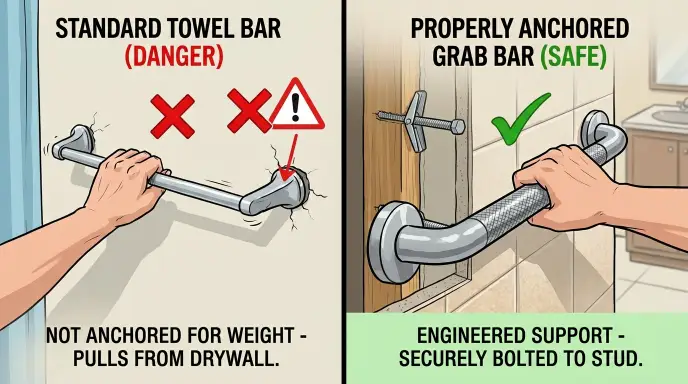
Watch where a hand goes first when someone loses their balance for even a split second. It’s almost always the nearest fixed object: a towel bar, a soap dish, the edge of a vanity. The problem is that a standard towel bar is designed to hold a towel, not a person.
- Most residential towel bars are only rated for light decorative loads, well under the weight of an adult body.
- If it’s the only thing within reach during a stumble, it will fail at exactly the wrong moment
- Walk the room and note every surface someone might instinctively grab, then check whether it’s actually built to bear weight
Thresholds and Tripwires

Two things trip more people than almost anything else in a bathroom, and neither looks dangerous at a glance:
- A raised door threshold — the small ridge under most bathroom doors
- A loose bath mat sitting on a wet floor
Both are classic tripping hazards, especially for anyone whose gait has become shuffling rather than a full foot lift, which is common with age-related changes in balance and stride length.<sup>4</sup>
Pathway and Clearance Check
If a cane, walker, or rollator is part of daily life, trace the actual path from the door to the toilet and to the shower. Common obstacles that narrow that path include:
- Laundry baskets
- Bathroom scales
- Step stools
Any of these can force an awkward pivot just to get around them, and an awkward pivot is exactly the kind of movement that leads to a fall.
Measurements That Actually Matter (ADA Benchmarks)
Generic advice like “install grab bars” doesn’t help much without knowing where and how. These are the specific numbers used in accessible design, and there’s real engineering logic behind each one.
Grab Bar Height: 33 to 36 Inch Rule
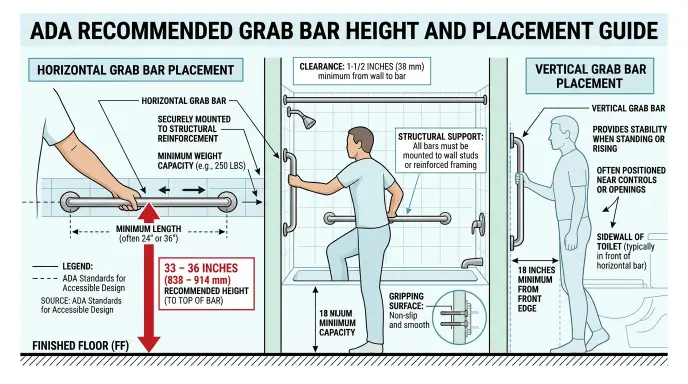
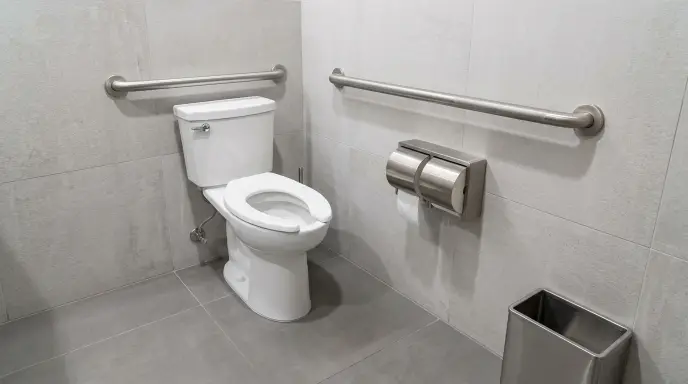
ADA guidance places grab bars 33 to 36 inches above the finished floor, measured to the top of the bar.<sup>1</sup> That range isn’t arbitrary. It roughly matches waist-to-hip height for most adults, which is the angle at which the wrist and forearm can lock and transfer real force without straining the shoulder. A bar mounted too low forces a bent-over grab that adds twisting force to the fall instead of stopping it; too high, and a person reaching for it while already off balance may miss it entirely.
Diameter matters just as much as height. ADA specifies a gripping diameter of 1.25 to 1.5 inches with at least 1.5 inches of clearance between the bar and the wall.<sup>1</sup> That clearance is deliberate: it’s wide enough for a full hand wrap, but tight enough that a wrist can’t slip through and get trapped if the person’s grip fails mid-fall.
Horizontal vs. vertical placement matters just as much as height:
- Horizontal bar (33–36 inches high): mount along the side wall of the shower or next to the toilet. This is the bar that takes weight when pushing up to stand or steadying mid-movement.
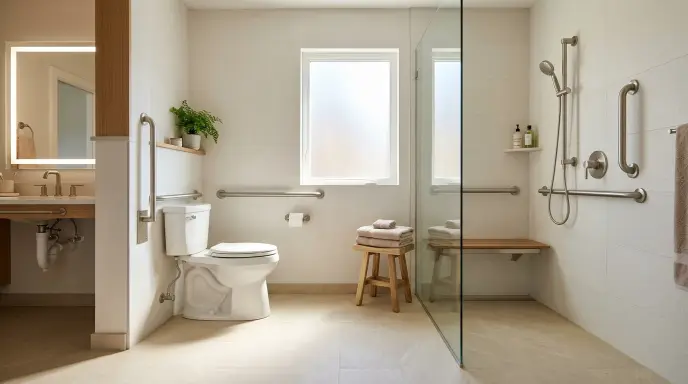
- Vertical bar (18–24 inches long): mount near the shower or tub entrance, roughly at shoulder-to-hip height. A vertical bar gives the natural, upright grip someone needs while stepping over the threshold, which a horizontal bar can’t provide at that exact moment.
Most bathrooms need both, not one or the other. A horizontal-only setup covers standing and sitting transitions but leaves the threshold step unsupported.
Toilet “Comfort Height” (17 to 19 Inches)
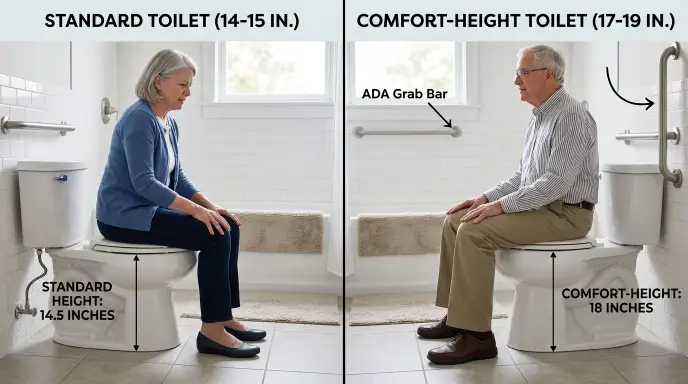
A standard residential toilet sits around 14 to 15 inches from floor to seat. That height was never designed with aging knees and hips in mind, and the deeper squat it requires puts real strain on joints every single time someone sits down or stands up. “Comfort height” toilets, or ADA-height toilets, raise that to 17 to 19 inches, which is closer to standard chair height and dramatically reduces the load on the knees during the transition. If replacing the toilet isn’t in the budget, a raised toilet seat with armrests gets most households to a similar effective height. Standard residential toilets sit too low for individuals with severe knee osteoarthritis or balance instability. Depending on whether your loved one struggles with joint bending or standing balance, compare toilet safety rails and raised toilet seats to see which equipment provides the safest transfer support. Reaching and twisting behind while seated on the toilet is one of the most common triggers for bathroom loss of balance. Pairing your safety rails with one of the best bidet attachments for seniors minimizes painful body rotation and makes personal hygiene far safer.
Doorway Width (Minimum 32 Inches)
ADA accessible routes require a minimum clear opening of 32 inches, with 36 inches considered the more comfortable standard for anyone using a walker or wheelchair.<sup>1</sup> Most older homes have bathroom doors closer to 24 to 28 inches wide. Swapping standard hinges for swing-clear hinges (sometimes called offset hinges) is a cheap fix that can recover roughly 2 extra inches of clearance without touching the framing, since the door swings fully clear of the opening instead of eating into it. Beyond non-slip floors and grab rails, entry access is critical: consider upgrading to emergency bathroom door hardware so a fallen individual never blocks the door from opening.
Non-Slip Flooring and Surface Friction
Understanding Skid Resistance (DCOF ≥ 0.42)
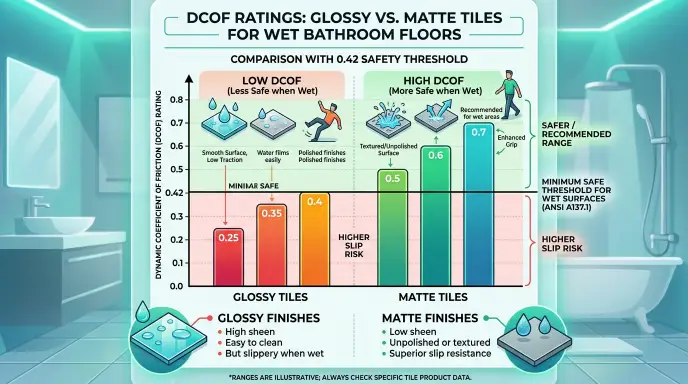
Tile manufacturers rate slip resistance using something called DCOF, or Dynamic Coefficient of Friction, measured under wet conditions.
- The tile industry standard, set by the American National Standards Institute, recommends a wet DCOF of 0.42 or higher for floors that will regularly get wet, which is essentially the entire bathroom floor.
- Most glossy, polished porcelain tile falls well below that number and turns dangerously slick the moment it’s wet, even though it looks perfectly clean and safe.
- Matte or textured tile finishes generally test much higher.
Upgrade to High-Traction Flooring. Eliminate glossy tiles and tripping thresholds by reviewing the safest bathroom flooring materials for seniors, focusing on wet DCOF ratings of 0.42 or higher.
Throw Rugs vs. Rubber-Backed Mats
Any loose cotton bath mat or decorative rug on a bathroom floor should go. They bunch up, slide on tile, and become a tripping hazard the instant a foot lands on the edge instead of the center. Never use regular decorative towels or throw rugs on the floor. Instead, invest in dedicated non-slip bathroom rugs for elderly safety that stay firmly anchored even when wet.
- Replace them with a heavy rubber-backed mat that stays flat and gripped to the floor
- Keep one clearly defined “dry zone” just outside the tub or shower where a person can step and towel off before walking further into the room
Even a heavy rubber-backed mat only helps if the floor underneath it actually gets dry. For the daily habits that make mats work — squeegee timing, fan run-time, and threshold towel passes — see our bathroom floor drying tips for seniors. Many seniors lean on the basin for balance while washing their hands or brushing their teeth, which can cause wall-mounted fixtures to collapse. Follow our practical sink and vanity safety tips for seniors to eliminate these daily hazards.
Anti-Slip Floor Treatments
For households that can’t replace tile, anti-slip treatments exist that chemically etch a microscopic texture into the surface of the existing tile without changing its appearance. These are applied by a professional in a few hours and meaningfully raise the DCOF of an existing floor, which is a far cheaper fix than a full flooring replacement.
Shower and Bathtub Access: The Most Dangerous Transition Zone
Solving the Tub Threshold Problem
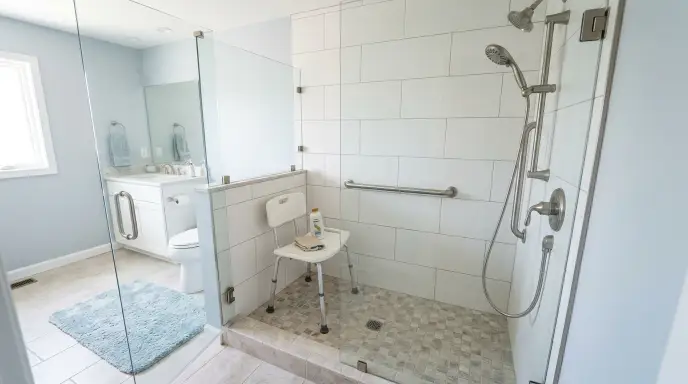
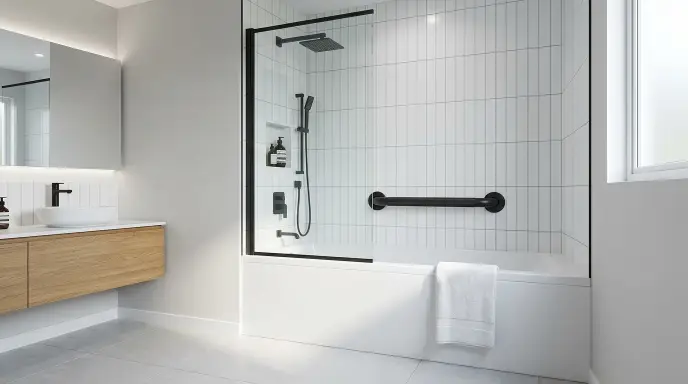
A standard bathtub wall is 15 to 18 inches tall, and stepping over it means balancing on one leg while the other clears the edge — arguably the single riskiest movement that happens in a typical bathroom. Two common fixes exist: a tub-cut conversion, where a licensed contractor cuts a low, sealed entry point into the existing tub wall, and a full low-curb shower conversion, which removes the step entirely. When choosing enclosure barriers, understanding the safety trade-offs of glass shower doors vs. curtains for seniors is essential to prevent both shattering trauma and tripping hazards. Both cost real money, but both eliminate the single-leg balancing act that causes so many falls. Proper pitch is everything in an accessible, barrier-free bathroom. Shower pans require a precise ¼-inch-per-foot gradient toward the drain to function safely. If an existing shower was improperly leveled during installation, follow our guide on how to fix bathroom floor drainage problems using slope-adjustable mortar rather than flat leveling compounds. Stepping over a high tub rim is one of the most common causes of balance loss during transfers. Before planning a demolition, explore practical ways to adapt an existing high-step tub for seniors with clamp-on rails and zero-standing transfer options. Preventing tap burns requires mechanical protection; learn how to install an anti-scald shower valve to keep water delivery strictly capped at safe temperatures. Eliminating standing tub transfers is a key milestone; make sure caregivers and seniors understand the proper technique for using a tub transfer bench.
Ergonomic Shower Seating
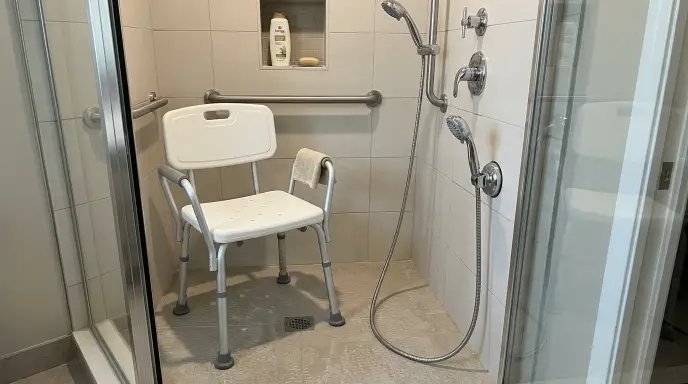
A shower bench or stool needs to check four boxes:
- Drainage holes so water doesn’t pool on the seat
- Rubber non-slip feet so it doesn’t slide on a wet floor
- A backrest for anyone who tires quickly or has limited core strength
- A clearly stated weight rating from the manufacturer, not a guess
A long-hose handheld shower head pairs naturally with a shower seat and also helps anyone who gets lightheaded from standing under a stream of hot water for an extended period, since they can sit and direct the spray themselves rather than standing and turning. To eliminate threshold-balancing hazards, choosing the safest bathtub seating equipment ensures seniors can bathe with full stability rather than stepping over high ledges. A loose or wobbly seat inside a wet stall can create a false sense of security. Follow practical guidelines to prevent shower chair slipping by leveling the legs against basin slopes and checking suction grip weekly. Pair your seating with the best handheld shower head setup for seated seniors so you never have to reach overhead. Stepping over high tub ledges accounts for a significant percentage of bathroom slips. Replacing standard fixtures with safe bathing alternatives like walk-in tubs and showers drastically minimizes transfer hazards for older adults.
Grab Bar Anchorage: The Part People Get Wrong
250-Pound Standard
Grab bars sold for bathroom safety are generally built to meet the ASTM F446 consumer safety specification, which requires the bar and its mounting hardware to withstand a minimum static load of 250 pounds applied in any direction without permanent deformation.<sup>2</sup> That’s not a “gentle lean” spec. It’s built around the reality that if someone actually starts to fall, they will grab hard and put their full body weight into that bar in an instant. A bar that isn’t rated and anchored to that standard can look secure for years of light use and still fail the one time it’s really needed. Preventing shower slips requires more than just grab bars; everyday grooming tools matter. Learn how seniors can wash their feet and back safely without bending to prevent sudden loss of balance.
Wall Studs vs. Hollow-Wall Anchors
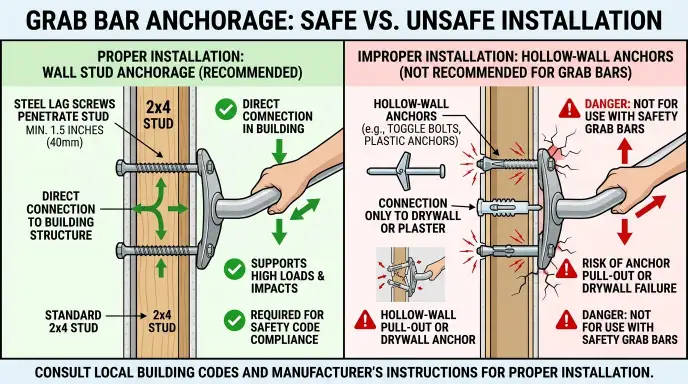
The bar itself is rarely the weak point. The wall behind it usually is. Grab bars need to be anchored into wood studs, or into solid blocking installed specifically for that purpose, using long, load-rated screws. If studs genuinely can’t be located in the right spot, specialized hollow-wall anchors built for grab bar loads (not standard drywall anchors from a hardware store bargain bin) can work, but they should be rated for the same 250-pound standard.<sup>2</sup> A stud finder and 20 extra minutes of planning before drilling is the cheapest insurance in this entire guide.
Real Danger of Suction-Cup Grab Bars
Suction-cup grab bars are marketed heavily for travel and temporary use, and that’s really the only context where they belong. They rely on an airtight seal against a smooth, flat surface, and bathroom tile grout lines, texture, and constant moisture cycling all work against that seal over time. A suction bar can hold firm for weeks and then release without warning the moment real weight is applied, which is precisely the scenario a permanent safety fixture is supposed to prevent, not cause. Slip-proofing the shower enclosure requires more than just non-slip mats; secure wall supports are mandatory. Follow our complete guide to walk-in shower grab bar placement to set up proper heights at entryways and seating areas. Never rely on temporary fixtures that can easily release; read our analysis on whether suction grab bars are safe for seniors before adding them to your shower.
Post-Installation “Tug Test”
After any grab bar goes in, don’t use it casually right away. Stand facing it, grip it the way you would during a real fall, and pull down and outward with your full body weight before anyone relies on it. This single step catches loose anchors, missed studs, and stripped screws before they become a real emergency instead of after.
Toilet Area Clearance and Standing Support
Wall-Mounted Bars vs. Free-Standing Rails
A wall-mounted grab bar is the sturdier, more permanent option and works well when there’s solid wall space on at least one side of the toilet. A free-standing toilet safety rail, which frames the toilet on both sides and bolts to the floor or the toilet base itself, is the better fit in a small bathroom where both walls are out of reach, since it gives two-handed, symmetrical support for pushing up to standing. Installing wall-mounted support is one of the quickest ways to prevent falls, but you need to ensure proper grab bar placement for seniors around the toilet and shower stall. Toilet-related injuries frequently occur not just when sitting down, but when twisting or leaning awkwardly to clean up. Review our dedicated walkthrough on how to wipe safely with arthritis and limited mobility to prevent off-balance slips.
Reach Ergonomics
Toilet paper holders and flush handles are often installed based on what looks tidy rather than what’s reachable without twisting. A twisting reach from a seated position, especially right after standing up, is a common and avoidable trigger for a loss of balance. Keep everything within a short, straight reach of where the person is actually seated.
Lighting, Door Clearance, and Emergency Protocols
Circadian-Friendly Night Lighting
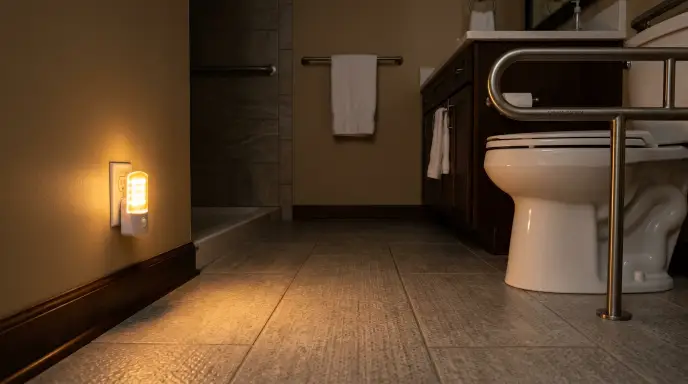
A bright overhead light flipped on in the middle of the night causes a few seconds of real, functional blindness while the eyes adjust — exactly when a half-asleep trip to the bathroom needs the most stability, not the least.
- Fix: floor-level, motion-activated night lights in a warm amber tone
- Why it works: they light the path without the harsh adjustment period a white ceiling light causes
Most dangerous slips occur between midnight and 6 AM when waking in darkness; installing targeted night light placements to prevent midnight falls ensures safe footing without turning on blinding overhead fixtures.
Outward-Swinging Door Problem
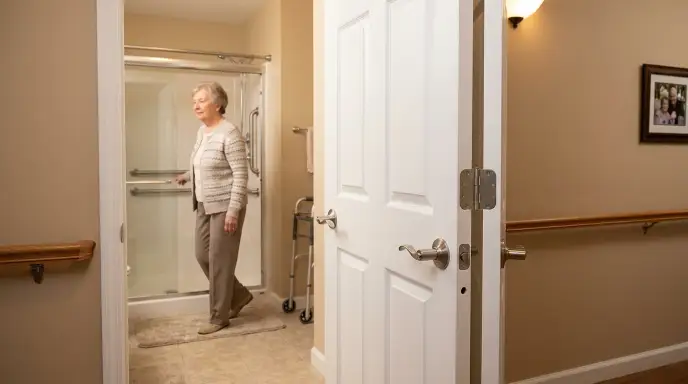
Most interior doors swing inward, into the bathroom. That’s a serious problem if someone falls near the door, because their body can physically block it from being pushed open from outside, delaying help by precious minutes.
- Fix option 1: reverse the door to swing outward
- Fix option 2: install a specialized hinge that lets the door lift off its track in an emergency
Either option solves the problem without needing to reframe the doorway.
Emergency Pull Cords and Alert Buttons
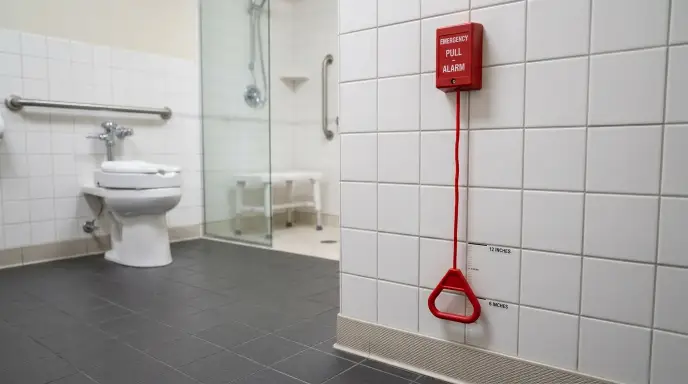
A waterproof emergency call button or pull cord mounted low, roughly 6 to 12 inches off the floor, matters because most falls end with the person on the ground, not standing at a normal reach height. A device mounted at standing height is useless to someone who’s already down. Preventing a long lie after a slip requires strategically placed hardware. Refer to our emergency alert button mounting dimensions to ensure cords and panic buttons are accessible if someone cannot stand.
Printable Checklist: Senior Bathroom Safety Audit
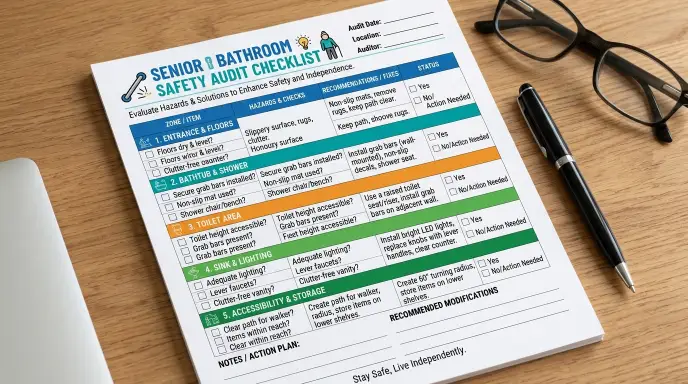
Use the table below as the basis for a one-page printable checklist.
| Bathroom Zone | Common Hazard | Immediate Fix | Standard to Follow | Priority |
|---|---|---|---|---|
| Walkway | Loose throw rugs | Remove immediately; replace with a rubber-backed runner | Flat, non-skid surface | High |
| Shower wall | Slippery tile, no support | Install a stud-anchored grab bar | 33–36″ height, 250-lb rating | High |
| Shower floor | Standing fatigue, slick floor | Add a rated shower chair plus handheld sprayer | Rubber feet, drainage holes | High |
| Toilet area | Low 14–15″ seat | Add a raised toilet seat with armrests | 17–19″ comfort height | High |
| Lighting | Dark corners at night | Install plug-in motion-sensor floor lights | Continuous, glare-free path | Medium |
| Doorway | Inward-swing trap | Install reversible or swing-clear hinges | Minimum 32″ clear width | Medium |
Swap painful, stiff twist knobs for easy-turn lever or touchless faucets to prevent seniors from losing their balance while straining to shut off the water. If you are debating whether to install standalone hardware or hire a contractor, check out our guide on senior bath remodel cost: DIY vs. full renovation to see real price comparisons.
Frequently Asked Questions
Can suction-cup grab bars be trusted for seniors?
No, suction-cup grab bars should not be relied on for daily safety. They’re fine for short-term travel use, but they aren’t a substitute for a permanently anchored bar. Moisture and grout texture can cause the seal to fail without warning, right at the moment someone’s full weight lands on it.
What’s the single most common cause of bathroom falls in seniors?
Stepping over the tub or shower threshold is the single riskiest movement in most bathrooms, since it forces a person to briefly balance their full weight on one leg on a wet surface. Research using national emergency department data found that among older adults’ at-home falls, the bathroom accounts for roughly 22.7% of cases, close behind the bedroom (about 25%) and stairs (about 22.9%).<sup>3</sup> That’s a more accurate picture than the often-repeated claim that 80% of home falls happen in the bathroom — treat that 80% figure as unsupported until you can trace it to a primary source.
How much does it cost to make a bathroom safer without a full remodel?
[Editorial note: the original draft gave a $150–$300 range for a mat, motion lights, a raised toilet seat, and two grab bars. I don’t have a verified current-pricing source for that figure, so it should be checked against actual retail prices before publishing rather than stated as a confirmed number.] As a rough, unverified estimate, a mat, plug-in motion lights, a raised toilet seat, and two stud-mounted grab bars are generally inexpensive relative to a remodel — confirm current pricing before quoting a specific dollar range.
Start With One Zone Today
Trying to overhaul an entire bathroom in one weekend, especially when it involves convincing an independent parent that changes are needed, usually backfires. Start with the shower and the flooring first, since that’s where the highest-risk transitions happen, and let the rest follow once those changes feel normal rather than like a sudden loss of independence. Bathroom fall prevention does not end when the water turns off. Many accidents occur when seniors try to balance on one foot to change. Follow occupational therapy protocols for dressing safely after a shower without falling using seated techniques and assistive aids. While installing safety equipment is essential, many families worry about the price tag. Find out does Medicare pay for senior bathroom modifications or if alternative financial assistance programs are available.
References
- U.S. Access Board. ADA Standards for Accessible Design. Washington, DC: U.S. Department of Justice; 2010. Accessed September 16, 2026. https://www.ada.gov/law-and-regs/design-standards/2010-stds/
- ASTM International. ASTM F446-19: Standard Consumer Safety Specification for Grab Bars and Accessories Installed in the Bathing Area. West Conshohocken, PA: ASTM International; 2019. doi:10.1520/F0446-19
- Moreland BL, Kakara R, Haddad YK, Shakya I, Bergen G. A descriptive analysis of location of older adult falls that resulted in emergency department visits in the United States, 2015. Am J Lifestyle Med. 2021;15(6):590-597. doi:10.1177/1559827620927070
- Colón-Emeric CS, McDermott CL, Lee DS, Berry SD. Risk assessment and prevention of falls in older community-dwelling adults: a review. JAMA. 2024;331(16):1397-1406. doi:10.1001/jama.2024.1416



16 Comments