

Bathroom Lighting for Aging Eyes: Best Night Light Placements to Prevent Midnight Falls
It is 2:47 AM. Your aging parent wakes up, shuffles toward the bathroom, and flips the overhead switch. A blinding flash of white light floods the room—and for several terrifying seconds, they cannot see a thing.
That momentary blindness is precisely when devastating falls happen.
For adults over 60, pupils take up to 30 seconds longer to adjust to brightness changes, while age-related corneal yellowing dims contrast sensitivity. Flipping on an overhead ceiling bulb does not solve darkness; it creates blinding glare across slick tile floors.
Preventing falls does not require brighter lights—it requires smarter placement. Here is how strategically positioned, low-glare night lights guide aging eyes safely without interrupting sleep.
Clinical & Design Standard Reference:
These recommendations align with environmental design standards established by the Illuminating Engineering Society (IES RP-28: Lighting and the Visual Environment for Senior Living) and certified occupational therapy fall-prevention frameworks.
Quick Answer: The 3 Non-Negotiable Placements
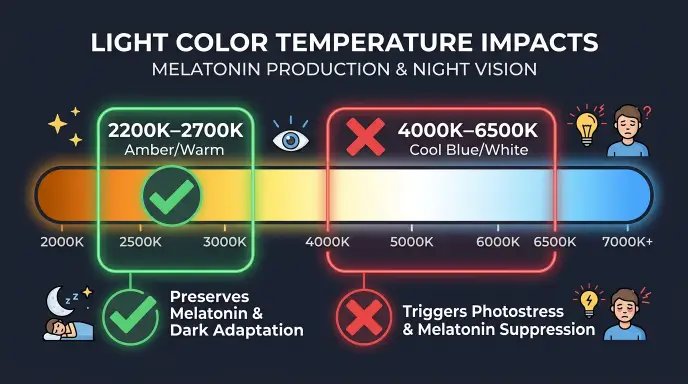
To eliminate midnight fall traps, place low-intensity (15–50 lumens), warm amber (2200K–2700K) motion-sensing lights at:
- Baseboard / Floor Level (4–6 inches up): Casts grazing light along walking paths without eye-level glare.
- Beneath the Vanity: Clears floor shadows around the sink basin.
- The Toilet Base: Marks the final target so overhead lights stay off entirely.
Always avoid blue or cool-white lights—they spike pupil constriction, destroy night vision, and suppress melatonin.
Table of Contents
Why Aging Eyes Fail Under Standard Overhead Lights
Understanding bathroom falls starts with ocular biology rather than simple clumsiness:
- Sluggish Pupil Adaptation: A 20-year-old’s pupil dilates or constricts within 5 seconds. By age 70, that same adjustment can take 25 to 30 seconds.
- The “Flashbang Effect”: Waking from a pitch-black room into an 800+ lumen overhead bulb causes photostress—flooding the retina and temporarily whiting out vision while feet are actively moving.
- Fading Contrast Sensitivity: Nuclear sclerosis (the natural yellowing of the eye lens) filters out light wavelengths, making a wet puddle look identical to a dry tile.
- Specular Glare: Direct overhead beams bounce off polished porcelain and ceramic, generating mirror-like reflections that trick the brain about actual surface depths.
Direct overhead beams bounce off polished porcelain and ceramic, generating mirror-like reflections that trick the brain about actual surface depths—an issue best eliminated by installing the safest bathroom flooring for seniors with matte, slip-resistant finishes.
5 Best Night Light Placements to Prevent Falls
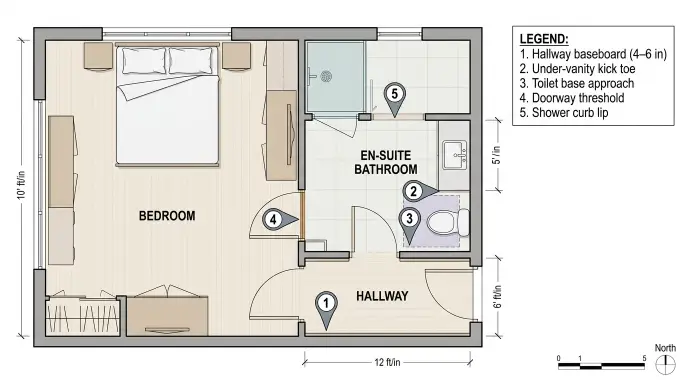
1. Baseboard Level (4–6 Inches Above the Floor)
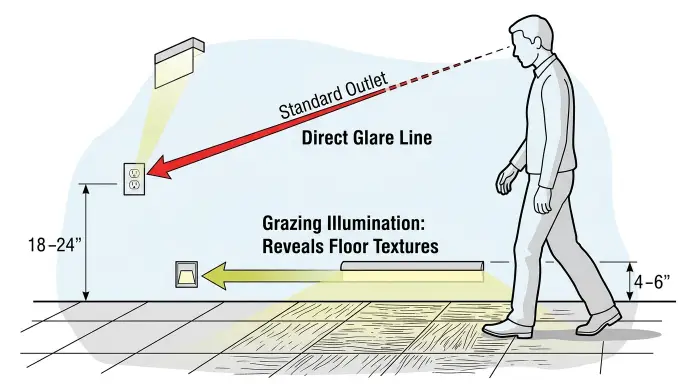
- Best For: Continuous path navigation from bedside to bathroom.
- Fixture Type: Low-profile motion sensor plug-in lights or recessed step lights.
- Why It Works: Floor-level grazing lights send horizontal beams across walking surfaces. They illuminate rug edges, thresholds, and obstacles clearly without throwing any light upward into a standing senior’s direct line of sight.
They illuminate floor transitions and thick mat edges clearly without glare, preventing stumbles over loose mats—be sure you are using secure bathroom rugs for seniors with non-skid rubber backings.
2. Under-Vanity Floating Glow
- Best For: Banishing sink-area shadow traps.
- Fixture Type: Adhesive rechargeable LED strip lights (PIR motion-activated).
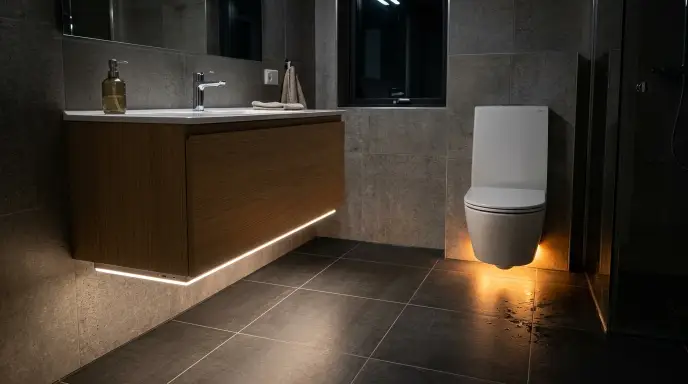
- Why It Works: Floating vanities and counter overhangs cast deep shadows precisely where feet need to pivot. A concealed LED strip underneath illuminates floor boundaries and clarifies depth perception with indirect, diffused bounce light.
Shadow-free vertical sconces around mirrors prevent squinting during daily grooming tasks. Proper lighting is a vital component of a safe bathroom vanity setup for older adults. Pair bright vanity task lighting with high-contrast bathroom faucets featuring clear red and blue indicators so low-vision users avoid accidental scalding.
3. Toilet Base & Bowl Approach
- Best For: Pinpointing the destination without turning on main lights.
- Fixture Type: Motion-activated amber toilet rim lights or low-wall outlet units.
- Why It Works: Sitting down and standing up at the toilet are peak instability moments. A focused 15–30 lumen light marks the target from across the room and defines the immediate floor perimeter for stable foot planting.
⚠️ The “Sitting Timeout” Trap:
Standard motion sensors shut off after 30 to 60 seconds of stillness. If a senior is seated on the toilet, the light will turn off, plunging them into pitch darkness right before the most physically demanding maneuver: standing up.
- The Fix: Select fixtures with an adjustable shutoff delay (minimum 2 to 3 minutes), or pair the area with an always-on 15-lumen dusk-to-dawn baseboard light to ensure a constant visual anchor.
Sitting down and standing up at the toilet are peak instability moments, which is why proper lighting should always be paired with physical supports like toilet safety rails or raised toilet seats for stable mobility.
4. Doorway Transition Threshold
- Best For: Bridging the sudden dark-to-light gap.
- Fixture Type: Wide-angle PIR motion puck light or low-profile plug-in.
- Why It Works: Moving between different flooring materials (such as bedroom carpet to slick bathroom tile) frequently snags shuffling feet. A light positioned right at the door frame activates 5–6 feet before entry, making the transition lip visible in advance.
5. Shower Curb & Grab Bar Perimeter
- Best For: Preventing catastrophic trips over shower curbs.
- Fixture Type: Battery-powered, IP65 waterproof strip light or illuminated grab bar.
- Why It Works: A 2-to-4-inch shower lip is easy to step over in daylight but nearly invisible in low ambient light. Delineating the threshold edge gives aging eyes clear vertical reference points.
Safety Rule: Use only low-voltage DC (5V battery/USB) units near moisture zones—never run mains voltage cords near water.
Delineating the threshold edge gives aging eyes clear vertical reference points, especially when reaching for support—see our detailed guide on walk-in shower grab bar placement to mount bars at the right height.
Key Lighting Specs: What Aging Eyes Actually Need
| Feature | Senior-Safe Standard | Why It Matters |
| Color Temperature | 2200K – 2700K (Warm Amber) | Zero blue light; protects melatonin and avoids retinal shock |
| Brightness | 15 – 50 Lumens | Sufficient for guidance without triggering pupil constriction |
| Mounting Height | 4 – 6 Inches (Max 12″) | Keeps bulbs out of sight lines; casts grazing floor shadows |
| Sensor Type | PIR Motion Sensor | Hands-free operation; ends dangerous searches for wall switches |
| Color Rendering (CRI) | 80+ CRI | Helps distinguish floor textures (slippery tile vs. dry mat) |
| Waterproof Rating | IP44 (General) / IP65 (Wet Areas) | Resists bathroom steam, condensation, and water splashes |
Top Night Light Solutions: Quick Buyer’s Guide
- Plug-In Amber Motion Lights (Best for Renters & Zero-DIY): Plugs directly into existing low wall outlets. Choose downward-facing lenses with built-in dusk-to-dawn sensors so they stay off during daylight hours.
- Rechargeable Magnetic LED Strips (Best for Under-Cabinet Glow): Attach via peel-and-stick magnetic brackets without any drilling or wiring. Battery packs last 4 to 8 weeks per charge and detach instantly via USB-C.
- Hardwired Recessed Step Lights (Best for Permanent Aging-in-Place): Installed flush into drywall or baseboards by an electrician. Provides a clean, permanent solution with zero loose cords or snag points.
- Amber Toilet Bowl Glow Lights (Best for Simple Destination Guidance): Hang securely over the bowl rim under the seat. Stick to warm amber LEDs—avoid multi-colored, flashing party novelties.
Bonus Safety Feature: Emergency Power Failure Backup
Midnight power outages can turn a familiar hallway into an immediate emergency. When choosing plug-in baseboard units, include at least one rechargeable emergency failure night light. These stay plugged into the wall to act as a standard amber motion sensor, but automatically switch on via internal lithium battery backup the moment grid power cuts out, doubling as a grab-and-go safety flashlight.
4 Critical Lighting Mistakes to Avoid
- Placing Lights at Eye Level: Standard 18-inch outlets can point bare LEDs straight into a downward-looking senior’s eyes, causing blinding glare that hides floor hazards.
- Lighting the Bathroom While Leaving the Hall Dark: Trips frequently happen halfway between the bed and the door. Light the path as a continuous safety runway.
- Beaming Light Directly onto Glossy Tiles: Direct angles create harsh white reflections, making flat floors look uneven or wet surfaces look dry.
- Most installations are positioned facing the bed to catch movement entering the bathroom, leaving a visual dead zone when turning around to head back. A groggy senior leaving the bathroom can easily step into complete darkness before the bedroom sensors register them.
The Fix: Treat the path as a two-way runway. Use sensors with a 120° to 160° wide-angle detection cone, or place dual opposing sensors so illumination triggers reliably whether walking forward or returning to bed.
Frequently Asked Questions
What color night light is easiest on elderly eyes?
Warm amber light (2200K–2700K) is optimal. Unlike blue or bright white light, amber wavelengths avoid circadian disruption, preserve dark-adapted rod vision, and don’t trigger painful pupil spasms.
How bright should a senior bathroom night light be?
Stick to 15 to 25 lumens for path and baseboard markers, and up to 40 to 50 lumens for counter/toilet task zones. Anything above 70 lumens introduces glare and damages sleep quality.
Are motion-activated lights safe for seniors with dementia?
Yes, provided they feature frosted, diffused lenses that turn on smoothly. Sudden bright clicks can startle cognitively impaired seniors. If motion sensors cause anxiety, choose always-on dusk-to-dawn lights instead.
Note: For complete home safety modifications, consider consulting a Certified Aging-in-Place Specialist (CAPS) or an occupational therapist.
Start with placements 1 and 3 if resources are limited… and consider pairing these lighting changes with our complete aging-in-place bathroom guide for a full room safety audit.

6 Comments