
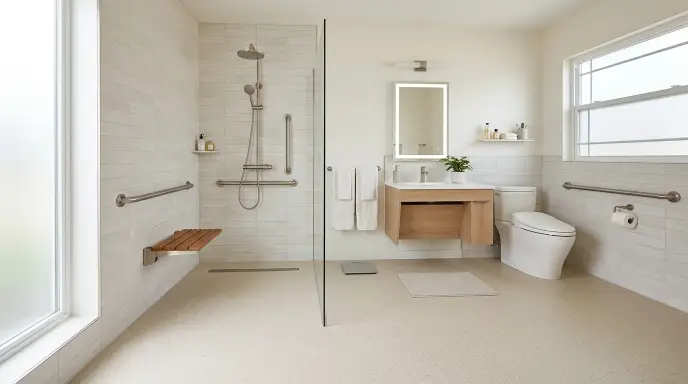
Safest Bathroom Flooring Materials for Seniors: DCOF Ratings, Fall Cushioning, and Replacement Costs
Choosing safe bathroom flooring for aging in place comes down to three measurable factors, not guesswork. First, the flooring must carry a wet DCOF (Dynamic Coefficient of Friction) rating of 0.42 or higher, as defined by the ANSI A326.3 standard. Second, the subfloor and finish material should offer moderate shock absorption without being so soft that it destabilizes a walker or wheelchair. Third, every transition point—doorways, thresholds, and shower curbs—must be flush and beveled to eliminate trip hazards. Even the most slip-resistant flooring cannot protect a senior if they lose balance climbing over a 15-inch tub wall. For older adults who cannot immediately replace their bathtub, follow these non-remodel high-step bathtub safety solutions to bridge the height gap safely.
Among all options, commercial-grade sheet vinyl and vulcanized rubber flooring offer the most balanced combination of grip, cushioning, and affordability. Textured porcelain tile remains the top choice for long-term durability in high-traffic bathrooms. Below, we break down the exact specifications, costs, and installation details you need before starting a remodel. If replacing your slick tile flooring isn’t immediately feasible, placing secure slip-resistant bathroom rugs designed for seniors outside the tub or vanity provides critical traction without a full remodel.
Table of Contents
Key Comparison Table: Senior-Safe Bathroom Flooring at a Glance
| Flooring Material | Wet DCOF Rating | Fall Cushioning / Shock Absorption | Wheelchair / Walker Friendly | Average Cost per Sq. Ft. (Installed) |
|---|---|---|---|---|
| Commercial-Grade Sheet Vinyl | 0.42 – 0.60 | Moderate (with cushioned underlayment) | Excellent | $4 – $8 |
| Virgin / Recycled Rubber | 0.60 – 0.80 | High | Good (firm enough for wheels) | $9 – $15 |
| Textured Porcelain (Mosaic/Matte) | 0.42 – 0.65 | Low to Moderate | Good (small tiles, minimal grout line) | $10 – $22 |
| Sealed Natural Cork | 0.42 – 0.55 | High | Not recommended for wheeled mobility aids; suitable only for assisted walking/cane users | $7 – $14 |
| Polished Tile / Natural Stone | Below 0.30 | Low | Poor (slick surface) | Avoid for bathrooms |
The Golden Metrics: How to Evaluate Senior-Safe Flooring
Understanding DCOF (Dynamic Coefficient of Friction) & ANSI A326.3
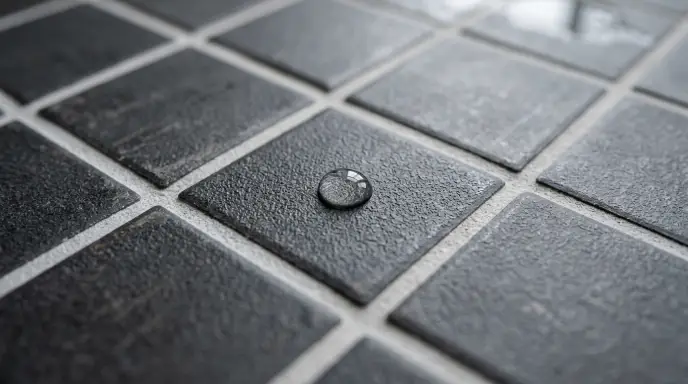
Older flooring guides often referenced SCOF (Static Coefficient of Friction), which measures resistance to slipping from a standstill. However, most falls happen while a person is walking—stepping out of the shower, pivoting toward a towel rack, or shifting weight while using a grab bar. This is why the flooring industry moved to DCOF (Dynamic Coefficient of Friction) under the ANSI A326.3 standard, which measures grip while a surface is in motion and wet—a far more realistic simulation of bathroom conditions.
For any wet area, including bathrooms, the ANSI A326.3 standard recommends a minimum wet DCOF of 0.42. Flooring marketed for bathrooms should always list this rating on the product spec sheet or box. If a retailer cannot provide a DCOF number, treat that as a red flag—especially for polished, glazed, or natural stone products.
Fall Cushioning vs. Mobility Aid Resistance
It may seem logical to install the softest possible flooring to reduce impact, but overly cushioned surfaces create a different hazard: mobility aid instability. Thick foam-backed mats, plush carpet tiles, or overly soft cork can cause a walker’s rubber tips or a wheelchair’s front casters to sink slightly, catch, or drag—leading to tripping rather than preventing it.
This is precisely why sealed cork, despite its excellent shock absorption, is flagged in the comparison table above as unsuitable for wheeled mobility aids. Its compressive give—ideal for cushioning a standing fall—works against stability for anyone relying on a walker or wheelchair, whose wheels need a firm, consistent surface to roll predictably.
The goal is firmness balanced with impact attenuation—a surface firm enough to support a rolling walker or wheelchair evenly, yet with enough give (via underlayment or material composition) to soften impact compared to rigid substrates like concrete or unpadded ceramic tile. This is why cushioned vinyl systems and vulcanized rubber—rather than raw hard tile or deep-pile carpet—dominate professional aging-in-place recommendations.
Top 4 Bathroom Flooring Materials Compared for Aging in Place
1. Commercial-Grade Sheet Vinyl (Best Overall Safety & Budget)
Sheet vinyl is installed in large, continuous rolls, which eliminates the seams and grout lines found in vinyl plank (LVP) or tile installations. This matters structurally: seams and grout joints are where water can seep beneath the surface, breeding mold and softening subfloor adhesive over time. A single-sheet installation, heat-welded at unavoidable joints, keeps the entire wet zone sealed.
Pros
- No seams for water infiltration
- Available in textured, wet-rated finishes with DCOF ratings above 0.42
- Compatible with cushioned underlayment for mild shock absorption
- Lowest material and labor cost among safety-rated options
Cons
- Less visually premium than tile
- Can dent under heavy fixed furniture
Estimated Cost: $4 – $8 per sq. ft. (installed)
2. Textured or Small-Format Porcelain Tile (Best Durability & Moisture Grip)
Porcelain remains a top pick when durability and long-term value matter, but selection details make or break its safety profile. A matte or textured finish should always be chosen over glossy, polished porcelain—gloss finishes drastically reduce DCOF ratings once wet.
Small-format tiles, particularly 2×2-inch mosaics, are inherently safer than large-format slabs because the higher density of grout lines acts as a natural traction grid underfoot. The grout lines create micro-level texture changes that increase friction, even when the tile itself is smooth.
Pros
- Extremely durable and long-lasting
- Wide range of matte, slip-rated finishes
- Small-format tiles improve grip via grout-line texture
Cons
- Hard surface offers minimal shock absorption
- Grout requires ongoing sealing maintenance
Estimated Cost: $10 – $22 per sq. ft. (installed)
3. Vulcanized Rubber Flooring (Best Shock Absorption & Maximum Grip)
Vulcanized rubber is the standard flooring choice in hospitals, physical rehabilitation centers, and clinical facilities—not by coincidence. Rubber flooring retains its grip even when saturated with water, and its inherent density provides superior impact attenuation compared to vinyl or tile, reducing the force transferred to the floor-contact surface during a fall.
Limitations: Rubber sheet flooring requires professional watertight seam welding. Improperly sealed seams can allow moisture penetration beneath the material, which undermines both the flooring’s grip and subfloor integrity.
Pros
- Highest wet DCOF ratings of any common material (often 0.60+)
- Superior shock absorption
- Naturally resistant to moisture damage when properly sealed
Cons
- Requires licensed installation for seam welding
- Higher material cost than vinyl
Estimated Cost: $9 – $15 per sq. ft. (installed)
4. Slip-Resistant Luxury Vinyl Tile (LVT) with Beveled Edge Warnings
Slip-resistant LVT offers a waterproof rigid core, making it more dimensionally stable than sheet vinyl in temperature-fluctuating environments. This is a reasonable middle-ground option, provided buyers understand its limitations.
Important caveat: Click-lock LVT systems have seams between planks or tiles. Even with waterproof cores, water can migrate into these click joints over time if the perimeter isn’t properly sealed with silicone at wall edges and around fixtures. For full wet-zone bathrooms (as opposed to half-baths), sheet vinyl or welded rubber remains a more reliable choice than click-together LVT.
Dangerous Flooring Choices to Avoid in Senior Bathrooms
Polished Natural Stone & Glossy Ceramic: Marble, travertine, and glazed ceramic tiles look elegant but often carry a wet DCOF rating well below 0.42. Combined with soap residue, these surfaces can become extremely slick—effectively behaving like an icy sidewalk underfoot.
Large-Format Smooth Tiles with Wide Grout Gaps: While large tiles reduce grout maintenance, wide gaps between them can catch the rubber tips of walkers or crutches, creating a snag-and-trip scenario rather than a slip scenario.
Loose-Lay Rugs and Backless Bath Mats: Unsecured rugs and mats without non-slip backing are one of the most common—and easily overlooked—causes of bathroom falls among older adults. If a bath mat is used, it should have a fully adhered rubber backing or be replaced with a built-in textured floor zone.
Installation Checklist: Eliminating Lip Hazards and Drainage Traps
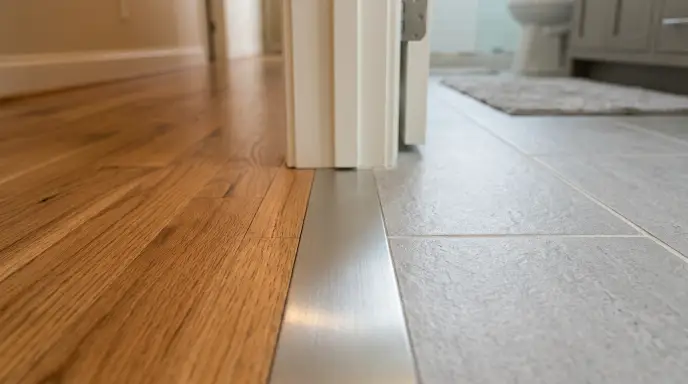
Beveled Flush Transitions: Any transition strip between a hallway or bedroom and the bathroom should sit flush with both surfaces—no raised lip or step-down. ADA-compliant transition strips are designed with a gentle bevel (typically no more than 1/4 inch rise) that mobility aids can roll over without catching. For more detail on managing floor-level moisture at these transition zones, see our guide on how to prevent water from pooling on your bathroom floor.
Proper Subfloor Leveling & Pitch: Bathroom subfloors should be pitched at approximately 1/4 inch per foot toward the drain. Without correct slope, water collects in low spots, creating standing puddles that increase both slip risk and long-term moisture damage to the subfloor.
Estimated Cost Breakdown: Material vs. Professional Labor
For a typical 50–70 sq. ft. bathroom floor replacement, costs generally break down as follows:
| Cost Component | Estimated Range (per sq. ft.) |
|---|---|
| Material Cost | $4 – $22 (varies by flooring type selected) |
| Demolition & Old Flooring Removal | $2 – $5 |
| Subfloor Repair / Leveling | $3 – $8 |
| Waterproofing Membrane Installation | $2 – $6 |
| Professional Installation Labor | $5 – $12 |
DIY vs. Licensed Contractor: While sheet vinyl and click-lock LVT are sometimes marketed as DIY-friendly, bathroom installations involve waterproofing membranes, subfloor pitch corrections, and seam sealing that directly affect long-term slip safety. A licensed contractor familiar with wet-area waterproofing standards should handle at minimum the membrane installation and seam welding (for rubber) to avoid moisture intrusion that could compromise the floor’s rated friction performance over time. For a full remodeling walkthrough, refer to our aging-in-place bathroom remodeling guide.
Daily maintenance also plays a role in preserving slip resistance—soap film and mineral buildup can gradually reduce a floor’s effective grip even when the DCOF rating is high. Learn more in our guide on how to keep your bathroom floor dry after every shower. If you are upgrading flooring, don’t overlook wall support; check the ideal height and placement for senior grab bars so wall anchors align with the floor layout.
Frequently Asked Questions
Q: Is vinyl flooring slippery when wet for seniors?
A: Not when the correct product is chosen. Standard glossy vinyl sheeting can become slippery, but textured, wet-rated commercial sheet vinyl with a DCOF rating of 0.42 or higher maintains grip even when saturated with water.
Q: Can you put non-slip rubber flooring inside a walk-in shower?
A: Yes, but only when installed with fully welded, watertight seams and paired with a properly graded, grated drain system. Without professional sealing, water can seep beneath the rubber and compromise both grip and subfloor integrity.
Q: What is the difference between SCOF and DCOF for bathroom safety?
A: SCOF measures resistance to slipping while standing still, while DCOF measures grip while the foot is actively moving across the surface. Since most bathroom falls happen during movement—stepping, pivoting, or walking—DCOF is considered the more realistic and relevant safety metric under the ANSI A326.3 standard.
For a broader look at fall-risk factors beyond flooring material selection, see our slippery bathroom floor safety risks for seniors guide, and review our complete senior bathroom safety checklist for additional structural recommendations.
Disclaimer: This guide covers architectural standards and non-slip surface materials based on industry friction tests (ANSI standards). It does not provide medical or clinical advice. Consult an occupational therapist or certified aging-in-place specialist (CAPS) for individualized mobility planning.

12 Comments