

Best Bathroom Faucets for Seniors: Easy Levers & Touchless
Traditional round twist knobs require pinching and torque—two motions that trigger severe pain for arthritic joints and risk serious slips if hands are wet or soapy.
If you’re caring for an aging parent or adapting your own bathroom for the years ahead, the faucet is one of the most overlooked—yet most dangerous—fixtures in the room. The wrong handle doesn’t just cause frustration; it causes falls, burns, and loss of independence.
Quick Verdict: Which Faucet Type Wins?
- For most seniors with arthritis or tremor issues: A single-handle ADA lever faucet is the safest, most reliable choice. It requires zero pinching, offers instant visual and tactile temperature feedback, and has no electronic components or batteries to fail.
- For individuals with severe mobility limits or paralysis: An automatic touchless sensor faucet paired with a pre-set thermostatic mixing valve offers hands-free convenience—provided a caregiver manages battery maintenance.
Table of Contents
Lever vs. Touchless vs. Traditional Knob: Quick Comparison
| Feature | Traditional Round Knob | ADA Single Lever | Touchless Sensor |
| Grip Force Required | High (pinch + twist) | None (push/nudge with palm/elbow) | Zero (hands-free) |
| Scald Safety | Low (slow dual-knob reaction) | High (visual handle position) | Moderate (no physical cue) |
| Ease of Cleaning | Low (tight crevices) | High (smooth exterior) | High (no touch contact) |
| Dementia Friendliness | Moderate | High (predictable manual control) | Low (confusing auto shut-offs) |
| Battery Dependency | None | None | Yes (4x AA every 6–12 mos) |
| Best Suited For | Not recommended | Arthritis, weak grip, aging-in-place | Tremors, limited limb reach |
Why Traditional Twist-Knob Faucets Are Dangerous for Seniors
The Biomechanics of Pain
Twisting a round knob forces the wrist into a combined pinch-and-rotate motion. For someone with osteoarthritis, rheumatoid arthritis, or carpal tunnel syndrome, this specific movement pattern is one of the most painful a hand can perform. The cartilage and tendons involved are already inflamed, and repetitive torque accelerates joint degeneration.
The Slip-and-Fall Link
When a knob is stiff or corroded, seniors instinctively lean their body weight onto the vanity edge to generate extra torque. This shifts their center of gravity forward over a wet, soap-slicked surface—a leading precursor to bathroom falls. If your counter isn’t secure, this problem compounds quickly. Review our guide to a stable bathroom vanity setup to eliminate wobble before it becomes a hazard.
Scald Hazards
With separate hot and cold knobs, reaction time matters. A senior with slowed reflexes or reduced hand sensation may not register that water has turned scalding until burns have already occurred—often within seconds at temperatures above 120°F. Pair any faucet upgrade with thermostatic anti-scald valves to close this gap, no matter which handle style you choose.
ADA Faucet Standards: The “Closed-Fist” Rule Explained
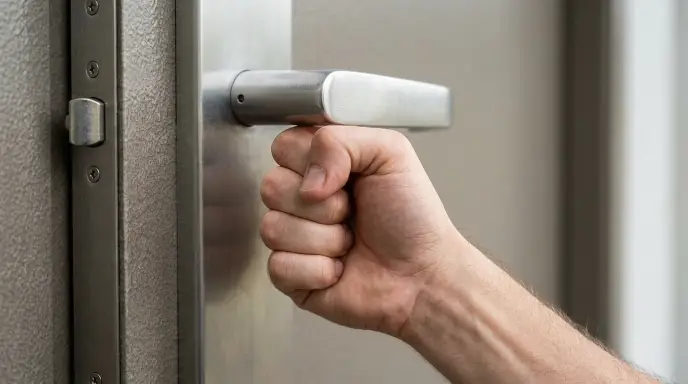
Most articles mention “ADA compliant” without explaining what that actually means in practice.
What ADA Compliance Actually Requires:
- Operable with one hand only.
- Cannot require tight grasping, pinching, or twisting of the wrist.
- Activation force must not exceed 5 lbs of pressure.
The Caregiver Test (Do This Before You Buy)
Before purchasing any faucet—whether online or in a showroom—perform this simple test: try operating it with only a closed fist or the back of your wrist, with no finger grip.
If you can turn the water on, adjust the temperature, and shut it off without pinching anything between your fingers, it passes. If you instinctively need your fingertips to grab and twist, it fails—regardless of what the packaging claims about “ADA compliance.” Many faucets marketed as senior-friendly still require a light pinch at the very end of the motion, which defeats the purpose entirely.
Lever-Handle Bathroom Faucets: The Gold Standard for Weak Grips
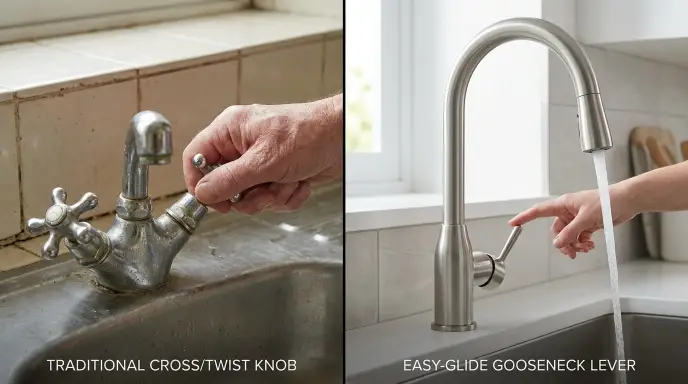
Single-Handle vs. Double-Handle Levers
- Single-Handle (Recommended): One continuous motion controls both water flow and temperature. A senior can push the lever up with an elbow, palm, or the side of a closed fist—no fine motor coordination needed.
- Double Blade/Wing Handles: Useful for retrofitting existing 3-hole vanity tops without replacing the sink, but they require two separate adjustments (hot and cold), which demands more coordination and reaction time than a single lever.
Spout Height and Reach Matter
A high-arc (gooseneck) spout reduces the need to bend at the waist—a motion that strains the lower back and increases fall risk when combined with wet floors. Taller spouts also allow a wider washing angle, reducing splash-back onto the counter and floor. If water is escaping the basin, review our guide on how to keep bathroom floors dry as a complementary fix.
Top Senior-Friendly Lever Faucet Features to Look For:
- Ceramic Disc Cartridges: Look for models like the Moen Eva or Delta Modern ADA Single-Lever. Ceramic discs ensure buttery-smooth gliding action that never stiffens from hard water deposits over time.
- High-Contrast Finish: Matte black or brushed nickel levers against a light-colored countertop improve visual edge detection for aging eyes. Pair this with better bathroom lighting to eliminate shadow confusion near the sink.
Touchless & Motion-Sensor Faucets: Benefits and Hidden Drawbacks
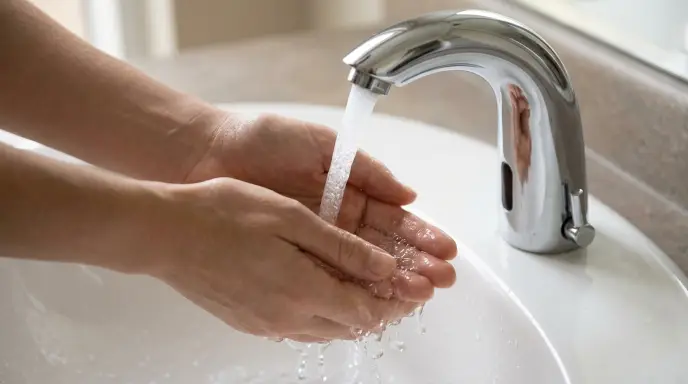
Where Motion Sensors Excel
- Zero Grip Force: Ideal for Parkinson’s, tremors, or partial paralysis where pushing a lever is difficult.
- Auto-Shutoff: Prevents sink overflow if a user forgets to turn the water off, reducing the risk of bathroom flooding and standing water slips.
If hand weakness makes turning standard round knobs painful, consider touchless or easy-glide lever controls throughout the home, especially when planning sink modifications in your aging-in-place kitchen setup.
The Hidden Drawbacks Competitors Don’t Mention
- Battery Access Issues: Most residential touchless faucets run on 4x AA batteries housed beneath the vanity, often behind supply lines. For a senior living alone, replacing dead batteries means crawling into a cramped cabinet—a task that’s physically impossible for many. If battery upkeep is missed, the senior is left without a functioning faucet.
- Cognitive Hesitation: For seniors with Alzheimer’s or mild cognitive decline, unpredictable automatic shut-offs are genuinely distressing. Water stopping mid-wash without an obvious physical cause can be interpreted as the faucet being “broken,” leading to erratic hand-waving or sink avoidance.
- Temperature Surprise: Without a physical lever to visually inspect before use, there is no manual cue for water temperature. Users place their hands under the spout with no warning of hot or cold spikes.
Bottom Line on Touchless: Touchless faucets work best when a thermostatic mixing valve is pre-installed to cap maximum water heat, and when a caregiver is actively managing battery upkeep.
Low-Cost Temporary Alternatives: Faucet Adapters & Extenders
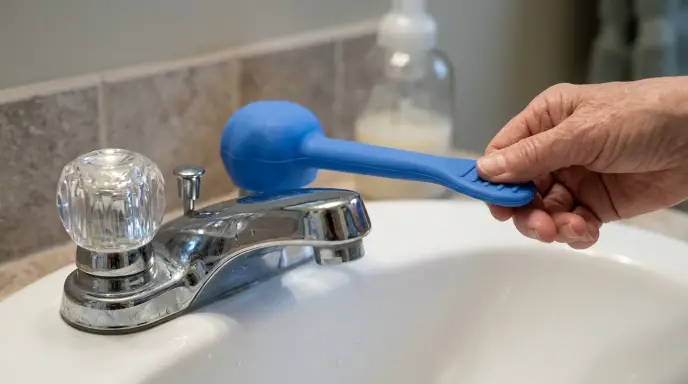
Not ready for a full plumbing replacement? These budget options provide immediate relief:
- Silicone Handle Turners & Lever Extensions: Slip over existing round knobs to convert them into lever-style handles for under $15, requiring no plumbing alterations.
- Screw-On Motion Sensor Adapters: Plug-and-play aerator attachments that add touchless activation to an existing spout, ideal for renters or assisted living facilities.
Buyer’s Checklist: What to Check Before Purchasing
- ✅ Ceramic Disc Valves: Eliminate rubber washers that degrade and require heavy torque over time.
- ✅ Mounting Configuration: Confirm your vanity’s existing 1-hole or 4-inch/8-inch 3-hole centerset before ordering.
- ✅ Finish Selection: Brushed nickel or matte finishes reduce glare and hide slippery soap scum better than polished chrome.
- ✅ Hot/Cold Red-and-Blue Indicators: Non-negotiable high-contrast markings to prevent accidental scalding, especially for low-vision users.
Frequently Asked Questions
Can an arthritic person operate a lever faucet with an elbow?
Yes. Single-handle ADA levers are specifically designed to be pushed, pulled, or nudged with an elbow, forearm, or closed fist—no finger grip is required at any point in the motion.
How often do batteries need replacement in a residential touchless faucet?
Most residential sensor faucets need battery replacement every 6–12 months depending on daily usage, though high-traffic households may need changes closer to every 4–6 months.
Are touchless faucets safe for seniors with dementia?
Not always. The unpredictable shut-off and lack of a physical handle can cause confusion or distress for individuals with cognitive decline. A single-lever manual faucet is generally better suited for dementia care due to its predictability.
What is the easiest faucet to turn off during an emergency?
A single-handle lever faucet, since one swift downward push shuts off both hot and cold water simultaneously—no searching for a second knob.
The Bottom Line
For nearly every aging-in-place situation, a single-handle ADA lever faucet with a ceramic disc cartridge is the safest baseline investment—reliable, predictable, and completely free of batteries or electronic failure points. Reserve touchless models for cases of severe mobility loss, and always pair them with a thermostatic mixing valve for temperature safety. Upgrading your vanity faucets to lever handles is only one step; make sure to complete a comprehensive bathroom safety audit to ensure grab bars and floor traction are also up to standard.
Ready to safety-proof the rest of the bathroom? Continue with our full Senior Bathroom Safety Guide or explore the complete Aging-in-Place Bathroom Guide for a comprehensive room-by-room safety overhaul.


7 Comments