

Best Cabinet Pulls for Arthritic Hands: Why D-Pulls Beat Knobs (2026 Guide)
Affiliate Disclosure: This guide contains affiliate links. If you make a purchase through these links, Agefolk may earn an affiliate commission at no extra cost to you. We independently evaluate and recommend products based on ergonomic accessibility standards and aging-in-place best practices.
Quick Verdict
Quick Answer: D-pulls are substantially better than traditional knobs for arthritic hands because they allow a “power grasp” using multiple fingers, the palm, or the wrist—eliminating the painful thumb-and-finger pinch grip. For optimal ergonomic leverage across accessible kitchen cabinets and bathroom vanities, choose a 4-inch to 5-inch pull with at least 1.25 to 1.5 inches of clearance (such as our top-rated wide-clearance pick) and a non-slip brushed finish.
Core Takeaways:
- Knobs trigger joint flare-ups: Round knobs demand a high-pressure pinch grip, concentrating shear stress directly onto the carpometacarpal (CMC) thumb base and finger knuckles.
- D-pulls distribute load: Wide D-shaped handles engage the whole hand, wrist, and forearm muscles, requiring significantly less grip force to open heavy drawers.
- ADA-aligned leverage: D-pulls satisfy universal accessibility principles by allowing closed-fist operation without twisting or tight grasping.
Table of Contents
The Biomechanics: How Knobs Trigger Joint Pain
The Pinch Grip Problem
Opening a standard drawer with a round or oval knob forces your hand into a concentrated “tip-to-tip” or “pad-to-side” pinch grip. Squeezing a small knob between the thumb and index finger transfers heavy mechanical force directly into the basal thumb joint (the carpometacarpal or CMC joint).
Because the CMC joint is one of the most common sites for osteoarthritis and rheumatoid inflammation, repetitive pinching causes cartilage wear, sharp pain, and joint stiffness. A tiny contact surface must generate 100% of the pulling force required to break drawer slide resistance. This issue mirrors why switching from rotary handles to lever mechanisms is essential across other fixtures—such as choosing touchless vs. lever faucets rather than twist valves.
Torque and Slippage
Traditional knobs create severe friction problems for individuals with reduced grip strength:
- Moisture and Oil: Kitchen moisture, lotion, or cooking oils turn smooth cabinet knobs into slick, unreachable obstacles.
- Compensatory Squeezing: Because a smooth knob offers no mechanical shelf or hook, users instinctively squeeze harder to keep their grip from slipping, multiplying pressure on inflamed joints.
- Zero Hooking Space: Round profiles cannot be pulled with an open hand or looped finger; operation depends entirely on pinch pressure.
Why D-Pulls Are the Gold Standard for Arthritic Hands
Power Grasp and Lever Advantage
D-pulls (wire pulls or bar pulls) transform the biomechanics of opening a cabinet. Instead of relying on thumb strength, a user can slide three or four fingers behind the bar. This enables a power grasp, recruiting the stronger flexor muscles of the fingers, wrist, and forearm while bypassing thumb joints entirely.
Closed-Fist Operation (ADA Standards)
Under ADA accessibility guidelines (Section 309.4), operable architectural hardware must be usable with one hand and must not require tight grasping, pinching, or twisting of the wrist. The operational force required to activate operable parts must not exceed 5 pounds.
A high-clearance D-pull satisfies this requirement: it can easily be operated using a loosely curled closed fist, the side of the palm, or an assistive cuff.
Wrist and Forearm Pulling
During severe morning stiffness or painful arthritis flare-ups, fine motor finger coordination drops significantly. A wide D-pull allows individuals to hook their entire wrist, forearm, or side of the hand through the opening to slide a heavy drawer open without gripping at all.
Direct Comparison: D-Pulls vs. Knobs
| Metric | D-Pulls (Loop / Wire) | Traditional Knobs |
| Grip Style Required | Power grasp (multiple fingers, full hand, or wrist hook) | Pinch grip (isolated thumb and index finger pads) |
| Joint Stress Level | Low to moderate (force distributed across entire arm) | High (concentrated on the thumb CMC joint) |
| ADA Compliance | Generally compliant (operable with a closed fist) | Non-compliant (requires pinching and fine dexterity) |
| Maximum Operable Force | Under 5 lbs (excellent mechanical leverage) | Often requires elevated friction grip to pull open |
| Functionality with Wet Hands | Excellent (relies on physical hooking, not friction) | Poor (fingers slip easily off smooth surfaces) |
| Installation Complexity | Two screw holes (requires center-to-center spacing) | Single center hole (simple screw attachment) |
Can Knobs Ever Work for Sensitive Hands?
If replacing two-hole hardware is not an immediate option, standard round knobs can be swapped for slightly more accessible single-point designs:
- T-Bar Pulls: A single-hole pull featuring a horizontal crossbar. It provides an edge to hook two fingers, reducing pinch force compared to a ball knob.
- Oversized Mushroom Knobs: Large-diameter flat-top knobs (1.5 inches or wider) provide a wider contact surface, spreading compression over slightly more tissue.
While these alternatives represent an improvement over round knobs, they still demand active gripping. D-pulls remain the definitive long-term solution because they eliminate pinching completely.
Key Buying Checklist: What to Look for Before You Buy
1. Finger Clearance (Projection)
Always inspect the projection dimension on manufacturer spec sheets. You need 1.25 inches to 1.5 inches of clearance between the back of the handle and the face of the cabinet door. Narrow gaps (under 1 inch) will pinch swollen knuckles, ring fingers, and hands affected by rheumatoid nodules. This clearance is equally critical when updating hardware on a bathroom sink vanity, where space around medicine cabinets and under-sink doors can be tight.
2. Center-to-Center Length
Avoid standard compact 3-inch pulls. For arthritic hands, look for:
- 4-inch to 5-inch center-to-center spacing (roughly 96mm to 128mm).
- An inner grip length spacious enough to insert four adult fingers without side-to-side friction.
3. Smooth, Rounded Contours
Select pulls with cylindrical, smooth tubular, or gently curved bar profiles. Avoid architectural designs with sharp 90-degree internal edges or thin rectangular bars that dig painfully into skin under load.
4. Finish and Grip Texture
Avoid ultra-high-polish chrome finishes, which offer zero tactile friction when hands are damp. Choose brushed nickel, satin brass, or matte black, which naturally provide subtle surface drag for a secure grip.
5. Pair with Low-Resistance Hardware
If heavy drawers stick or demand excessive force, handles alone may not solve the problem. In a comprehensive aging-in-place kitchen plan, pairing D-pulls with smooth full-extension slides or retrofitting cabinets with pull-out cabinet organizers eliminates the friction of digging deep into lower shelves. Similarly, addressing overhead strain with pull-down cabinet shelves brings high storage within reachable range so you never have to strain your joints at an awkward angle.
Top Ergonomic D-Pulls for Arthritic Hands in 2026
1. Best Overall: Wide-Clearance D-Shaped Bar Pull (5-Inch)
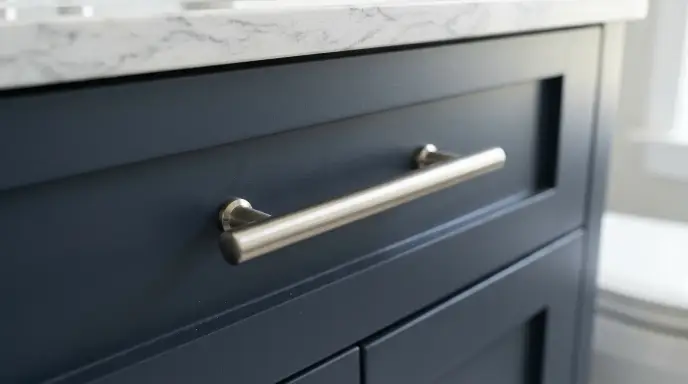
- Core Specs: 5″ Center-to-Center | 1.4″ Projection | Brushed Stainless or Nickel.
- Why It Works: Fits full adult hands comfortably, leaves ample room for stiff knuckles, and features soft, rolled edges with zero pinch points.
“Ravinte 5” Brushed Nickel Bar Pull: Round profile that eliminates sharp pressure points and provides enough width for a 4-finger grasp. Note: It features an extended T-bar tip rather than a closed loop, so keep clothing loose from edges.
2. Best for Deep Pots & Pans Drawers: Heavy-Duty Wire D-Pulls (6 to 8-Inch)
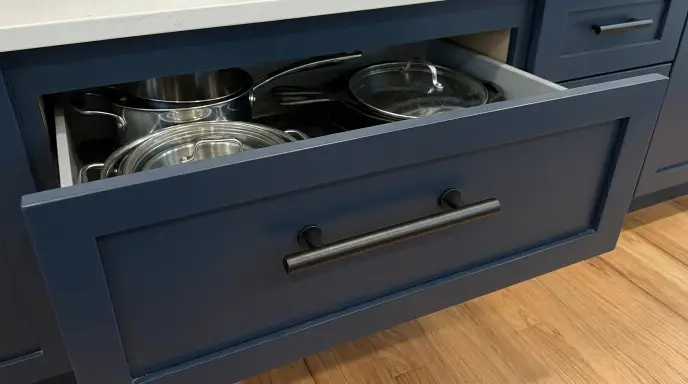
- Core Specs: 6″–8″ Length | Thick gauge metal | Deep projection.
- Why It Works: Deep kitchen drawers filled with cast iron or appliances demand greater leverage. Extended wire pulls let you pull using both hands or loop an entire forearm to open the drawer smoothly.
3. Best Budget Multi-Pack: Rounded Arch Cabinet Pulls
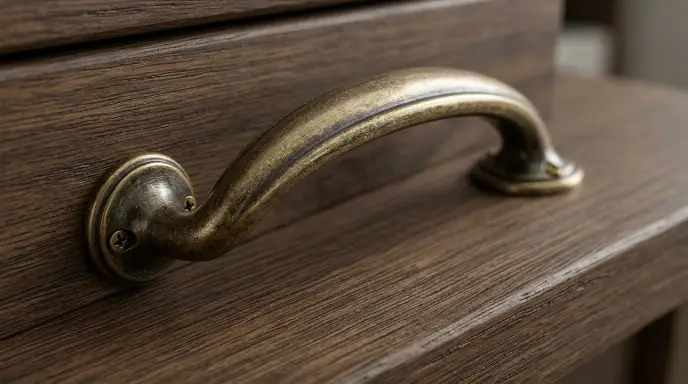
- Core Specs: 4″ Center-to-Center | Gentle upward bow | Multi-pack bundle.
- Why It Works: An economical choice for outfitting a full kitchen. The gentle arch leaves extra room in the center of the handle where the fingers need it most.
4. Best No-Grip Alternative: Push-to-Open Mechanical Latches
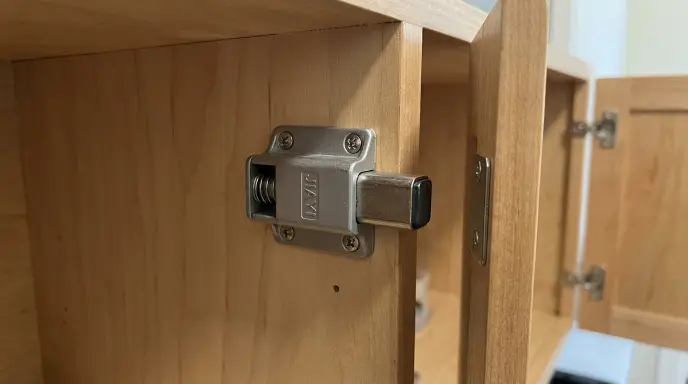
- Core Specs: Spring-loaded magnetic or mechanical push release.
- Why It Works: If gripping or pulling hardware has become too painful due to advanced arthritis or severe loss of hand strength, this push-to-open latch bypasses handles completely. Instead of grasping and pulling, a light push with your palm, wrist, forearm, or elbow activates the heavy-duty internal spring, popping the cabinet door open effortlessly. The magnetic catch keeps the cabinet securely shut until pressed again. It is the most reliable, zero-grip adaptive solution for upper wall cabinets and lightweight pantry doors.
Easy Retrofitting: How to Replace Knobs with D-Pulls Without Ruining Cabinets
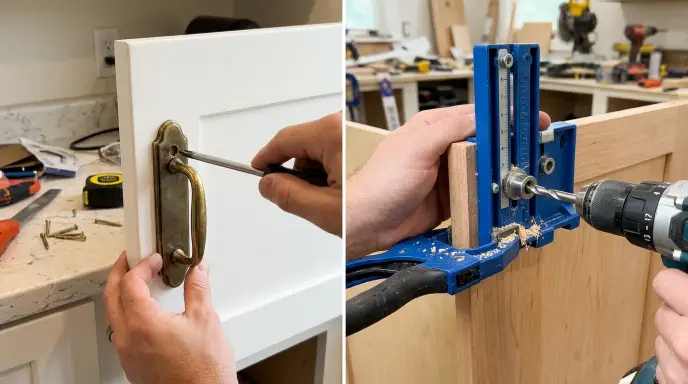
Moving from a single-hole knob to a two-hole D-pull is straightforward with the right approach:
Option 1: Use an Elongated Backplate (No Patching Required)
Cabinet backplates or adapter plates sit flat against the cabinet door underneath the new pull.
- The plate completely conceals the original center knob hole and any finish discoloration behind it.
- Install your new two-hole pull directly through the backplate holes into the door.
Option 2: Use an Alignment Jig for Precise Drilling
Drilling uneven holes can cause hardware to bind. Use an adjustable cabinet hardware drill template (jig):
- Place painter’s tape over the cabinet face where new holes will go to prevent wood tear-out.
- Set the jig stops to your exact center-to-center measurement (e.g., 96mm or 128mm).
- Clamp the jig securely and drill perpendicular guide holes at low speed.
Option 3: Fill, Sand, and Refinish
For a seamless modern look without backplates:
- Fill the existing single hole with color-matched wood putty or two-part epoxy filler.
- Sand flush using 220-grit sandpaper once fully cured.
- Apply touch-up cabinet paint or stain, then drill fresh mounting holes using your template.
Frequently Asked Questions
Are cup pulls (bin pulls) good for arthritis?
No. Cup pulls require you to slide your fingers upward from underneath and curl your fingertips against a metal lip. This puts direct tension on the distal and proximal interphalangeal finger joints, making cup pulls difficult and uncomfortable for anyone with limited grip strength or finger pain.
What is the ADA guideline for cabinet pulls?
The Americans with Disabilities Act (ADA) requires cabinet hardware to be operable with one hand, requiring no tight grasping, pinching, or twisting of the wrist, with a maximum operating force of 5 pounds. D-shaped loop handles and push-latches fully meet this specification when installed with adequate clearance.
What size cabinet pull is best for weak or stiff hands?
A pull with a 4-inch to 5-inch (96mm to 128mm) center-to-center length and at least 1.25 inches of clearance is ideal. This dimension provides enough internal room for three to four fingers to slide through easily, eliminating friction on swollen joints.
Final Thoughts
Living with arthritis shouldn’t mean struggling to access your own kitchen tools or bathroom essentials. Upgrading your hardware makes heavy drawers easier to slide, providing safe storage for compact adaptive gadgets like battery-operated hands-free can openers. Swapping round knobs for properly sized, wide-clearance D-pulls replaces a painful pinch grip with natural arm leverage. Pair 4-to-5-inch pulls with smooth contours, high-contrast brushed finishes, and hardware backplates to make your home functional, accessible, and pain-free. Replacing tight round cabinet knobs with D-shaped pulls eliminates pinch grip throughout your kitchen. To further reduce joint strain during daily meal preparation, explore our top-rated kitchen tools for arthritis designed specifically for weak or stiff fingers. Upgrading to D-shaped cabinet pulls solves the daily pull-and-tug strain on finger joints, but opening threaded containers remains one of the highest-friction tasks in the kitchen. To maintain a complete joint-friendly space, pair your ergonomic hardware with no-grip jar opening tools that protect vulnerable knuckles from twisting flare-ups. Upgrading cabinet hardware eliminates finger pinch fatigue, but chopping dense vegetables presents an even greater joint hazard; explore our tested guide to ergonomic kitchen knives for arthritis to protect your joints during daily meal prep.
Disclaimer: This article is for informational purposes and should not be taken as medical advice. If you experience chronic hand pain, joint deformities, or sudden loss of grip strength, consult an occupational therapist or medical professional for personalized ergonomic evaluations.






9 Comments