
Toilet Safety Rails vs. Raised Toilet Seats: Which Prevents Falls Better for Seniors?
Medical Disclaimer: This guide provides evidence-informed home safety and functional mobility guidance for educational purposes only. Always consult a licensed physical therapist (PT), occupational therapist (OT), or physician before purchasing mobility assistive equipment for specific post-surgical precautions or progressive neurological conditions.
A surprising majority of serious bathroom injuries among older adults do not occur in the shower or while walking across slick tiles. They happen during the toilet transfer zone—the high-risk transition of sitting down and standing back up.
That brief window requires shifting your center of gravity, balancing briefly on one dominant leg, and executing controlled muscle deceleration. When quadriceps fatigue or joints lock up, balance disappears in an instant.
The Quick Verdict (Which One Is Safer?)
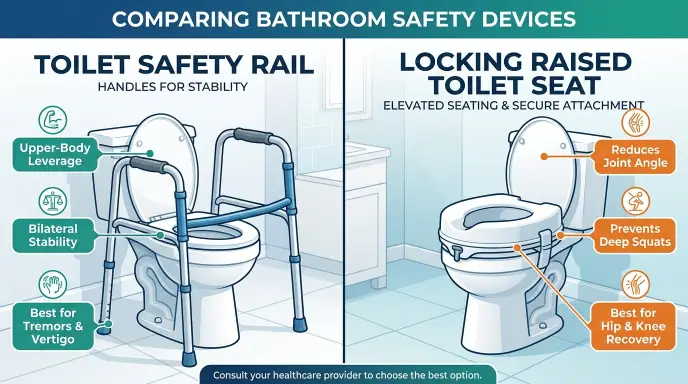
Raised toilet seats prevent falls by reducing hip and knee flexion angles (the 90-degree rule), eliminating painful deep squats for seniors with severe arthritis or post-hip surgery. Toilet safety rails prevent falls dynamically by providing upper-body leverage and bilateral stability for seniors who experience tremors, unsteadiness, or post-sit dizziness. Choose a raised seat for joint restrictions; choose safety rails for balance failure.
If you are renting or not ready for a major structural overhaul, both rails and risers serve as instant, zero-remodel solutions outlined in our full aging in place bathroom guide. While securing the shower and vanity are vital parts of a comprehensive checklist for senior bathroom safety, the toilet transfer zone represents the single highest risk for sudden joint failure and loss of balance.
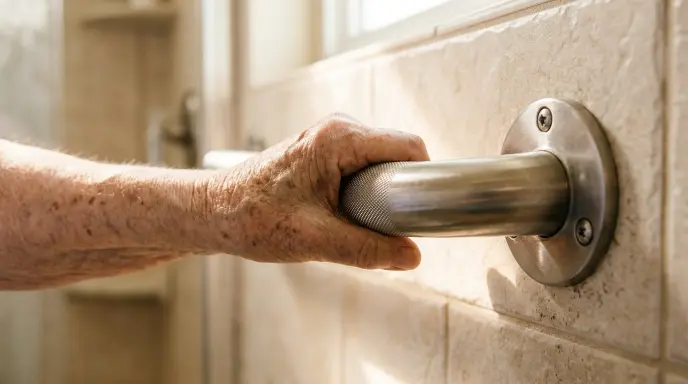
If a permanent, stud-anchored grab bar installation isn’t feasible—such as in rental properties, bathrooms with tiled drywall lacking solid backing, or short-term post-operative setups (refer to our complete guide on Exact Grab Bar Placement for Elderly Bathrooms)—both options deliver non-invasive, no-drill fall prevention you can deploy immediately.
Why Seniors Fall in the Toilet Zone: The Biomechanics
Generic product roundups treat toilet aids like simple bathroom accessories. From an occupational therapy perspective, bathroom falls stem from two distinct biomechanical failure points:
1. The “Point of No Return” (Eccentric Muscle Failure)
Standard residential toilets measure roughly 14 to 15 inches from floor to rim (compared to ADA comfort-height toilets at 17 to 19 inches). Lowering your body down onto a standard bowl requires significant eccentric quadriceps strength—the muscle’s ability to brake against gravity under load.
When aging muscles fatigue in those critical final 4 inches, the descent switches from a controlled sit to a dead drop. This jarring impact shocks the lumbar spine, risks pelvic fractures, and frequently causes individuals to tilt sideways off balance.
2. Orthostatic Hypotension (Post-Void Dizziness)
Older adults frequently spend extended periods seated on the toilet. Rapidly standing up causes blood pooling in the lower extremities, triggering an immediate drop in systolic blood pressure known as orthostatic hypotension.
That sudden wave of lightheadedness hits precisely while the user is mid-stride, turning an ordinary bathroom visit into an acute fall emergency. How smoothly and securely someone pushes up into a standing posture matters just as much as the seat itself.
Deep Dive: Toilet Safety Rails (Safety Frames)
Toilet safety rails—often called safety frames—mount directly behind the toilet hinge bolts or rest as a freestanding aluminum surround, giving the user two sturdy handles at resting forearm height.
How Safety Rails Function
Safety rails redirect the mechanical load of standing. Instead of relying 100% on degraded knee extensors and hip flexors, the user leans forward (the “nose over toes” transfer position) and recruits their latissimus dorsi, triceps, and pectorals. Offloading up to 40% of peak leg exertion stabilizes the body’s center of mass throughout the lift. While support rails prevent loss of balance, keep a dedicated emergency call button beside the toilet mounted 32 to 36 inches high, safely separated from assistive rails to avoid accidental triggers.
When Rails Are the Safest Choice
- General Postural Instability: The senior can comfortably bend their knees to 90 degrees, but sways or loses balance upon reaching full extension.
- Mild Neurological Tremors or Stroke Recovery: Hemiparesis or generalized weakness requiring bilateral, parallel support surfaces.
- Narrow Lateral Clearance: Tight bathrooms where wall-mounted grab bars are too far away to grip effectively.
Hidden Hazards & Limitations
- The “Wobble” Factor in Low-End Units: Budget aluminum frames using tension clips often exhibit 1 to 2 inches of play under full load. If a senior reaches for an armrest that shifts, that flex triggers an immediate loss of balance.
- Bowl-Mounted vs. Floor-Supported: Frames that anchor solely to the toilet seat bolts can crack porcelain or loosen over time if subjected to uneven, one-sided leverage. Always prioritize models that transfer force directly down into rubberized, slip-resistant floor ferrules.
- Zero Joint Flexion Relief: A safety rail does not alter toilet height. If dropping below parallel causes acute knee or hip pain, handles alone will not prevent joint collapse during descent.
Deep Dive: Raised Toilet Seats (Toilet Risers)
Raised toilet seats add 2 to 5 inches of molded, heavy-duty composite elevation to the porcelain rim, functionally transforming a low basin into an accessible pedestal.
How Risers Function: The 90-Degree Rule
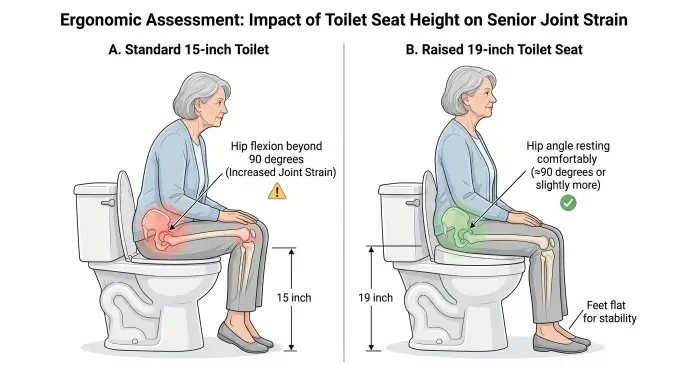
The fundamental mechanical principle behind a raised toilet seat is joint angle limitation:
The Core Rule: Higher Seat = Less Joint Bending (Safer for Hips & Knees)
Standard post-surgical precautions mandate avoiding hip flexion beyond 90 degrees to prevent hip dislocation. Adding a 4-inch riser keeps the pelvic basin level with or slightly higher than the knees, meaning the user merely hinges backward rather than squatting down into deep flexion.
A raised toilet seat doesn’t just make standing up easier—it also prevents severe hip compression, creating the necessary clearance to reach around comfortably. For individuals struggling with restricted shoulder or spinal movement, check our complete guide on safe toilet hygiene for seniors with limited mobility.
When a Raised Seat Is Non-Negotiable
- Total Hip Arthroplasty (Hip Replacement): Essential during the initial 8 to 12 weeks of recovery when posterior hip precautions apply.
- Severe Knee Osteoarthritis: Eliminates bone-on-bone patellofemoral friction caused by pushing out of a deep squat.
- Tall Seniors with Frailty: An individual over 5’10” using a standard 15-inch toilet experiences extreme knee angles without elevation.
Dangerous Pitfalls Competitors Ignore
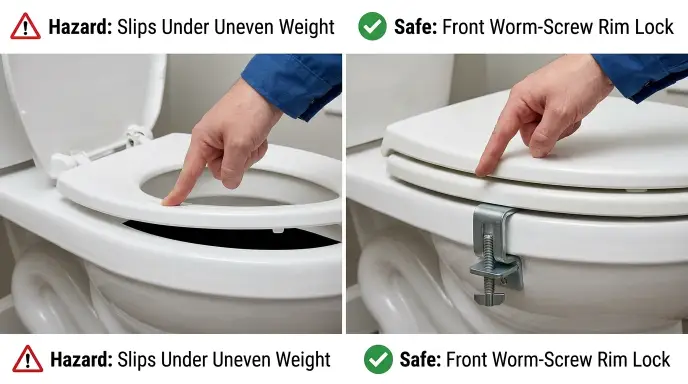
- Non-Locking “Rest-On” Designs: Inexpensive molded plastic rings that simply rest on the porcelain bowl are significant fall hazards. When an elderly user shifts their weight laterally to clean themselves, an unsecured riser can slide off the rim, causing an immediate pelvic spill.
- The Dangling Foot Trap: When feet float in the air, pelvic stability is compromised. A solid transfer requires firm traction against the base ground, which is why pairing proper seat height with the safest bathroom flooring for seniors prevents dangerous transfer slips. Installing a 5-inch riser for a petite individual (under 5’3″) lifts their feet entirely off the floor. Without flat-foot contact (plantar floor contact), the user loses lower-limb proprioception and pelvic grounding, dramatically increasing their fall risk while trying to stand up.
Toilet Safety Rails vs. Raised Toilet Seats: Feature-by-Feature Comparison
| Functional Metric | Toilet Safety Rails (Safety Frame) | Raised Toilet Seat (Seat Riser) |
| Primary Safety Mechanism | Upper-body leverage, active balance control | Eliminates deep hip/knee joint flexion |
| Best Clinical Indication | Balance deficits, Parkinson’s, orthostatic dizziness | Hip replacement, knee replacement, advanced arthritis |
| Transfer Style | Active push-off using arms and shoulders | Passive elevation; minimal bending required |
| Primary Failure Risk | Frame wobble or lateral flexing under uneven load | Shifting/tilting if using non-clamping models |
| Impact on Leg Clearance | Requires adequate clearance around toilet base | Requires matching bowl length (Round vs. Elongated) |
| User Independence Impact | Aids natural sit-to-stand rehabilitation | Simplifies sitting down without eccentric dropping |
| Installation Method | Bolted behind hinge pins or freestanding | Front-locking worm screw or bolted beneath seat |
| Hygiene Maintenance | High; easy to wipe around porcelain | Moderate; requires frequent detachment for cleaning |
While safety rails and raised seats solve the problem of sitting down and standing up, they don’t solve the difficulty of reaching behind to wipe. To eliminate awkward twisting entirely, many seniors pair their setup with an arthritis-friendly bidet attachment (just make sure to verify side clearance between the rail frame and the bidet control panel)
The OT Decision Matrix: How to Choose
Scenario A: Recent Joint Replacement or Severe Arthritis
- Primary Need: Joint sparing.
- The Choice: Locking Raised Toilet Seat.
- Why: The patient cannot safely or comfortably bend their knees/hips past 90 degrees. Upper-body strength cannot replace missing joint clearance.
Scenario B: Intact Joints, but Neurological Instability or Vertigo
- Primary Need: Dynamic physical stabilization during transfer.
- The Choice: Toilet Safety Rails.
- Why: The legs can handle the angle, but the user needs solid bilateral handholds to arrest lateral sway and counter orthostatic lightheadedness upon standing.
Scenario C: The Complex Mobility Case (The Hybrid Winner)
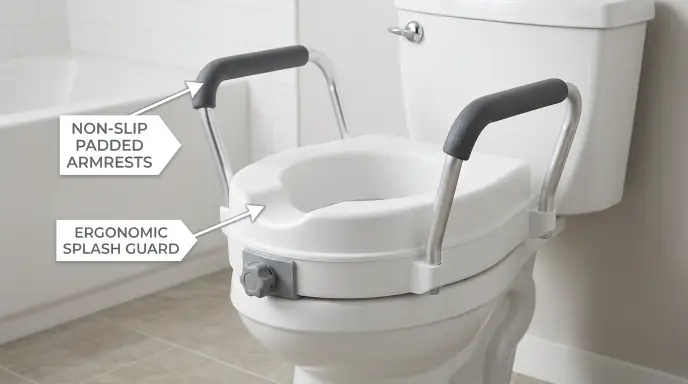
- Primary Need: Simultaneous joint relief and lateral balance support.
- The Choice: Raised Toilet Seat with Integrated Armrests.
- Why: For seniors managing both osteoarthritic knee stiffness and vestibular balance deficits, combining products (or using a single integrated unit that locks to the bowl and features padded steel arms) provides the most comprehensive fall prevention envelope.
4 Critical Safety Rules Before You Buy
- Verify Your Bowl Geometry (Round vs. Elongated): Standard American residential toilets are either Round (~16.5 inches from mounting bolts to front lip) or Elongated (~18.5 inches). Buying an elongated riser for a round bowl leaves an overhang that acts as an unstable lever when weight is placed on the front lip.
- Require Front-Clamping Locks: Never purchase a slip-on or gravity-held raised toilet seat. Insist on models featuring an adjustable heavy-duty front-locking bracket with a worm screw that clamps rigidly to the inner porcelain rim.
- The 90-Degree Flat-Foot Check: With the user seated, their thighs should be parallel to the floor or angled slightly downward, with both soles planted firmly on the bathroom floor. If their heels or toes float, reduce riser height immediately or pair it with an ADA-compliant non-skid foot platform. Ensuring flat-foot contact gives the senior leverage, but having rubber-backed footing is just as crucial; pushing off from a smooth, slippery bathroom floor can still trigger a lateral slide even with sturdy rails.
- Demand Static Weight Ratings of 300+ lbs: Even for a senior weighing 140 lbs, the dynamic downward force applied during an uncontrolled slip or one-sided grab easily exceeds double their resting body weight. Ensure the equipment carries tested heavy-gauge aluminum or steel construction ratings.
Frequently Asked Questions
Can you use safety rails and a raised toilet seat together?
Yes, provided they do not mechanically interfere with one another. If combining separate pieces, select a freestanding floor-supported safety frame that straddles the outside of the toilet, leaving the bowl entirely clear for a front-locking raised seat. Alternatively, purchase a dedicated 2-in-1 elevated seat with integrated padded handles.
Are toilet seat risers without handles safe for elderly use?
Only for individuals who possess intact upper-body coordination, good core stability, and zero vestibular balance issues. If the individual has ever experienced a near-fall or relies on furniture walking throughout the home, handle-free risers leave them without a recovery grip if they slip.
Does Original Medicare cover toilet rails or elevated seats?
Under standard Medicare Part B, convenience and personal-care bathroom items—including standard toilet safety rails and raised seats—are generally categorized as non-covered items, even if prescribed by a physician. However, many Medicare Advantage (Part C) plans offer home safety and fall-prevention benefit allowances that cover these durable medical aids.
How many inches should a raised toilet seat add?
The standard target is a finished seat height of 17 to 19 inches from floor to top of seat (matching ADA comfort guidelines). For an older adult under 5’4″, a 2- to 3-inch riser is typically optimal. Seniors 5’10” and taller frequently require a 4- to 5-inch elevation to maintain safe 90-degree pelvic alignment.
The Takeaway: Matching the Tool to the Deficit
Neither mobility aid is universally superior. Raised toilet seats solve the joint flexion problem. Toilet safety rails solve the upper-body leverage and balance problem.
Accurately matching the physical limitation to the equipment is what eliminates transfer-related falls. If uncertain, schedule a single in-home occupational therapy assessment to have the bathroom space, toilet height, and user transfer biomechanics professionally evaluated.
Next Step: Falls don’t only happen during the daytime. If nighttime bathroom trips are also a concern, our upcoming guide on bathroom night lighting for fall prevention covers how proper lighting design can reduce disorientation-related falls — a commonly overlooked companion safety measure to the equipment discussed here. Once your toilet area is stabilized, address the wet zone where 80% of falls occur. Check our walkthrough on walk-in shower grab bar placement and bench heights to secure your daily bathing routine.





7 Comments