
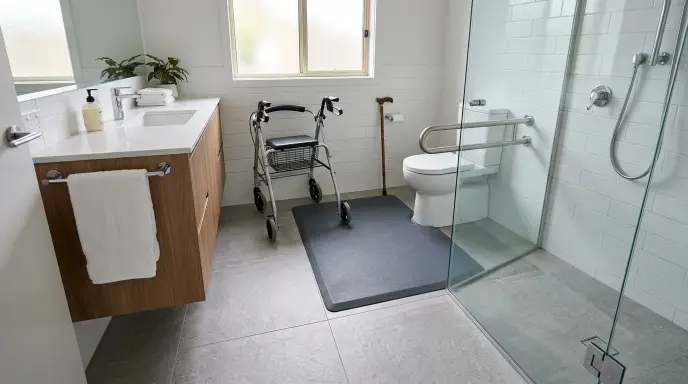
Why Standard Bathroom Rugs Are a Major Trip Hazard for Seniors (And Safe Alternatives)
Quick Answer: When evaluating whether standard bathroom rugs for seniors are safe, data shows they are actually one of the top in-home fall hazards for older adults. According to the CDC, more than 1 in 4 Americans aged 65+ fall each year, and bathroom floors—especially rugs with curling edges, no grip, or that catch mobility devices—are a leading contributor. The fix isn’t complicated: remove high-pile, unanchored rugs and replace them with low-profile, beveled-edge, slip-resistant alternatives designed for aging bodies and walking aids.
Key Takeaways:
- Why it matters: A rug that “looks fine” can still create a 1/4″–1/2″ edge lip that’s enough to trip a shuffling foot or catch a walker wheel.
- What’s dangerous: Fluffy chenille rugs, small pedestal mats, unanchored memory foam, and any rug without a beveled edge.
- The fast fix: Swap to a low-profile rubber-backed mat (under 1/4″ thick) or skip rugs entirely and use direct-to-floor adhesive treads.
Editorial & Safety Note: This guide is for informational, home-safety, and environmental modification purposes only. It does not constitute medical advice or an occupational therapy assessment. If your loved one experiences severe balance loss, frequent falls, or foot drop, please consult a licensed physical therapist or healthcare professional for a personalized evaluation.
Table of Contents
The Hidden Physics: Why Standard Bathroom Rugs Fail Seniors
Most articles tell you rugs “can be slippery.” That’s true, but it’s not the whole story. The real danger is mechanical—it’s about how an aging body physically interacts with fabric and floor. Understanding the mechanics helps you make smarter choices, not just fearful ones.
The “Shuffling Gait” Factor
As we age, gait patterns naturally change. Many older adults develop a shuffling gait—reduced foot lift, shorter strides, and less ground clearance. This can be related to general muscle weakness, balance changes, or fear of falling itself.
Clinical Note: Significant gait changes, including symptoms related to foot drop or neuropathy, should always be evaluated by a healthcare provider. This guide addresses environmental fall prevention only.
Here’s the problem: a rug doesn’t need to be thick to cause a fall. Even a 1/4-inch pile height is enough to catch a toe that isn’t lifting properly. ADA guidelines (Section 302) specify a maximum carpet pile height of 1/2 inch, with firm backing, requiring any vertical edge over 1/4 inch to be beveled—a safety standard almost all decorative bath rugs completely ignore.
The Mobility Device Catch (Walkers & Canes)
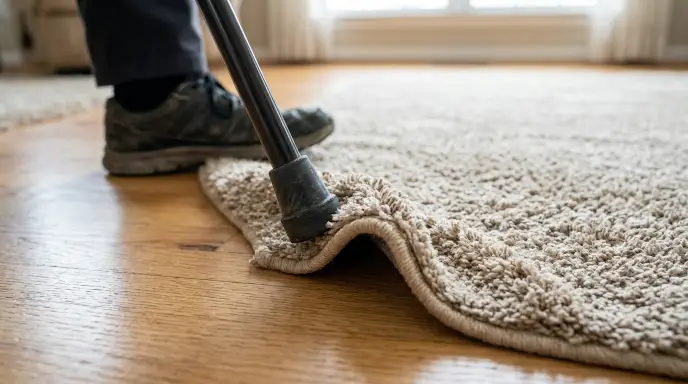
If your loved one uses a walker, cane, or rollator, rugs create a second layer of risk. Small walker wheels and rubber cane tips aren’t designed to roll smoothly over fabric borders. Instead, they:
- Catch on the rug’s raised edge, causing a sudden stop-and-lurch motion.
- Push the rug forward, bunching the fabric into a ridge.
- Create an unstable pivot point exactly where the person is putting their weight.
This “bunching” effect is especially dangerous because it happens gradually—the rug looks fine in the morning, but after a few walker passes, it’s rippled into a hazard by afternoon.
The Degrading Latex/Rubber Backing Myth
Many families believe a rug is “safe” simply because it has a rubber or latex backing. But repeated laundering breaks down that backing over time. The rubber cracks, flakes, and eventually turns to fine powder that sits between the rug and the tile—acting like invisible ball bearings. The rug looks secure, but it’s actually gliding on a microscopic layer of degraded rubber dust. This is one of the most overlooked causes of “unexplained” bathroom slips.
4 Dangerous Rug Types to Remove from a Senior Bathroom Immediately
Walk into the bathroom right now and check for these four categories. If you find any, it’s time for a swap:
- Fluffy/High-Pile Chenille Rugs: They feel soft and cozy, but that softness works against balance. Older adults rely on firm sensory feedback from their feet to stay upright; a plush rug absorbs that feedback and creates a sinking, unstable surface.
- Small Accent/Pedestal Rugs (Around Toilets): These small mats seem harmless, but they take the most concentrated body weight shifts—sitting down and standing up—right on an unanchored surface. This is one of the most common fall points in senior bathrooms.
- Rugs Without Beveled Edges: A straight-cut, thick edge is essentially a curb. Bare or socked feet catch on it easily, especially in low-light early morning or nighttime bathroom trips.
- Unanchored Memory Foam Mats: These look modern and safe, but on wet tile they can create a hydroplaning effect (aquaplaning)—a thin layer of water gets trapped underneath, and the whole mat slides as one unit. Controlling standing water before stepping out minimizes floor slickness entirely; see our guide on How to Keep a Bathroom Floor Dry After a Shower.
Safe, Fall-Proof Alternatives to Traditional Bathroom Rugs
Going rug-free (or rug-smart) doesn’t mean a cold, clinical bathroom. Here are the safest, most practical bath mat alternatives for seniors:
Ultra-Low-Profile Rubber-Backed Commercial Mats
Look for mats designed with beveled ramp edges—the same design principle used in ADA-compliant commercial flooring. These allow walker wheels and cane tips to roll over smoothly instead of catching. Combined with a firm, non-compressing rubber base, they provide stability without sacrificing slip resistance.
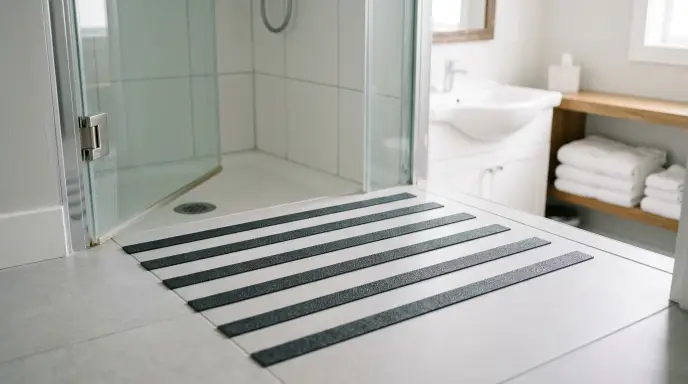
Textured Slip-Resistant Treads (Direct-to-Floor)
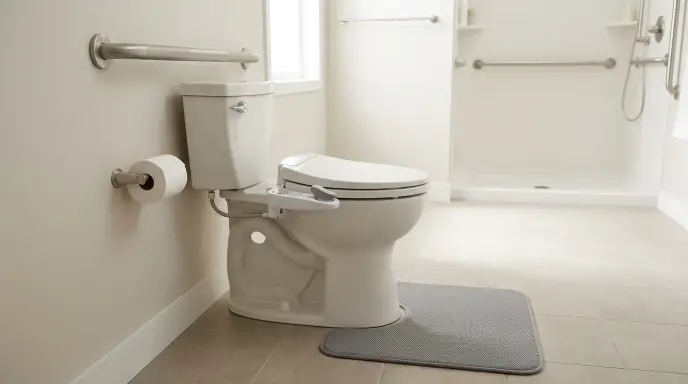
For a true zero-trip-hazard solution, adhesive slip-resistant treads applied directly to the tile eliminate the “rug” altogether. There’s no edge, no height, and no bunching risk—just added traction exactly where it’s needed, like in front of the shower or sink. Keep an absorbent, non-skid mat placed firmly under your dressing stool to maintain traction while stepping into clothes. See how this fits into the full routine for safe post-bath dressing for seniors.
Fast-Drying Rigid Stone/Diatomaceous Earth Mats
Unlike fabric, these rigid mats don’t fold, curl, or bunch. They absorb water almost instantly, keeping the surface dry underfoot within seconds of stepping out of the shower—dramatically reducing the window of slip risk.
Safety Note: Always place rigid stone mats over a dedicated non-skid mesh pad. A bare stone slab on wet, smooth tile can slide under shifting weight.
The “Towel-Assisted Dry Zone” Strategy
For a completely rug-free approach: designate a “drainage zone” directly in the shower or tub area where the person towels off before stepping onto the main bathroom floor. This keeps the rest of the floor dry and rug-free entirely, removing the hazard at its source rather than managing it after the fact. Never throw a bath towel on the floor to step on—it creates a loose sliding hazard. Instead, use a non-skid rug paired with a proper seated post-shower drying routine.
Comparison: Safe Bathroom Rugs for Seniors: Low-Profile Alternatives
| Feature / Metric | Traditional Plush Bath Rug | Low-Profile Rubber Grip Mat | Direct Adhesive Non-Slip Treads |
| Trip Risk (Edge Catch) | Extremely High | Very Low (Beveled Edge) | Zero (Flush with tile) |
| Walker/Cane Safe | No (Bunches & catches) | Yes (Smooth roll-over) | Yes (No obstruction) |
| Slip Resistance (Wet) | Low to Moderate | High | Maximum |
| Cleaning & Hygiene | Traps mildew and dust | Quick wipe-down / Air dry | Cleans directly with floor |
| Sensory/Balance Feedback | Poor (Soft, sinking base) | Firm & Stable | Maximum solid contact |
Why Traditional Bathroom Rugs Aren’t Safe for Seniors (And How to Talk to Them)
This is one of the most common—and most emotionally loaded—challenges caregivers face. Here’s how to handle it without conflict:
- Understand the “why” first: Often, it’s not about the rug itself—it’s about cold feet. Tile floors can feel uncomfortably cold, especially for those with poor circulation. Removing the rug without addressing that root need often leads to it quietly reappearing days later.
- If removal isn’t possible yet, secure it properly: Use double-sided heavy-duty carpet tape around the entire perimeter—not just the corners. This is a non-damaging option that works well for renters and won’t harm tile or grout. Re-check the tape every 2–3 weeks, as adhesive weakens with moisture exposure.
- Offer a transition alternative: Non-skid grip socks or indoor grip sandals can solve the “cold floor” problem directly, making the rug unnecessary without a confrontation. This is often the fastest way to get buy-in from a resistant loved one—address the comfort issue, and the safety issue often resolves itself.
How to Ensure the Exposed Tile Below Remains Non-Slip
Removing a hazardous rug is only half the job. If the tile underneath doesn’t have adequate wet traction, you’ve simply traded one hazard for another.
Before finalizing your rug-free bathroom, check:
- The floor’s slip rating: Bathroom tile should meet or exceed a DCOF (Dynamic Coefficient of Friction) rating of 0.42 or higher for wet-area safety—this is the industry benchmark for adequate wet traction.
- Worn or polished spots: Note where years of foot traffic may have smoothed out the tile’s natural surface micro-texture.
- Grout line condition: Degraded or missing grout can create uneven, trip-prone seams.
Once you remove high-risk rugs, evaluating your underlying surface is critical. Review our guide, Safest Bathroom Flooring Materials for Seniors: DCOF Ratings and Fall Cushioning, to ensure your bare floors maintain proper wet traction. Removing dangerous rugs is a crucial first step, but it leaves your bare tile exposed to water drops and moisture. If your underlying tiles lack natural grip, learn actionable strategies on how to make a slippery bathroom floor safer for the elderly to prevent falls without a full remodel. Non-slip rugs are critical underfoot, but pairing them with proper grab bar placement next to the shower ensures seniors have two points of balance.
For complete room modifications beyond textiles, check out our Senior Bathroom Safety Checklist.
Frequently Asked Questions
Q1: Can rug tape make standard bathroom rugs safe for seniors?
Rug tape helps temporarily prevent edges from curling, but it doesn’t eliminate the underlying risk. The rug’s fabric texture, thickness, and compressibility still interfere with balance and gait—tape is a short-term fix, not a full solution.
Q2: Why are suction-cup mats not always reliable on tile floors?
Suction-cup backing depends on a smooth, non-porous surface to create a vacuum seal. Textured tile or wide grout lines let air seep in, weakening the seal over time. This can cause the mat to shift suddenly and unexpectedly—often without any visible warning sign.
Q3: What is the safest mat thickness for an aging-in-place bathroom?
Generally, look for mats under 1/4 inch (6mm) thick with a flat, beveled edge. This height range is low enough to avoid catching feet, canes, or walker wheels, while still providing enough texture for slip resistance.
Swapping out hazardous throw rugs is only one piece of home modification. For a complete room-by-room safety overhaul including doorway clearances, zero-threshold entries, and lighting, check out our comprehensive aging-in-place bathroom remodeling guide.
Bathroom falls are preventable with the right knowledge and practical swaps. If you found this guide helpful, consider sharing it with another caregiver—small adjustments can make a measurable difference in protecting independence at home. Ensuring bathroom rugs are safe for seniors starts with eliminating high-pile mats. Eliminating loose throw rugs solves the floor-level trip hazard, but transitioning from the floor into a deep tub introduces a vertical barrier. Pair your non-slip floor setup with our guide to making a high-step bathtub safe without construction.
Medical & Safety Disclaimer: This guide is intended solely for home-safety education and environmental risk reduction. It does not replace clinical evaluations from a physician, physical therapist, or certified occupational therapist.

11 Comments