
Shower Chair vs. Transfer Bench: Which Is Safer for Your Bathtub Setup?
Editorial Note: This guide follows geriatric care safety standards and occupational therapist fall-prevention protocols for bathtub mobility equipment.
For a standard bathtub, a transfer bench is significantly safer than a shower chair because it eliminates the need to step over the tub’s 14–18 inch wall while balancing on one foot — the single leading cause of bathroom falls among seniors and post-surgery patients. A shower chair works fine only if the user can already step in and out completely unassisted. Choosing the right tub seating is an essential part of broader aging-in-place bathroom modifications designed to prevent accidental injuries.
Table of Contents
The Quick Verdict: Safety at a Glance
| Feature | Shower Chair | Transfer Bench | Best Fit For |
| Entering/Exiting Method | Step-over (one foot in, one foot out) | Slide-in while seated | Transfer bench = safer for most |
| Fall Risk at Tub Edge | Moderate to High | Lowest | Transfer bench |
| Space Requirement | Compact (fits fully inside tub) | Needs 12–18″ clearance outside tub | Shower chair = small bathrooms |
| Bathtub Compatibility | Best with wide, flat-bottom tubs | Fits almost all standard tubs | Transfer bench |
| Weight Capacity (Standard) | ~300 lbs | ~300–500 lbs (bariatric options) | Depends on user weight |
| Best For | Independent balance, resting during bath | Limited mobility, stroke, wheelchair | See Decision Checklist below |
Understanding the Bathtub Threshold Hazard
The “One-Foot Balance” Danger
Most standard bathtubs have a rim or wall measuring 14 to 18 inches high. If you are looking for additional methods for navigating a high-step bathtub safely without remodeling, seating devices serve as the first line of defense. To get in or out, a user must briefly balance on one leg while lifting the other over this barrier — a motion responsible for an estimated 85%+ of bathroom slip-and-fall injuries in older adults. This single moment of instability is the core safety issue that separates these two products. Stepping over high barriers accounts for a large portion of tub incidents, making targeted senior bathroom safety strategies crucial for daily bathing.
How Each Device Handles the Ledge
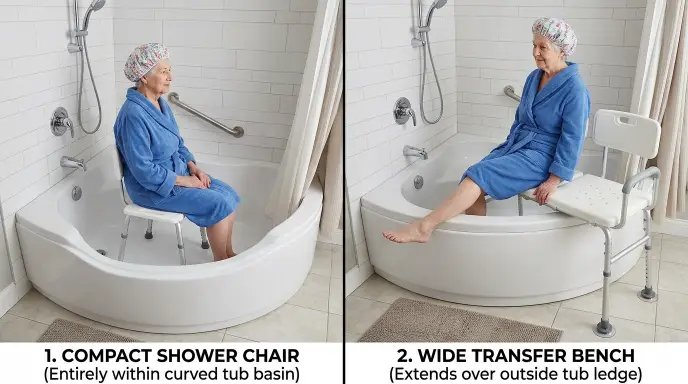
- Shower Chair: The user must step over the tub wall before sitting down. The chair itself offers zero physical support during this critical transition.
- Transfer Bench: The user sits down outside the tub first, then safely swings and slides their legs in one at a time—never needing to balance on one foot over the ledge.
Deep Dive: Bathtub Transfer Bench (The Gold Standard for Tubs)
How It Actually Works
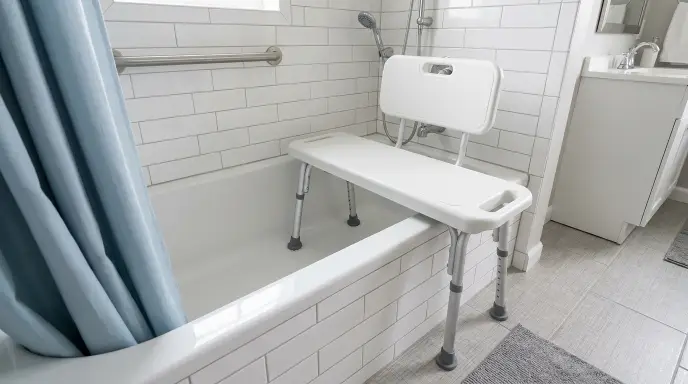
A transfer bench straddles the tub wall: two legs sit inside the tub floor, while two legs sit outside on the bathroom floor. The user sits on the outer portion, slides across the bench surface, and lowers into the bathing area. Chairs and transfer benches work well as low-cost aids, but they take up floor space and can complicate entry. For a seamless setup, many families weigh upgrading to a walk-in tub or barrier-free shower instead of relying on portable seating. Your choice of bathing seat largely depends on threshold height; see how seating needs differ between low-curb vs curbless shower setups.
Key Safety Advantages
- No-step transfer: The entire entry and exit happens while seated, eliminating the risk of single-leg balance.
- Reduces caregiver strain: Caregivers guide a seated slide instead of lifting or spotting a standing transfer, lowering lower-back injury risks.
- Medical utility: Highly recommended for stroke recovery, hip replacement rehabilitation, and wheelchair-to-tub transfers.
When seated on a chair, standard hoses pull taut. Upgrade to a dedicated handheld shower head setup for seniors with an 84-inch hose. A sturdy shower bench provides a stable base not just for bathing, but also for drying off and putting on lower garments. Learn how to utilize your seat when dressing after bathing for seniors to prevent one-legged balancing.
Drawbacks to Consider
- Floor space footprint: Requires 12–18 inches of clear floor space outside the tub.
- Water containment: Shower curtains do not close naturally over the bench frame.
- The Fix: Either cut a short vertical slit in the curtain liner at bench height, or tuck the liner tightly around the inner seat frame to keep water contained inside the tub.
Draping the liner properly helps prevent puddle formation, which is vital for keeping your bathroom floor dry after a shower and avoiding secondary slip hazards outside the tub.
Deep Dive: Shower Chair in a Bathtub (When Is It Safe?)
How It Actually Works
All four legs sit directly inside the tub basin. There is no exterior straddling — the entire frame lives strictly inside the tub. Before buying a wide transfer bench, be aware of sliding shower door hazards for seniors that can restrict entryway width down to under 28 inches.
Safety Advantages
- Compact profile: Ideal for small or narrow bathrooms where exterior floor space is obstructed by a vanity or toilet.
- Seated rest: Provides solid, seated posture for individuals who experience fatigue or dizziness but can still clear a ledge safely on two feet. Because a shower chair offers no stability during the step-in phase, pairing it with proper grab bar placement is critical for maintaining balance.
Risk Factors in a Standard Tub
- Curved or sloped tub floors: Many bathtubs slope inward for drainage. A 4-legged chair can easily wobble or fail to suction on non-flat surfaces.
- Zero entry support: The user still faces the full step-over fall risk before they ever touch the seat.
Standard shower chairs take up less space than benches, but their smaller footprint makes them more prone to shifting on wet acrylic; make sure you know how to keep your shower chair stable before using one in a narrow basin. Whether using a freestanding chair or a tub bench, combine your seating with long-handled sponges and foot scrubbers for seniors to eliminate the need for dangerous bending.
User Independence vs. Caregiver Assistance (Who’s Helping?)
This factor gets overlooked constantly, but it often decides the right product faster than bathroom measurements.
- With a Shower Chair: The user must step in unassisted, or a caregiver must physically hold and steady their full body weight over the tub ledge — a motion that places heavy strain on a caregiver’s spine.
- With a Transfer Bench: A caregiver simply helps the user sit on the exterior seat, then gently guides their legs over the threshold as they slide across.
Quick self-check: Will this person bathe independently, or will a caregiver assist each time? If a caregiver is involved, the transfer bench almost always wins on physical safety and ergonomics.
Decision Checklist: Which One Fits Your Specific Bathroom?
Choose a Transfer Bench if:
- The user cannot balance steadily on one leg (e.g., following a stroke, hip replacement, or knee surgery).
- The bathtub wall is taller than 15 inches.
- There is at least 12–18 inches of unobstructed floor space beside the tub.
- A caregiver assists with bathing transfers.
Choose a Shower Chair if:
- The user can step into the tub independently and only needs seated resting support.
- Bathroom floor space is severely limited (tight door clearances or adjacent fixtures).
- The tub basin floor is completely flat with no rounded contours.
Essential Measurements to Take Before Buying
- Tub Wall Height & Interior Width: Measure the outside wall height (typically 14–18 inches) and interior floor width to ensure legs sit completely flat.
- Outside Floor Clearance: Ensure at least 12–18 inches of open floor space outside the tub wall, free from toilets or vanity cabinets. Ensure the surface where the bench legs rest is stable and dry, keeping in mind best practices for preventing slippery bathroom floor accidents.
- Weight Capacity: Standard models support up to 300 lbs, while bariatric or heavy-duty versions handle 400–500 lbs. Always match the rating to the user’s weight, especially for transfer benches that bear full dynamic weight during entry slides.
Portable transfer equipment is often covered under Part B as Durable Medical Equipment (DME). Learn more about how the claims process works in our complete senior bathroom Medicare coverage breakdown.
Frequently Asked Questions

Can a shower curtain close with a transfer bench?
Yes. You can cut a small vertical slit in a plastic shower liner so it fits neatly around the bench frame, or drape the inner liner between the seat sections to channel water directly down into the drain.
Does Medicare cover shower chairs or transfer benches?
Generally, no. Original Medicare classifies shower chairs and transfer benches as “Personal Convenience Items” rather than strictly covered Durable Medical Equipment (DME). However, certain Medicaid programs or Medicare Advantage (Part C) plans may provide partial allowances.
What if my bathtub has sliding glass door tracks?
Sliding glass door tracks can obstruct transfer bench legs or crack under weight. The safest solution is to remove the sliding glass doors entirely and replace them with a shower rod and curtain, or verify whether the bench legs clear the track height.
Practical Recommendation
If balance, mobility, or post-surgical recovery is an active concern, a bathtub transfer bench is the safer choice. It completely removes the single most dangerous moment in home bathing: balancing on one leg over a 14–18 inch ledge. If you decide a bench is the right fit for your setup, read our complete tutorial on how to use a tub transfer bench safely to master the scoot-and-pivot technique and avoid water leaks.
If the bather steps over the tub rim with complete stability and merely needs a place to sit during the shower, a compact shower chair is a reliable, space-saving alternative — provided the tub floor is level and non-slip. Always measure exterior clearance, tub height, and weight needs before ordering.





12 Comments